
There Is Friendship at Work. It Just Doesn’t Look Like the Version You Were Promised.
A hot pot dinner, three old stories, and four tests I use before I call a colleague a friend.
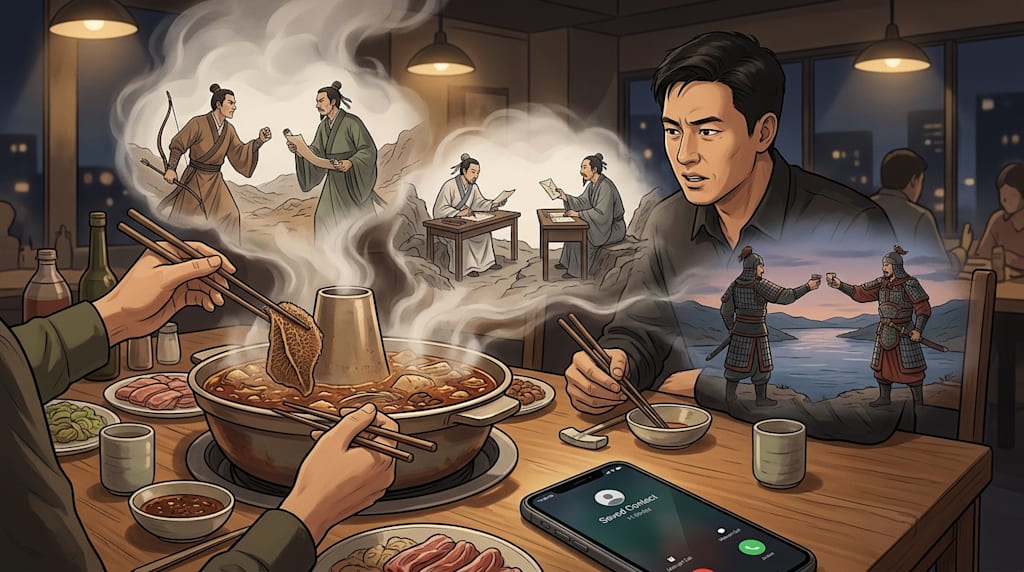
At last night’s college reunion, by the second half of the hot pot, the conversation turned to work.
Lao Zhou, who works in the public sector, put down his chopsticks. “There is no friendship at work,” he said. Li Bin, a middle manager, picked it up. “Work is interest math.” My chopsticks stopped halfway to my mouth. I did not have a reply.
On the way home, I kept turning it over.
Ask “Is there friendship at work?” and you get the same answers. “No, only interests.” “Do not treat colleagues as friends.” “Work is not a place to make friends.” Those answers come from people who have hit walls. I understand them. I still do not buy the flat version.
Some relationships grow into friendship in the places where interests are most tangled and positions are most opposed.
Guan Zhong and Bao Shuya ran a business together and served in the army together. Later they served different princes, Prince Jiu and Prince Xiaobai, and became rivals for the same job. Guan Zhong shot an arrow at Xiaobai to help his own prince. Xiaobai won and became Duke Huan of Qi. Bao Shuya was given a high post.
The expected move was payback. Bao Shuya did not make it. He knew what Guan Zhong could do for a state. He recommended the man who had almost killed the duke. People warned him. Guan Zhong is your rival. He almost killed the ruler. Keeping him is dangerous. Bao Shuya stepped aside from the chancellor’s seat. Guan Zhong ran Qi, pushed reforms, and helped Qi become a hegemon. Years later Guan Zhong said, “My parents gave me life. Bao Shuya knows me.”
In an office, this looks like two colleagues competing for a supervisor job. The winner does not kneecap the loser. He sees what the other does well and says so to the boss. Most people fear being outshone. Bao Shuya was willing to help someone else rise. That kind of move is rare. It is also a form of workplace friendship.
After the Yongzhen Reform failed in the Tang dynasty, Liu Yuxi and Liu Zongyuan were demoted and sent away. Liu Zongyuan went to Yongzhou. Liu Yuxi was sent to Bozhou, which was farther and harsher. Liu Yuxi had an elderly mother at home. The trip made it hard for him to care for her. Liu Zongyuan sent a memorial to the court. He offered to swap his post for Bozhou and go to the worse place himself. The court changed the order. Liu Yuxi went to Lianzhou.
They wrote letters for decades. They comforted each other. When Liu Zongyuan died, his last letter asked Liu Yuxi to care for his children and organize his manuscripts. Liu Yuxi spent years compiling Liu Zongyuan’s collected works.
In an office, this looks like a failed project and a round of demotions. Some people hunt for a scapegoat. Some protect themselves. Some colleagues share the pressure and do not step on the person who is already down. Friendship in good times is cheap. People scatter when trouble arrives. Someone who carries a little of the weight with you is different.
After the Three Kingdoms period ended and Jin unified China, Yang Hu of Jin held Jingzhou. Lu Kang of Wu held the border. They were rivals in opposing camps. Common sense said they should watch each other for tricks. They admired each other’s conduct and ability instead. When border farmers harvested grain, Yang Hu banned looting. His side paid for the grain they took. When Wu soldiers got sick, Yang Hu sent medicine. Lu Kang received wine from Yang Hu. His men feared poison. Lu Kang drank it. He trusted Yang Hu not to use a low trick. Lu Kang also told his men not to provoke the other side. Hold the line. That was enough.
Each man served his own ruler. Their positions were opposed. They did not frame each other. They did not play dirty. In business today, this looks like two rival company heads fighting for market share and still refusing to spread rumors. They do not kick each other when one is down. Workplace friendship does not require daily contact. Respect across a line, with no dirty tricks, is already rare.
Then there is the ordinary case.
Most relationships at work are cooperative arrangements. When interests line up, people get along. When interests collide, cracks show. That is normal. Not every colleague is friend material. Treating workplace socializing as friendship confuses a partner with a friend. Treating work as a battlefield makes the day heavier than it needs to be.
The useful question is what to expect from workplace relationships. With most colleagues, decent cooperation is enough. Do not stab people in the back. Do not kick people when they are down. Keep the line when interests are at stake. Reach out when someone is in trouble. Anyone who can hold those lines is worth keeping.
I use four tests before I call a colleague a friend. When you are in trouble, does he reach out? When you are not in the room, does he protect you? When interests conflict, does he follow the rules? After you leave the job, does he still answer? Two out of four is rare.
Keep boundaries too. Cooperate first. Become friends later. Do not lend money. Do not pass messages. Do not force people to pick sides. When a serious conflict of interest is coming, name the rules early. Do not hand every secret to a colleague. Friendship is not proved by telling each other everything. It is proved by not harming you even with boundaries in place.
So is there friendship at work?
Yes. It is scarce. It is not the default. It is not lunch every day or drinks after work. It is not treating every colleague as a friend. It looks like a person who does not harm you when interests are on the table, who still names your strengths after competing with you, who carries a little of the weight when you are down, and who keeps the line clean even when you are on the other side.
Lao Zhou and Li Bin were not wrong. They were lowering expectations after seeing people turn on each other. Low expectations are not the same as zero.
I have a former colleague’s number in my phone. We have not worked together for three years. We do not chat. We rarely like each other’s posts. Last year something happened at home. I called him at midnight. He picked up. He did not ask what was wrong. He said, “Tell me.”
Work is tangled. People are hard to read. That is exactly why a relationship that survives a test of interest is worth keeping. Do not expect every colleague to become a close friend. Decent cooperation with most people is enough. If you find someone who understands you and does not calculate against you when things go wrong, save the number.
About the Creator
Jin
Writer of reamstories
https://reamstories.com/jin
Enjoyed the story? Support the Creator.
Subscribe for free to receive all their stories in your feed. You could also become a paid subscriber, letting them know you appreciate their work.
Comments
There are no comments for this story
Be the first to respond and start the conversation.