
The Whiteboard Said 1,240. Then Someone Wrote 8,600.
Companies used to count people. The ones moving faster now count how much work closes without a human touching it.
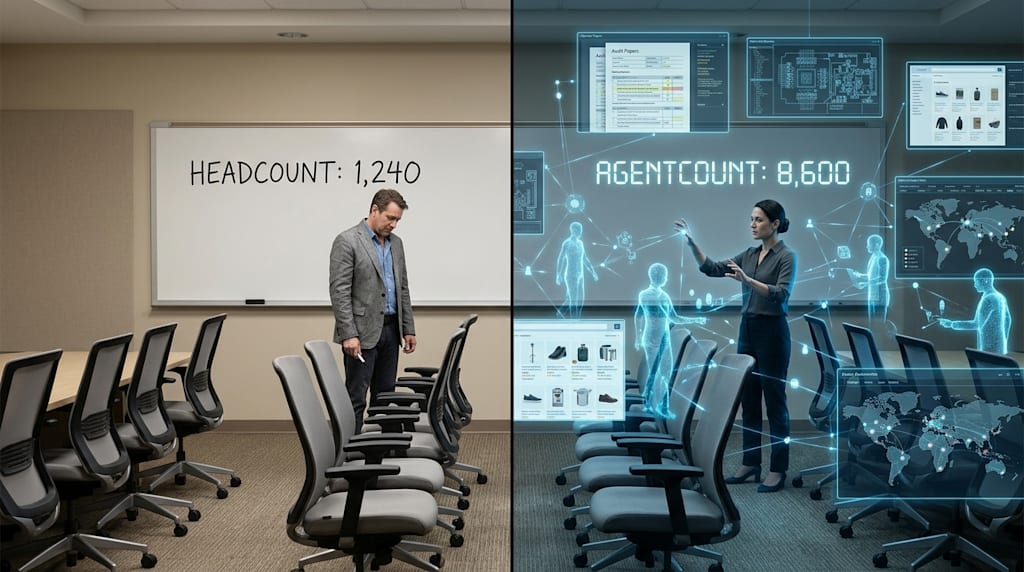
The whiteboard in the conference room still said Headcount: 1,240.
Someone had drawn a line through it and written another number underneath: AgentCount: 8,600.
The operations director capped the marker and asked the room a question no one had prepared for.
“How much of this month’s work closed without a human touching it?”
No one answered. Someone flipped open a notebook. Someone else looked at the CFO. The question stayed on the board, next to the number.
That question has started following managers out of meetings. For years, the first question one company asked another was simple: how many people do you have? Headcount meant scale. Headcount meant capacity. Headcount meant you were a serious operation.
Now the question is changing. People still matter. The unit of production changed.
At the Apsara Conference, in a forum titled “AI Native Reshapes Enterprise Productivity,” this shift was put on the table without decoration.
Chen Yusen runs the Qwen Office business unit, formerly DingTalk, and oversees a user base in the hundreds of millions. He said the label “AI Native” is useless. The only measure that matters is practical: count how much work inside a company is actually closed by AI.
The work has to close. Assistance and suggestions do not count.
Whoever gets agents deep enough into the production pipeline gets the ticket into the next cycle.
The numbers are already moving. Alibaba disclosed that its token-related MaaS business reached RMB 16 billion in ARR. With AI cloud included, the figure exceeded RMB 40 billion. Behind each call sits a digital worker writing a quote, checking an audit paper, drawing a blueprint.
The yardstick is sliding from Headcount to AgentCount.
AI-native is a closure rate
For a long time, most people understood AI in a narrow way. First it was a model with surprising compute in a lab. Then it was a chat box on a phone, polishing an email, collecting a few links, generating an image. In that stage, it was a small tool. No one handed it the keys.
This year, that shell is breaking.
Zhang Liang laid out a three-stage path that is easy to recognize inside almost any company.
Stage one: employees each find an AI tool and use it on their own. Stage two: agents are embedded into private data and workflows, and humans and machines work together. Stage three: professional experience is distilled into a cloud brain, becoming reusable digital assets.
The most visible change, Zhang Liang said, is that boundaries are dissolving. An individual developer turns into a company. A small company grows into a large one. The line is no longer clear. A few people can do very large things. One person can run what used to take a company. It is getting harder to classify companies by headcount.
That dissolution hits companies of different ages in different ways, but with the same force.
For teams with no historical baggage, it means being small and hitting above their weight from day one.
Chengdu Paizi Interconnect is a useful sample. EDA software has long been a walled compound built by international giants: thousands of engineers, decades of design rules, seat-based software selling for millions. A lightweight R&D team of a few dozen people moved the design engine, rule library, and experience onto the cloud. Multi-agent collaboration kept industrial fault tolerance pinned to a 100% DRC compliance line. The full PCB design flow ran through.
The results were not subtle. Compared with manual work, device library creation and document recognition accuracy held above 95%. Group processing speed rose more than 100 times. Rule-layer merge resolution reached 90%. Data upload speed increased fivefold.
A team that, by industry convention, would have needed a thousand people to sustain, used cloud asset compounding to break through a technical barrier held by overseas giants, at a fraction of the labor cost.
For large, process-heavy mature companies, the key is removing the heaviest mechanical burden without endangering business continuity.
ShineWing CPA has more than ten thousand professionals. It faces strict data privacy rules, compliance red lines, and walls between databases. In the past, a senior cost engineer or auditor preparing a professional report had to switch among Tianyancha, Tonghuashun, Yidong, Glodon, and other systems, manually stitching data together. Most of the energy went into “people finding data.”
ShineWing did not throw out a business system it had used for seven or eight years. It added a unified AI work platform on top. High-frequency data was called through MCP. Analysis data was imported through APIs. Frontline staff entered a goal at a single entry point. Backend agents penetrated the professional databases, cross-checked, and produced a draft working paper.
No layoffs. No smashing of the old system. But the most time-consuming mechanical hauling was handed to agents.
Two cases. Two cross-sections of transformation.
Zhang Liang gave a cold reminder: using AI and burning tokens does not make an organization AI-native. But not using it means there is no chance. Whether a small team wires AI into its workflow on day one, or a large organization dismantles its information islands, the question is the same: can you hand actual business to agents, and turn every token into production?
Why this year? The model crossed the usability line. Cost fell below the kill line.
The obvious question is why the acceleration is happening now.
Chen Yusen has a clear view. Unlike Silicon Valley, where labor costs are high, many basic businesses in China are stacked with people. Efficiency is mediocre, but the cost does not hurt enough. He gave a business formula:
New experience minus old experience minus replacement cost must be greater than zero.
If AI takes over a task and improves efficiency by only 20% or 30%, that small gain cannot cover the replacement cost. Companies have no reason to operate. His experience is that only when AI pushes efficiency to three to five times the human equivalent do companies cross the observation threshold and decide to rebuild the process.
What broke the deadlock was the base model quietly crossing the economics line.
Xu Dong, vice president of Alibaba’s Qwen large model business, gave two coordinates: the usability line and the cost kill line.
The usability line refers to a new generation of models, represented by Qwen 3.8 Max, finally crossing the production threshold in long-horizon planning, function calling, and complex programming. It no longer needs a human feeding instructions step by step. It can hold a goal for days, break down a long-chain task, and schedule stably across multiple software systems and databases.
The cost kill line came harder. When Qwen 3.8 Flash pushed input cost to RMB 0.8 per million tokens, the combined cost of one enterprise-grade intelligent call fell below RMB 0.2. The wall created by overseas models, often tens of RMB per million tokens, was pushed down. Edge work that companies once thought “not worth automating” suddenly had a near-extreme return on investment.
Many companies do not yet realize how much complex work AI can already take over.
In cross-border e-commerce, time is the most brutal lifeline. Overseas consumer trends, platform algorithms, and hit-product cycles change by the day, sometimes by the hour. For sellers going abroad, if a product listing is half a step slow, prepared inventory can become dead stock. Listing a product usually requires multiple rounds of communication across roles and cross-language tuning. Fast: two or three days. Slow: more than a week. The natural traffic window is easily missed.
After connecting Qwen and Wanxiang multimodal models, Yixiang Technology, also known as Feixiang Agent, rebuilt that cross-border content chain into an automated pipeline. A full set of image, text, and video materials that used to take days can now be produced in batches in one minute. Production cost per set dropped from hundreds or thousands of RMB to RMB 5.
That kind of business-level break reshapes how companies choose a cloud provider and model base.
When AI was a toy, selection looked at benchmark scores and API prices. Some companies ran an open-source model locally for a demo and called it enough. When companies start handing core business and delivery orders to agents, that single-point logic fails.
Companies begin to understand: in a production environment, one smart model cannot hold up a commercial loop.
Zhang Liang pointed to the trend. Enterprise customers are not individual developers. They choose technology partners carefully. They need a long-term, full-stack base. Model intelligence sets the ceiling of an agent. But what decides whether a business survives is whether compute can be supplied continuously, whether the system crashes under massive requests, whether it holds under peak concurrency, and whether the underlying toolchain absorbs engineering complexity.
That is the core code behind Alibaba Cloud’s AI business growth and its tens of billions in ARR.
The demands changed. Alibaba Cloud’s answer is full-stack capacity. When Feixiang faced hundreds of thousands of merchants calling at once, Alibaba Cloud provided not only Qwen and Wanxiang models, but a global compute acceleration network and a minimal console deployment. A lightweight team with no professional operations knowledge could launch a high-concurrency architecture with a few commands, avoiding the huge cost of building infrastructure.
The collaboration target moves from people to intelligent copies.
For decades, companies maintained large pyramids because human communication bandwidth and information processing capacity were limited.
That multi-layer management is being pierced by agent collaboration networks.
Li Bin, CTO of Gaofan Polang, said in a roundtable that companies grew into pyramids because people were the smallest execution units.
In an AI-native organization, people are compressed into “responsibility nodes.” If this business or this SKU is mine, the execution nodes underneath are agents. A product owner can go from writing a PRD, scheduling, progress tracking, all the way to supply chain coordination and promotion. The long friction between traditional roles is flattened.
Zhang Liang’s own practice confirms it. Tracking 30 key accounts used to take hours of meetings, reports, and alignment. Items agreed on in a meeting could go unclaimed days later. Now agents can summarize millions of customers daily, penetrate to atomic-level customer pain points, and automatically ask the responsible person whether the commitment was carried out. The team even fed the manager’s talking points, meeting records, and review logic into the system, running an internal “boss digital twin” that frontline employees can call at any time.
The nature of management reverses. AI cuts the middle loss that grew between layers to move and process information. It leaves management itself alone.
The deeper shift is in how the company’s core knowledge and experience assets exist.
In the old model, experience sticks to the employee’s body. A senior salesperson leaves with closing skills. A senior engineer leaves with design heuristics. What remains inside the company is often broken data and a vacuum.
In an AI-native organization, experience is solidified into digital assets. During daily operations and business flows, the system extracts process parameters, analysis logic, and professional heuristics. After human review, they settle into cloud rule libraries and Skill libraries. When the next business starts, the system calls these skills and runs most of the work on its own. Personal experience that used to leave with people becomes an organizational asset running in the cloud.
When skills can be standardized and execution is taken over by groups of agents, the logic of job division collapses. Chen Yusen and others on the panel agreed: traditional job boundaries inside companies will blur.
On the endgame of human-machine collaboration, opinions differ.
Lin Weicong, CTO of Huoyu Connection, said the old trinity of judgment, execution, and responsibility has been torn apart. Humans keep judgment and responsibility. Manual execution is stripped away.
Zhang Wenjun, co-CEO of PsyGo, goes further. He argues that both execution and judgment should be handed to AI. Human managers should only define the vision and goals at the source, and give final release and acceptance. All middle flow and collaboration should be closed by groups of agents.
What to keep cold.
The more exciting the narrative, the more it needs a cold knife.
First, many cases and numbers in this story come from vendor presentations or customer accounts. Efficiency multiples, ARR, and token consumption need definitions and context. They cannot be directly equated with universal productivity.
Second, high-risk scenarios are still bound by responsibility, explainability, data security, and regulation. In auditing, medicine, industrial design, and financial compliance, AI can take over execution. The final signature, release, and accountability still rest with people. Handing all judgment to AI is far from settled, technically or ethically.
Third, the threshold is not cheap models. Whether processes are standardized, data is governed, systems are connected, and the organization is willing to change decide whether AI can close the loop. Many companies buy models, burn tokens, and stay at “employees use AI to polish emails” because processes are islands, data is dirty, and responsibility is unclear.
Fourth, not all work suits agents. Work that needs creativity, empathy, complex negotiation, ethical judgment, and cross-cultural understanding still depends heavily on people. An AI-native organization still has people. The division of labor changes.
The whiteboard
The operations director put down the marker.
“Next month,” he said, “I want the number.”
The room did not applaud. No one made a speech. The CFO wrote down a date. The head of delivery opened a laptop. The whiteboard still had Headcount: 1,240 crossed out, and AgentCount: 8,600 underneath.
The question stayed where he left it.
About the Creator
Jin
Writer of reamstories
https://reamstories.com/jin
Enjoyed the story? Support the Creator.
Subscribe for free to receive all their stories in your feed. You could also become a paid subscriber, letting them know you appreciate their work.
Comments
There are no comments for this story
Be the first to respond and start the conversation.