
The Vietnam Trap
It costs 10% more to build here than in China. So why are the world's biggest brands still rushing in?
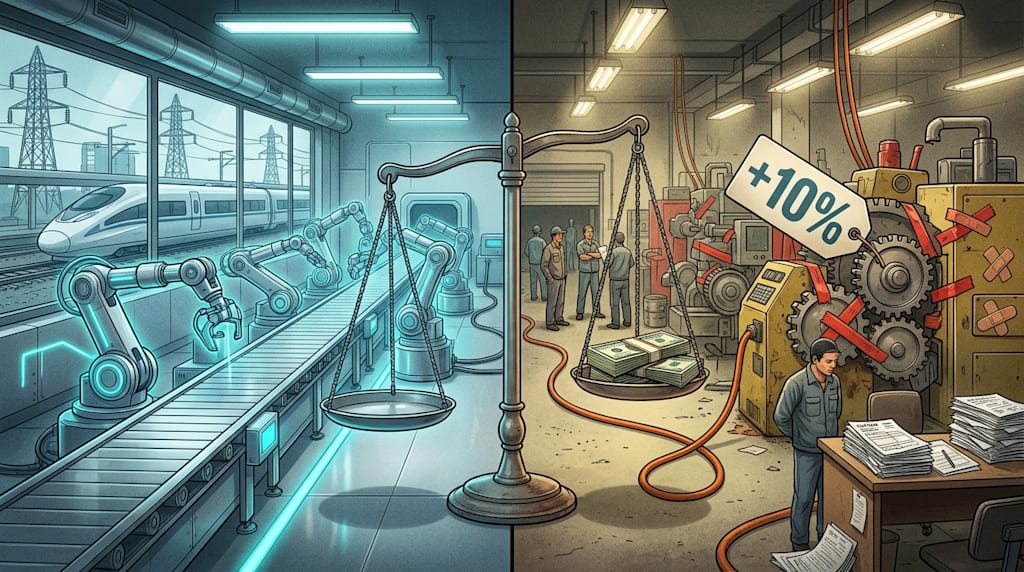
In September 2026, an executive from the Danish furniture giant Tretong did some math for the media. Vietnamese workers earn roughly half of what their Chinese counterparts make. Yet the total cost of setting up a factory in Vietnam comes out 10% higher than in China. Raw materials have to be shipped from China. Skilled workers have to be flown in to train locals. Approvals, management overhead, and hidden facilities all eat into the margin.
He said all this while his own factory had already been running in Vietnam for two years.
Pause on that detail. He did something he knew was inefficient, did it anyway, and admitted it publicly. That is behaviour, not an explanation of behaviour. It tells you more than any industry report could.
I. Breaking Down the 10%: Where Does the Extra Cost Come From?
The media loves to sum up Vietnam with six words: "low labour costs." Those six words might have worked for Dongguan in 1990. For Vietnam in 2026, they leave out more than they include.
First, working hours. Vietnamese wages are half of China's. But wages are quoted per month; output is measured per hour. Most Vietnamese factories run a strict eight‑hour, five‑day week. Overtime is extra and tightly controlled by unions. On a typical Chinese production line, effective working hours are at least 30% higher. Divide wages by effective hours, and the unit‑labour‑cost gap shrinks to a sliver. Go one layer deeper: the same order takes 30 days in China, but 45 in Vietnam. Capital tie‑up, warehousing, and the customer's patience do not show up on payroll. They show up on the balance sheet.
Second, industrial clusters. The Danish boss put it bluntly: most raw materials still have to be shipped from China. What he left unsaid is that Vietnam's supply‑chain radius is simply too long. In the Pearl River Delta, a broken mould gets repaired and returned the same afternoon. In Vietnam, a missing component means waiting for shipping, customs, and inland transport, sometimes receiving the wrong batch. This "waiting cost" cannot be captured by freight fees alone. It is a systemic drag on rhythm.
Third, training. There are Chinese employees in Vietnamese factories, training local apprentices. Once the locals are up to speed, those Chinese staff are usually sent back. Standard procedure, nothing new. But the output loss, the defective rates, and the management friction during the entire training cycle are all sunk into that 10%.
Fourth, and rarely factored in: Vietnamese workers are not lazy. They are non‑cooperative by design. They leave on time. They refuse overtime. They demand regular team‑building events and holiday perks. Forced overtime? The union organises, and workers have been known to smash equipment. This is not a discipline issue. It is institutionalised labour‑side pricing power. Vietnamese unions fight for workers' rights; Chinese unions help maintain production order. The cost structures of these two systems are not even on the same coordinate plane.
II. Then Why Go at All?
If it were purely an economic calculation, the equation would not add up. So switch to a different ledger.
Ledger No. 1: risk avoidance. Tariff barriers and political scrutiny on "Made in China" in Western markets are becoming a structural cost. Vietnam's 10% premium is, in the spreadsheets of multinationals, a compliance cost. Pay 10% to get around a wall, rather than getting crushed by it. This is not a commercial decision; it is the price geopolitics quotes on supply chains. Do you pay it? Most do.
Ledger No. 2: market access. Vietnam does not enjoy low tariffs and Western favour because it is cheap. It enjoys them because it is "not China." It joined free‑trade agreements. It reformed its labour laws. It projects an accommodating stance toward international rules. The cost of that posture partly materialises as that 10% factory premium.
So the phrase "doing it while gritting one's teeth" translates to this: that 10% is not a miscalculation. It is a necessary expenditure in a different accounting system.
III. Vietnam Is Doing Its Own Sums, Too
Many see Vietnam as a passive recipient of low‑end capacity. That view may be outdated.
Vietnam is doing something counter‑intuitive. It takes orders, but it also picks them. It has barely finished making shoes and socks, yet it is already talking about AI and chips. Low‑margin, labour‑intensive industries are being deliberately squeezed out through union‑led wage hikes, land‑use restrictions, and labour‑law limits on overtime.
What does that mean? Vietnam does not want to stay "cheap" forever. It knows that if it competes only on price, it will remain trapped at the bottom of the value chain. It is willing to bear a 10% cost disadvantage in exchange for retaining labour bargaining power and a compliant image, in order to attract higher‑tier industries.
Whether this strategy succeeds is another question. But it reveals one thing: this round of industrial relocation is not just about moving capacity. It is about moving ambition. Vietnam does not intend to repeat China's forty‑year journey. It wants to skip the middle thirty years.
IV. History Repeats, but Not in the Same Rhyme
Many like to apply the historical pattern of "four waves of industrial transfer" — from Britain to the US, to Japan, to the Four Tigers, to China. Each wave looks like "costs rose, so industry left."
But all four previous waves shared one premise. The relocation was of production capacity itself, built anew. British garments moved to the US. American radios to Japan. Japanese TVs to Taiwan. Taiwanese shoes to Dongguan. Each new place started from scratch, but everything needed eventually grew there.
This time is different. The capacity relocated to Vietnam is not independently grown. It is plugged into an extension cord that runs from China. Raw materials from China. Equipment from China. Technical backbone from China. The Vietnamese factory is not "another factory." It is "an offshore workshop of a Chinese factory."
This implies one thing. If that cord is pulled one day, the Vietnamese line will not spin on its own. This is not about who is smarter. It is a hard constraint of growth cycles. A mature industrial cluster requires not just money and land, but a decade or more of compromises, trial and error, and technical sedimentation. Vietnam cannot skip that cycle, just as China could not skip it back then.
Hence the Danish boss's line: "We did business in China for over twenty years, and only went to Vietnam two years ago." Those twenty years were precisely the time China's supply chain took to mature. Vietnam has only just started.
V. Closing: There Is No "Next China"
Put all this together. The plain conclusion is this: the very idea of a "next China" is invalid.
China's manufacturing competitiveness was never "cheap labour." Cheapness was merely the outcome. The causes were total‑factor, squeezed investment: energy subsidies, tax breaks, land concessions, cheap capital, infrastructure built ahead of demand, and cut‑throat competition among local governments to attract investment. Add the scale effect of a unified market of 1.4 billion people, and unit costs fall to levels other countries simply cannot replicate.
Vietnam cannot have those. Its advantages lie elsewhere: institutional openness, alignment with international rules, and geopolitical dividends. But these come at a cost. That 10% premium, and upward pressure on labour costs that will only grow.
The future of global supply chains will not be "who replaces whom." It will be "who survives in which niche." China holds the card of efficiency. Vietnam bets on access. The West builds walls of rules.
The Danish boss's factory still runs in Vietnam. He spoke a truth, and then went back to business. That is the most telling layer. Everyone knows the current state is imperfect. Everyone accepts it because no one knows a better solution.
About the Creator
Jin
Writer of reamstories
https://reamstories.com/jin
Enjoyed the story? Support the Creator.
Subscribe for free to receive all their stories in your feed. You could also become a paid subscriber, letting them know you appreciate their work.
Comments
There are no comments for this story
Be the first to respond and start the conversation.