
The Vehicle Price Discount Wave: A Radical Brand Value Reevaluation
What would you do for a discount on the products in your company?


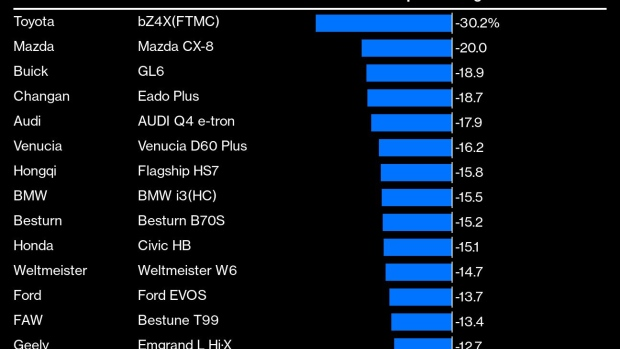
Since 2023, a Vehicle Price Discount Wave has happened in China. Over 10 Vehicle companies such as BYD, Tesla, Honda, CWM, GAC, Toyota, Chivey, etc. executed discount action on their force product. The amounts of vehicles reduce the price by at least 30k RMB (above 4k-5k dollars).
However, I don't want to dwell too much on the insurance itself. As a marketer, I would like to have a deeper explanation of the wave of price discounts, the essential logic.

A Vehicle Price Discount Wave Formation
whether the Inside or Outside would become the Potential Direct Factor. Discount pricing is a type of promotional pricing strategy where the original price for a product or service is reduced. The Reasons for Discounting Products have a lot. They can be concluded as internal conditions and external conditions.

The internal conditions focus on a company or product itself.
- Upcoming Product Update
Products soon to be replaced or upgraded are often discounted to clear out inventory before new models arrive.
- Low Inventory Turnover
Products that are not selling well (unsalable items) may be discounted to increase sales and free up warehouse space.
- Market Saturation
When products are too similar within a market segment, causing customer confusion, discounts may be used to increase product appeal and differentiation.

On the contrary, the external conditions emphasize the impact of the environment. Some conditions are as below:
- Economic Downturns
The downtrend commercial environment. During periods of economic decline, businesses may lower prices through discounts to maintain sales volume and customer interest.
- Decline in Consumer Purchasing Power
The same as the declining of customers’ life quality. If there is a noticeable decrease in the general quality of life or purchasing power of customers, businesses might use discounts to keep products affordable.
- Competitive Pricing Pressures
Discounts may be necessitated by similar actions from competitors, aiming to retain market share and customer loyalty.
Price Discount essential logic: A process of product and brand value reevaluating

Angle for marketing, essentially, discount action is a process of product and brand value reevaluating. Price is a significant component of a product's perceived value. Discounts can influence consumer perception by suggesting a more favorable value proposition, making the product more attractive at a lower price point.
Thus, Discounting is often employed as a strategic tool in marketing to adjust the perceived value of a product or brand. It's not merely about reducing prices but about re-aligning the product's value proposition in the eyes of consumers.

When a product is discounted due to factors like overstock, impending obsolescence, or competitive pressure, it prompts customers to reassess its worth. If the discount is perceived as justifying the product's benefits, consumers may be more inclined to purchase at the reduced price.
It seems a strong tool in marketing, but it also has an invisible damage behind the benefit, brand devaluation.

How to deal with it? To catch the pillar!
Offering constant discounting can lead consumers to perceive that your product or service does not have high intrinsic value, which is far more harmful than the price reduction itself!
Hence, as a marketer, even facing the discount action on our company, we should convince the audience with our efforts that this action is short-term and product values don’t lose as discount processing, to avoid damage to the brand’s depreciation.

Some key content we should spread to them in whatever actions
- Define the Duration
This action is temporary and limited. It just lasts during an extended period such as a month or 15 days.
- Highlight Customer Benefits
This action is in the hope that customers can spend less for an equivalent product.
- Maintain Brand Value
Emphasizing the USP value of our product in order to certify that discounts on products don’t cause the brand’s depreciation.
- Acknowledge External Influences
Or, blaming the action on external factors such as society, the industry’s commercial environment, or the competitors’ discount actions.
- Commit to Sustainability
At last, we should announce that our company will insist on long-termism and sustain-development, improving customers’ confidence.

In the end, although price reduction will reduce the company's profits and cause brand devaluation and other issues. From another perspective, products that can overcome the wave of price cuts will benefit long-term development. Therefore, it is necessary to strengthen the display of product highlights and advantages, the pillars. They will become the most powerful weapon for marketers to fight against the wave of price cuts.
About the Creator
kent li
a brand marketing specialist, who is good at studying the marketing of Chinese local brands or Global brands in China.
Enjoyed the story? Support the Creator.
Subscribe for free to receive all their stories in your feed.
Comments
There are no comments for this story
Be the first to respond and start the conversation.