
The Unemployment Lie Hard Workers Keep Hearing
Your work ethic did not disappear. The job did.
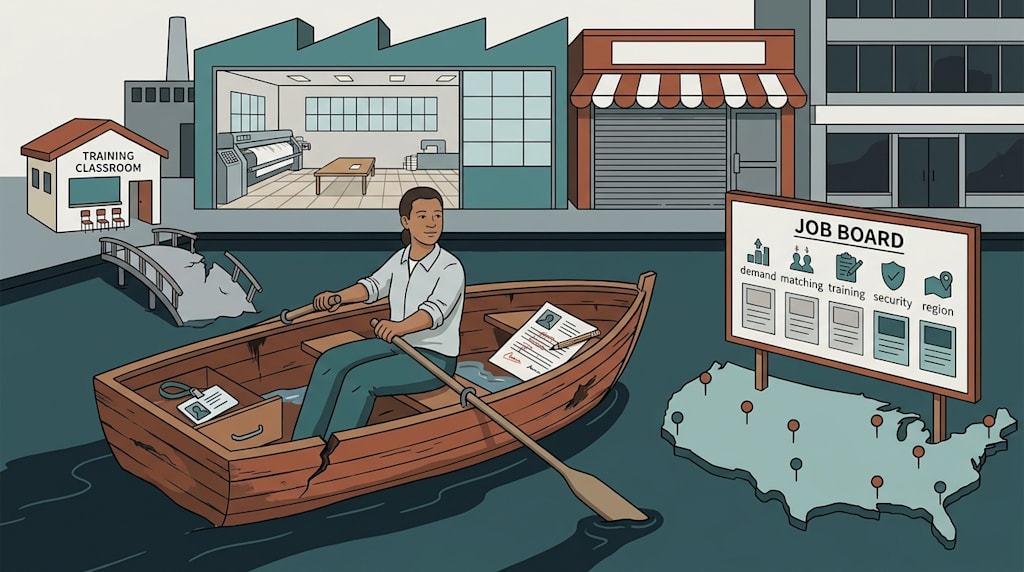
When people discuss unemployment, a familiar story appears. A person loses a job because he was not hardworking enough, not dedicated enough, not responsible enough. If he had tried harder, stayed later, complained less, and shown more loyalty, the story goes, he would still be employed. This story comforts managers. It also survives because it is repeated, not because it is tested.
The main driver of employment and unemployment is the demand for labor and the structure of that demand, not the work attitude of a single person. Personal responsibility and effort matter. They help a person perform inside an existing job. They improve a worker’s position inside a given pool of openings. They cannot create a job that does not exist. They cannot reverse an industry-wide contraction. They cannot stop a factory line from being automated, a store from closing, a business line from being shut down, or a project from moving to another city.
The claim that unemployment is mainly an attitude problem turns a structural problem into a moral problem. It tells workers to row harder while ignoring that the boat may be leaking or headed somewhere else.
1. The basic logic of unemployment is a mismatch between labor supply and job demand
Unemployment is not simply a situation in which some people do not want to work. It is a situation in which labor supply and job demand fail to match. The mismatch appears in at least five dimensions: quantity, location, skill, information, and price.
Consider five short scenes.
A warehouse in Shenzhen posts eight openings for forklift operators. A worker in Shenyang has fifteen years of warehouse experience. He cannot move because his mother needs dialysis three times a week and his wife’s job is local. The job exists. The worker exists. The location does not match.
A logistics company asks for a forklift certification and basic inventory software skills. An applicant spent twenty years on a sewing line. She can inspect a seam at a glance and train a new worker in three days. She cannot operate the forklift. The skill does not match.
A factory posts its vacancy on three recruitment platforms and a local labor bureau account. A job seeker checks one platform, sees no response, and stops looking. The information does not match.
An employer offers 6,000 yuan a month for a job that requires a 50-minute commute each way. The applicant’s rent is 2,800 yuan, childcare is 1,500 yuan, and transport is 600 yuan. She needs at least 7,000 yuan to break even. The price does not match.
A position is filled on Tuesday morning. An applicant submits her resume on Wednesday afternoon. The timing does not match.
None of these scenes requires a worker with a bad attitude. Each requires a worker who is in the wrong place, with the wrong skill, looking at the wrong information, at the wrong price, at the wrong time. Personal effort can improve a worker’s position inside a matching process. It cannot make an absent job appear, move a factory to a worker’s city, convert a sewing operator into a forklift driver overnight, or force an employer to raise a wage above what the business can pay.
The first variable is not attitude. It is the number of jobs and the shape of those jobs.
2. Industrial change removes jobs before it removes workers’ diligence
The past few decades offer repeated examples of structural unemployment caused by industrial adjustment. In each case, many of the workers who lost jobs were not lazy, disloyal, or irresponsible. They were experienced, punctual, and skilled in jobs that disappeared.
Take a textile worker. She entered a mill at twenty-one and spent twenty-three years on the same workshop floor. She could hear a machine misfeed before the alarm sounded. She trained new workers. She never missed a shift without arranging a replacement. Then the mill installed an automated loom line. The new line needed two technicians per shift, not forty operators. The workshop was decommissioned in one quarter. She could run the old loom. She could not program the new line. The local retraining course ran six weeks at night and taught basic computer operation. The nearby jobs that paid above her previous wage asked for forklift certification, electrical maintenance, or warehouse system experience. She took a job as a warehouse sorter. Her hourly wage fell by 15 percent. Her commute grew by fifty minutes each way. She still works hard. Her attitude did not change. Her job did.
Take a retail clerk. The store where she worked sold household goods. Monthly rent rose from 18,000 yuan to 30,000 yuan. The same items sold online for about 40 percent less. The owner cut staff from six to three, then closed the store. She moved to a warehouse picking job. She now scans barcodes for eight hours and wears knee supports. She did not become less dedicated. The store’s business model stopped working.
Take a tutoring company that cut an entire department in one week after a policy change. Take a property sales office that reduced its staff from twelve to four after sales slowed. Take an internet company that shut a business line after a quarterly review and told forty people on a Friday that their positions no longer existed. In each case, the workers’ attitudes were not the variable that changed. The demand for their work changed.
A worker can be diligent for twenty years and still lose a job when the job itself is removed from the economy. The phrase “if you work hard, you will not be unemployed” is not a description of the labor market. It is a slogan that survives because it is repeated.
3. Personal effort is a marginal variable, not a decisive one
None of this means personal effort is worthless. It means personal effort has a boundary.
Inside an existing job, effort matters. A worker who prepares and follows through is more likely to keep a job when a company cuts staff. A worker who can document results and learn new tools is more likely to move faster when he loses a job. In a pool of fifty applicants for one opening, effort, preparation, and skill can decide who gets the offer. These are marginal effects. Marginal effects are not nothing.
But marginal effects cannot replace the pool itself. A worker can row harder. A worker cannot turn a leaking boat into an aircraft carrier. A worker can improve his position on the boat. He cannot decide where the boat is going, whether the boat has a hole, or whether the shipping company has decided to scrap the route.
Aggregate demand and its composition determine the job pool. Individual effort determines a worker’s matching efficiency and relative competitiveness inside a given job pool. Effort affects who is retained, who is hired, and who moves faster. It does not determine whether the job pool exists.
When an industry contracts, a project relocates, or a more advanced technology is deployed at scale, individual diligence, loyalty, and professional responsibility produce little against the structural force. A worker may be the best operator in a workshop that no longer exists. A clerk may be the most reliable employee in a store that has lost its customers. A project manager may be excellent at a business line that the company has decided to close. The job disappears first. The worker’s attitude is left standing in an empty room.
4. Unemployment is not the same as personal failure
A rational understanding of unemployment begins by separating the outcome from the person. Most unemployment results from a combination of external factors: industry cycles, corporate strategy, business contraction, technological substitution, and regional relocation. A person may be laid off not because his ability is poor, but because the business line he worked on was cut. A person may fail to find work not because he is lazy, but because local demand for his occupation has shrunk.
This is not an argument for avoiding responsibility. It is an argument for accurate attribution. Accurate attribution leads to effective action. If a worker misreads structural unemployment as personal failure, he may respond by working longer hours in a shrinking field, competing on price, or enrolling in a course that does not connect to real openings. If he recognizes the external factors, he is more likely to focus on skill transfer, information access, regional options, financial planning, and job-search pacing.
Take a worker laid off from a company that closed a business line. In the first week, he put his badge in the bottom drawer and did not open it. In the second week, he rewrote his resume. He changed “responsible for customer follow-up” to “handled 60 customer accounts and reduced complaint response time from 48 hours to 12.” He changed “participated in system upgrade” to “led a three-person team that migrated 1,200 records with zero data loss.” He did not write “I am a failure” on the page. He wrote what he had done. The action did not erase the layoff. It restored a working description of his abilities.
Unemployment is an event. Personal failure is a judgment. The two are not the same, and treating them as the same makes the event harder to survive.
5. Solving unemployment requires a system, not a call for better attitudes
If the first variable is demand and structure, then the solution cannot be a campaign to improve professional spirit. Structural unemployment has a hard gap. That gap requires a system.
First, the demand side needs job creation and industrial support. Without a job pool, training becomes a queue with certificates. A local industrial park with empty units and no incoming firms will not be fixed by telling unemployed workers to be more positive. Demand policy, investment policy, and industrial policy set the size of the pool.
Second, the matching side needs better information. Job postings are duplicated across platforms, outdated, or disconnected. Public employment services should update openings daily, verify contact numbers, and publish skill requirements in plain language. A worker should not need to guess which of five platforms carries the active listing.
Third, the skill side needs training that connects to actual job descriptions. A course that teaches “office software” while local employers ask for “SQL and dashboard reporting” is not a bridge. It is a delay. Training providers should compare course keywords with hiring keywords, track placement rates by course, and publish the results.
Fourth, the security side needs a stronger floor. Unemployment insurance should process claims within a predictable number of days. Social insurance continuity should be explained in one page. Public employment services should offer case management for workers in structurally declining industries, not only a website link.
Fifth, the regional and price sides need attention. A job that requires a two-hour commute and 1,800 yuan in monthly transport may not be a real option for a worker with childcare duties. A wage that sits below the local cost of living will not fill a vacancy. Public policy can reduce relocation costs, support childcare, and improve transport links. The market can adjust wages. Both matter.
None of these tasks can be replaced by a speech about attitude. A speech does not create a job, verify a posting, align a course with an employer, process a claim, or reduce a commute. A system does.
6. Individuals can act, but only inside the boundary
Recognizing the structural constraint does not mean individuals should sit still. It means individuals should act inside the boundary and not confuse individual action with structural solution.
First, do not bind your entire self-worth to one position or one employer’s badge. A job is a job. A person is a person. A worker can love his work and still refuse to make a company ID the whole of his identity. Build portable skills: writing a clear handover note, reading a basic spreadsheet, explaining a process to a new colleague, managing a small project, handling a customer complaint, learning a digital tool. For each skill, keep one piece of evidence: a document, a certificate, a supervisor’s message, a completed project.
Second, if you develop a side income, calculate the net hourly return. Subtract commute, materials, platform fees, and tax. If the side work pays less per hour than rest or skill study, do not call it a rescue plan. A side income can add resilience. It can also add exhaustion.
Third, prepare a contingency plan before the risk arrives. Write one page: severance amount, savings, monthly essential spending, cash runway in months, social insurance contribution base and payment channel, three contacts who may know openings, two job boards to check weekly, one training course with a start date and a placement record. Set a weekly job-search schedule: applications on Monday and Tuesday, follow-ups on Wednesday, skill practice on Thursday, review on Friday. Decide a short-term income floor: the amount you need per month to cover rent, food, transport, and insurance. Write it down. A plan does not stop unemployment. It reduces the panic that makes unemployment worse.
Fourth, treat job search as a matching problem, not a moral test. If fifty applications produce no interview, the problem may be the target, the resume, the location, or the wage range. Change one variable at a time. Ask for one piece of feedback. Track responses. The goal is not to prove effort. The goal is to find a match.
7. Two refusals
Calling unemployment an attitude problem is lazy. Saying individual effort means nothing is surrender. The first claim is more common, so it should be dismantled first.
The first variable is the demand for labor and the structure of that demand. Personal effort is a marginal variable. It affects who moves faster inside a job pool. It does not determine the size or shape of the pool. A system handles the hard gap: demand, matching, skills, security, and regional access. An individual handles the boundary: portable skills, accurate attribution, financial preparation, and a paced search.
A policy that treats structural unemployment as a moral problem will produce speeches and not jobs. A worker who treats structural unemployment as personal failure will produce self-blame and not a plan. Both mistakes are avoidable. The first step is to name the first variable correctly.
About the Creator
Jin
Writer of reamstories
https://reamstories.com/jin
Enjoyed the story? Support the Creator.
Subscribe for free to receive all their stories in your feed. You could also become a paid subscriber, letting them know you appreciate their work.
Comments
There are no comments for this story
Be the first to respond and start the conversation.