
The “Unemployment Buffer Period” Is a Signal, Not a Safety Net
AI job replacement policy sounds bigger than it is. Here is what it covers, what it leaves out, and what workers should watch instead.
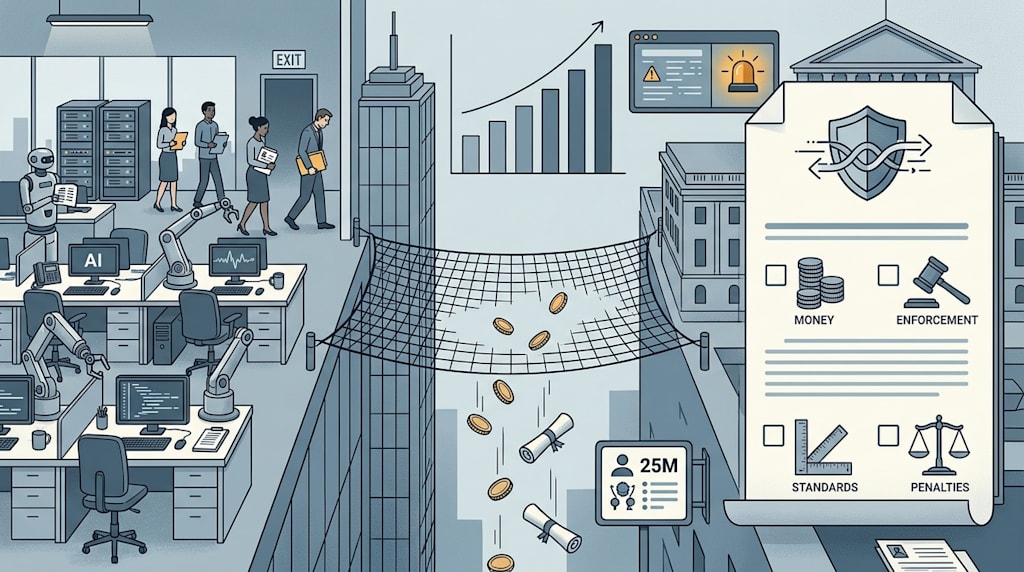
Now that “unemployment buffer period” has entered policy language, there is no need to cheer or dismiss it immediately. Four tests show whether a policy concept has force: who pays, who runs it, what standard applies, and what happens when nobody complies.
All four remain vague. During the buffer, are wages paid in full or cut? Does social insurance continue? Is training paid? If a worker is replaced after training, is compensation higher than statutory layoff pay? Is the buffer mandatory or advisory? If a company submits a plan and then cuts staff anyway, what penalty applies?
Until those answers exist, the buffer can become a soft policy: companies write their own plans, government offers guidance. Some brand-conscious employers may act more carefully. The behavior of all employers will not change. At this point the concept works as a risk warning, a policy signal, and an expectation-management tool. It accepts that AI replacement has entered corporate decisions and labor relations. It remains far from a protection system workers can rely on.
Companies that choose AI replacement are acting rationally inside the distribution system
AI job replacement is not only a moral question. In a competitive market, companies facing price wars, cost pressure, and efficiency competition often make a reasonable and lawful choice when they replace some positions with AI. If they do not violate labor law or carry out unlawful termination, accusing them of “using AI” is weak.
In primary distribution, companies pursue efficiency and profit. In secondary distribution, government adjusts through taxes, social insurance, and fiscal spending. The issue is how the gains from replacement and the costs of unemployment are divided. If companies capture the efficiency gains and cost cuts, workers absorb lost jobs and re-employment pressure, and the fiscal side offers only bottom-line, inclusive protection, then a buffer without fiscal and social-insurance support becomes an appeal to corporate goodwill.
Goodwill has a place. It cannot serve as the foundation of a system. Two paths remain viable. One imposes hard limits on AI replacement through mandatory policy. The other uses broader fiscal policy, including training subsidies, social-insurance continuation, unemployment assistance, and job-transfer support, to absorb employment pressure. Current policy leans toward the second path. Intensity and speed will decide whether it works. A concept without money buffers rhetoric, not risk.
The policy attitude balances development and security
Domestic attitudes toward AI and employment look divided. AI investment must stay hot. Favorable policies continue. A large share of funds from new financial support tools has flowed into the sector. At the same time, officials are managing expectations. Some policy figures have called for early “policy arrangements” for possible AI investment failures. Financial regulators have noted that past technological revolutions produced “local bubbles.” The National Development and Reform Commission has said it will strengthen monitoring and early warning of AI job-replacement risks and improve bottom-line, inclusive social security.
This looks contradictory: encourage AI and worry about AI. The logic is development plus security. Investment heat stays because AI is a key variable in industrial competition and technological progress cannot slow just because employment is at risk. Bubble warnings, failure planning, and job monitoring appear early because decision-makers see the risks. They prefer to develop first, monitor second, and provide bottom-line protection last. They do not want to preserve jobs by banning AI replacement.
The policy logic is: no brake, but a warning light; no ban on replacement, but preparation for a safety net. Large mandatory restrictions on AI replacement are unlikely in the short term. Monitoring indicators, early-warning systems, expanded social security, and training and job-transfer support are more likely. If those measures are underfunded and slow, a gap opens between policy attention and what workers feel.
Two employment numbers matter more than AI anxiety
Two employment numbers deserve more attention than abstract debate about AI and unemployment.
First, undergraduate graduates will keep rising before 2038. The projected number for 2038 is about 16.73 million. For more than a decade, the supply of young, highly educated labor will grow. AI replacement tends to hit entry-level white-collar jobs, repetitive mental work, and standardized process roles. More supply plus replacement pressure will keep structural employment stress high.
Second, the 15th Five-Year Plan employment targets have changed. Unlike the 13th and 14th Five-Year Plans, there is no specific target of “no less than 50 million” new jobs. A new indicator appears: a target of 25 million urban unemployed people re-employed. The signal is clear. Policy focus has shifted partly from creating incremental jobs to re-employment and bottom-line protection for the existing unemployed. This does not abandon new job creation. The indicators now stress structural problems and the unemployed stock.
Read together, the two numbers point to structure, not anxiety. The future employment problem is not only total quantity. It is who can match a job and who needs bottom-line protection. Where the money comes from, who runs training, how willing companies are to cooperate, and how workers’ rights carry over matter more than the concept.
What workers can do and what policy must supply
Workers need concrete steps, not pure anxiety and not a casual “accept the trend.”
First, reduce assumptions about one job’s stability. AI replacement may hit a position, a process, or a class of entry-level work rather than an entire industry. Transferable skills, cross-role ability, and skill with AI tools matter more than guarding one job.
Second, protect cash flow and social-insurance continuity. If the buffer lacks institutional support, personal cash flow is the first safety net. Labor contracts, layoff compensation, social-insurance payments, and unemployment-insurance eligibility deserve attention. That is rights protection, not ignorance of the trend.
Third, watch implementation, not concept heat. Paid training, job transfer, and compensation after replacement decide whether the policy has value.
For policy, three tests matter more than a new concept. Can the buffer be institutionalized? Can fiscal and social-insurance support connect? Can AI replacement enter layoff reporting and employment monitoring? A voluntary corporate plan remains soft guidance. A buffer linked to paid training, job-transfer subsidies, social-insurance continuation, and compensation standards can become a working institution.
Closing
The “unemployment buffer period” currently has a strong signal, soft guidance, and weak implementation. It recognizes AI job replacement and tries to manage expectations. It remains far from a protection system workers can rely on. Companies that choose AI replacement are acting rationally inside primary and secondary distribution. Policy balances development and security: no brake, but a warning light.
Do not treat the buffer as an existing safety net. Do not dismiss AI anxiety as ignorance. Understand the trend, stay prepared, and watch the money, institutions, and implementation behind the concept. The trend is clear. Protection is not. Workers can only increase their own certainty while protection remains uncertain.
About the Creator
Jin
Writer of reamstories
https://reamstories.com/jin
Enjoyed the story? Support the Creator.
Subscribe for free to receive all their stories in your feed. You could also become a paid subscriber, letting them know you appreciate their work.
Comments
There are no comments for this story
Be the first to respond and start the conversation.