
The Undergraduate Field: Why Your 18-Year-Old Self Still Shows Up in Every Job Application
Employers say they want skills. The first filter says something else.
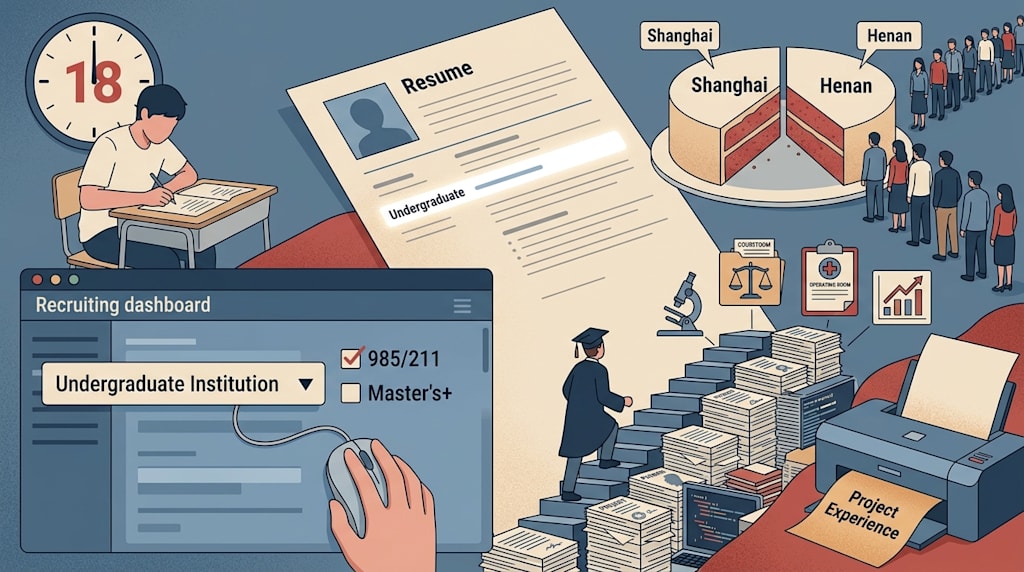
The Undergraduate Field
In the recruiting dashboard, the undergraduate institution field sits open by default. The HR person checks 985/211. Then checks master’s or above. Clicks. The page refreshes. Eight hundred resumes become one hundred twenty. She picks up her cup. The water is cold. She does not drink. The next field is highest degree. She clicks again. Sixty-seven remain.
The undergraduate field works like an old sluice gate. It closes first. The other gates open later.
People ask why jobs look at the first degree instead of the highest degree. The answer sits in that mouse click. The recruiter does not know you. She has thirty seconds. The gaokao is the cheapest proof available.
1. An old ticket, stamped again and again
The gaokao is one of the most standardized exams in the country. Same time, same paper, same marking standards. An eighteen-year-old sits in a classroom and, with a pen, decides which city he will live in, whom he will meet, and which line he will write on a resume.
The postgraduate exam works differently. Part of the preliminary test is nationally unified. Specialized subject exams are often written by each school. Difficulty, scope, grading, and information access vary. Interviews leave room for judgment. Recommended admission takes many places. Transfer admission still looks at undergraduate background. The first degree gives a hard signal. The highest degree gives a noisy one.
Recruiters cannot unzip a life. They see a file name. The undergraduate school is that file name. It does not show what is inside. It decides whether anyone opens the file.
This is statistical discrimination. Not every elite undergraduate is strong. Not every ordinary undergraduate is weak. Recruiters still use group averages when they cannot assess individuals. It is cheap, fast, and convenient. A good first degree raises the chance of passing the filter. A bad first degree demands more proof.
The first degree signals entry. It does not decide the end.
2. Where you line up matters more than how hard the paper is
A common claim says a first-tier Shanghai student would end up in a vocational college in Henan, while a first-tier Henan student could reach a 985 in Shanghai. The direction has some truth. The numbers are exaggerated.
The gaokao does not admit by one national cutoff. It admits by provincial quotas and provincial rankings. Shanghai has fewer test-takers and more local elite universities. Its 985/211 admission rate is among the highest. Henan has many test-takers and fewer high-quality local universities. Its admission rate is low. The same label “first-tier” can sit on different provincial rankings, different competition, and different difficulty.
The enrollment plan is a cake. Fifty thousand people in Shanghai share one piece. One million people in Henan share one piece. The cutoff score is what remains after the cake is cut. The quota is the cause.
Beijing and Shanghai write their own papers. Their scores cannot be compared directly with national papers. Finding the Shanghai paper easy does not make Shanghai admission easy. Finding the national paper hard does not make Henan admission worse. Admission is provincial competition. It is not a cross-provincial score contest.
If Heilongjiang and Henan use the same paper, their undergraduate cutoff lines can still differ. Heilongjiang students are not smarter. Henan students are not dumber. Test-taker numbers, enrollment plans, cutoff ratios, and admission rates create the gap.
A Shanghai test-taker who went to Henan, took the Henan gaokao, and competed for Henan quotas would probably fall. “Probably a vocational college” lacks evidence. A Henan first-tier test-taker placed in Shanghai to compete for Shanghai quotas might get into a better school. “Could get into a 985” still depends on ranking, major, and year.
Comparing the gaokao across provinces requires provincial rankings, admission rates, enrollment plans, and major choices. Turning “Shanghai first-tier” and “Henan first-tier” into “vocational college” and “985” is emotional shorthand. The anger behind it is real: same effort, different province, different fate. Same score, different household registration, different destination.
That anger follows people into the first degree. First-degree differences come from individual effort and from institutional position.
3. The postgraduate exam reshuffles. It does not cancel.
A postgraduate exam classroom. One in the morning. The desk holds politics review books, English past papers, and major-course notes. Some people move from a second-tier university to a 985. Some fall from a 985 to an ordinary school. The exam offers a chance to reorder the ranking.
Part of the preliminary exam is nationally unified. Many people change their highest degree and career path through it. For people with a bad first degree, it is a compensation channel.
It is not absolutely fair.
Specialized subject exams are self-designed. Difficulty, scope, grading, and information transparency vary. Some schools give high scores. Some suppress scores. Some publish clear reading lists. Some keep information closed. Candidates compete on learning ability, information gathering, and resource access.
Interviews are subjective. Performance, undergraduate background, research experience, and supervisor preference affect the result. A high preliminary score can be rejected. A mediocre preliminary score can recover in the interview. More subjective room means more room for the first degree to seep in.
Recommended admission takes many places. In popular majors at elite schools, it keeps rising. Unified-exam places shrink. Competition grows. Recommended admission depends on undergraduate school, major ranking, and research resources. A good first degree helps. A bad first degree often means the single-plank bridge of the unified exam.
Transfer admission also looks at undergraduate background. Some schools prefer 985/211 undergraduates. In the transfer market, the first degree is hard currency.
The interview teacher flips through the resume. He sees the undergraduate field and pauses for half a second. That pause does not decide everything. It exists. The highest degree can cover part of the first degree’s shadow. It cannot erase it. When every competitor has a good highest degree, the first degree becomes a distinction again.
The postgraduate exam is another shuffle. It does not void the cards already played.
4. Labels step back. Output steps forward.
The weight of the first degree depends on the job.
Investment banks, consulting firms, big tech companies, and some central state-owned headquarters receive too many applicants. Recruiters use the first degree as a pre-filter. Ordinary undergraduates can sometimes do these jobs. The applicant pool already has enough people from good schools. Recruiters avoid risk.
R&D positions, research institutes, and university faculty look at research output. Papers, patents, projects, experimental ability, and academic potential matter more than the first degree. Someone from an ordinary undergraduate background who publishes in top journals during a PhD can still enter a good platform. The research world recognizes output, not the gaokao score.
The first degree still affects the research path. It affects access to good labs, good supervisors, and good resources. A good first degree starts higher and lowers trial-and-error costs. A bad first degree needs stronger results.
Tracks that value output give less weight to the first degree. Tracks that value labels give more. If your first degree is bad, go where output matters. Build verifiable production. If your first degree is good, do not treat it as a lifetime pass. It helps you pass the first filter. After that, the highest degree, output, and rare skills still matter.
5. Replaceability and rare skills
The most critical thing in job hunting is whether you can provide skills others cannot easily copy.
If you are like a factory product, identical to thousands of others, you are replaceable. What you know, others know. What you can do, others can do. Your resume looks like thousands of others. Recruiters filter by external labels: degree, age, gender, certificates. The first degree becomes important.
If you can provide what others cannot, the situation changes. You can write high-quality code, build a hit product, win a difficult client, publish a hardcore paper, explain a complex problem clearly, or integrate resources across fields. The first degree becomes background. It does not decide the outcome.
Extending your education helps build rare skills. More years give you time for works, papers, projects, internships, networks, and cross-disciplinary ability. Undergraduate study is general education and basic training. Master’s and doctoral stages can build professional depth.
More years do not automatically create rare skills. Some people do a master’s to delay employment. Some do a PhD to escape society. Some collect degrees and produce nothing verifiable. What you did during those extra years matters.
Years of education are the container. Rare skills are the content. A large empty container is still empty.
6. Two kinds of people trapped by eighteen
Two kinds of people get trapped by the first degree.
The first kind has a good first degree and only a first degree. He did well on the gaokao and entered an elite school. He accumulated nothing in university. He produced no work after graduation. He grew little at work. At class reunions, he keeps bringing up the gaokao. Degrees make him proud. Ability makes him silent. He uses the first degree to comfort himself and to hide later stagnation.
The second kind has a bad first degree and only that degree. He did not do well on the gaokao and has never gotten over it. He failed the postgraduate exam, or passed it without changing his situation. At work, he remains angry about that exam at eighteen. When drunk, he says, “If only back then.” He feels the world is unfair. He feels others only look at the first degree. He feels his effort goes unseen. He has not produced anything new to prove himself.
These two kinds look opposite. They are two sides of one coin. One lives off the first degree. One is trapped by it. Both anchor their lives at eighteen.
The first degree matters. It affects the starting point, the slope, and the first impression. It does not decide the endpoint. Long-term development depends on whether you keep producing verifiable value.
A good first degree is not a lifetime pass. A bad first degree is not a lifetime verdict. You can take the postgraduate exam, study abroad, change careers, do projects, build a portfolio, and build networks. Ten years can make people stop asking only about your undergraduate school.
The bigger problem is having only the first degree. Good or bad, having only it means you have not grown anything new since.
7. The undergraduate field is still there
The recruiting system. The HR person closes the page. Tomorrow brings another eight hundred resumes. The undergraduate field is still there.
You cannot change it. You can change the next field. Project experience. Portfolio. Papers. Patents. Client lists. Code repositories. Surgical records. Court hearing notes. Sales data. What you have done becomes new filter fields.
The printer spits out a sheet of paper. On it: Project Experience. The paper is warm.
About the Creator
Jin
Writer of reamstories
https://reamstories.com/jin
Enjoyed the story? Support the Creator.
Subscribe for free to receive all their stories in your feed. You could also become a paid subscriber, letting them know you appreciate their work.
Comments
There are no comments for this story
Be the first to respond and start the conversation.