
The Three Tables at Every Wedding That Explain Everything
Relatives get the fish. Friends get the fried chicken. Both are love.
Last month I went to another wedding.
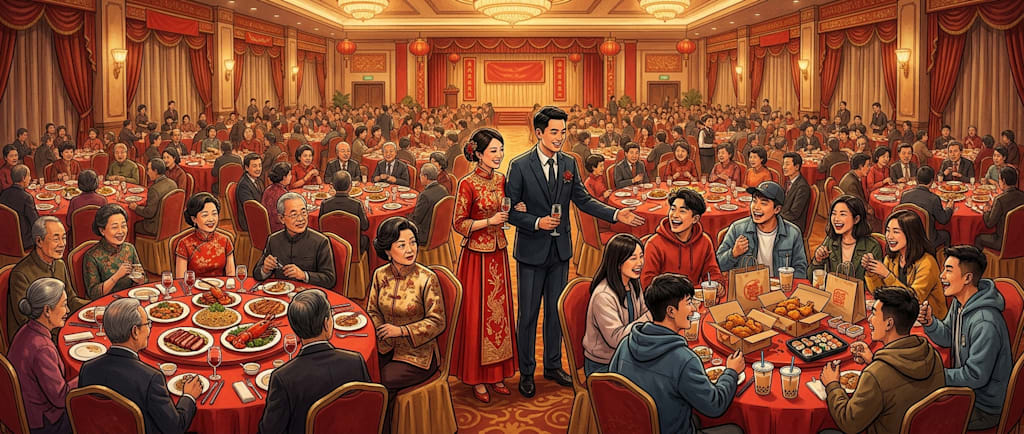
The table I sat at happened to be right on the border between the friends’ section and the relatives’ section. To my left were the bride’s college roommates. To my right was a distant uncle of the groom. When the same steamed grouper was brought to the table, the left side started filming it for their group chat, while the right side discussed whether it was wild or farmed. Both sides were lively, but the quality of the liveliness was completely different.
When the bride and groom entered, all thirty tables applauded at once. As the applause died down, someone at the left table shouted, “Old Zhou, your tie’s crooked,” while someone at the right table quietly asked the person next to him, “Is this the groom’s side or the bride’s side?” The groom laughed on stage and unconsciously touched his tie.
Throughout the banquet, the three friends’ tables were the most relaxed. Someone had come in a hoodie. Someone sat down and pulled out a bag of duck necks to share. Someone raised a hand halfway through the groom’s speech and asked, “Wasn’t your first date at an internet cafe?” The bride was not annoyed. She took the microphone and said, “Right. He played games, I scrolled food reviews, each of us looking at our own screen.” The three tables burst out laughing. There was laughter at the relatives’ tables too, but after laughing they would glance at one another, as if checking whether the joke had been appropriate.
Later I noticed a detail. On the lazy Susan at the friends’ table, besides the hotel’s cold appetizers, there were several takeout bags. Fried chicken, sushi, milk tea, the wrappers still half unopened. When the groom came over to toast, someone at the friends’ table handed him a piece of fried chicken. He took a bite and said, “Tastes better than pork knuckle.” His Second Aunt glanced at him and said nothing.
Ten years ago, this would probably have been called improper. But sitting there that day, I found it natural. The people at the friends’ table ate like this all the time. On weekends they would order takeout, crowd around one table, and whoever grabbed first ate. At the wedding they had simply brought their usual way of eating with them. There was no performance in it. Takeout was their own language here. If you made that table sit up straight through ten formal courses, they would not know where to put their hands.
The bride is a food-review blogger. I knew that before the wedding, but I saw the traces of her profession clearly at the friends’ table. Someone asked her the difference between the fried chicken from one takeout place and another. She put down her chopsticks and talked for five minutes, from the marinade to the oil temperature, and finally said, “The owner used to have a stall in the wet market. When you eat it, pay attention to the skin. There’s a charcoal note.” Then she laughed at herself and said, “Occupational hazard.” No one at the table found it strange. They just kept eating and drinking.
Every Sunday afternoon when my son goes back to school, his mother orders him a KFC meal to take with him, because the cafeteria is closed that evening. Each time he gets the paper bag, he does not eat right away. He opens the top, sniffs it, and only then takes out the chicken. It is a small action, but I know he is confirming, “This is the taste.” When the bride talked about fried chicken at the wedding, I thought of my son sniffing the paper bag. Food is one thing when it reaches your mouth. The actions of smelling it, touching it, opening the package are another. Those actions store memory.
The relatives’ tables have their own logic. When the groom’s parents went from table to table to toast, people at that whole stretch stood up, held their glasses properly, and some even pushed their chairs in. When the groom’s father introduced “This is your Third Uncle,” the groom called him that, and Third Uncle patted him on the shoulder and said, “Live well together.” You cannot say that at the friends’ table, but among those tables it carries weight. Those people may not be close to the groom, but they have had decades of ties with this family. They sit here to give the parents face, and to make an entry in their own ledger of obligations. Treating them to a formal meal is not distance. It tells them, “This meal was prepared specifically for this relationship.”
So the dignity of a wedding does not lie in every table having identical dishes. The steamed fish and braised pork knuckle cannot be missing from the relatives’ tables. That is decorum. Fried chicken and milk tea do not lose face at the friends’ tables. That is ease. The key is whether the couple knows which table is eating ritual and which is eating friendship. The tables were separate. The status was not. Each ate in comfort. That was hospitality.
But takeout at a wedding has also gone wrong. I heard of another wedding where the couple cut corners and ordered takeout for every table. The elders’ table did not touch their chopsticks from beginning to end, and when the banquet was over, an old lady took the daughter-in-law by the hand and said, “If you’re short of money, you could skip the wedding.” The problem was not takeout itself, but the lack of advance notice. If you order a set meal from a time-honored restaurant for the elders’ table and say beforehand, “Mom, Dad, I ordered what you like for your table,” and keep takeout only for the friends’ tables, it works. Food safety is the same. Fried chicken skin softens when cold. Ice melts in milk tea and dilutes the taste. If these details are handled well, it is innovation. If not, it is fobbing people off.
When the banquet ended that day, someone at the friends’ table put the leftover fried chicken back into the paper bag and said, “Microwave it tomorrow and it’ll still be good.” The people next to him teased him for being stingy. He said, “You don’t get it. This place’s chicken is good cold too.” The groom stood at the door seeing guests off. He saw this, turned to the bride and said something, and the bride smiled.
I did not hear what they said. That picture stayed with me. At the door, the groom’s parents stood straight and saw guests off. Nearby, friends with takeout bags laughed. In the middle, the bride and groom shook hands with elders while turning back to the friends’ table and gesturing, “Go ahead.”
Thirty tables have thirty tables’ rules. Three tables have three tables’ ease. Rules held feeling. Ease held feeling too. A wedding that gets to this point has done the work.
About the Creator
Jin
Writer of reamstories
https://reamstories.com/jin
Enjoyed the story? Support the Creator.
Subscribe for free to receive all their stories in your feed. You could also become a paid subscriber, letting them know you appreciate their work.
Comments
There are no comments for this story
Be the first to respond and start the conversation.