
The Silent Goodbye: Holding a Hand in Their Final Moments
A true story of nursing, compassion, and the power of presence
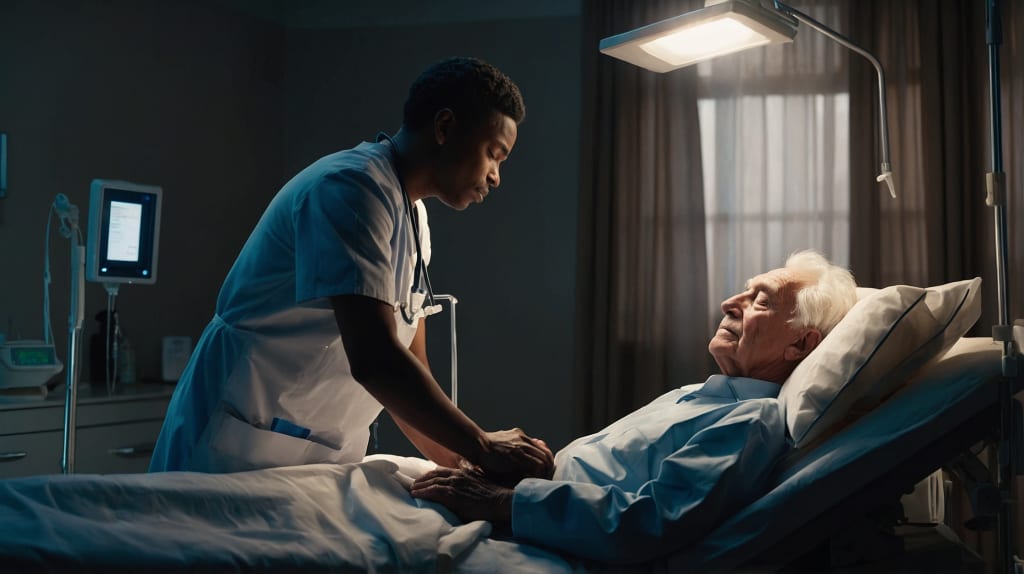
I met Mr. Langston on a Tuesday morning.
The kind of Tuesday where the air felt heavy with something unsaid, even before I stepped onto the ward. He was in Bed 3, tucked under too-thin sheets, eyes closed but not sleeping. His chart said palliative. His breathing said soon.
He’d come in the night before. No family listed. No visitors logged. Just a man in his eighties, brought in from home with metastatic cancer, lungs filling up with fluid, and time slipping faster than the IV drip beside him.
“Morning, Mr. Langston,” I said softly. He opened one eye and gave the briefest nod.
That was our introduction. No pleasantries. No backstory. Just two humans meeting at the end of one life and in the middle of another’s shift.
The room smelled of antiseptic and something older—like books that hadn’t been touched in years. He didn’t say much all day. In fact, he didn’t speak at all. But his eyes followed me. Every time I checked his oxygen. Every time I adjusted his pillows. When I brought his medication, he looked at me, nodded once, and took it without a word.
But later, just before my shift ended, he spoke.
“Don’t leave me alone tonight.”
His voice was raspy, barely audible.
I paused. “I’ll let the night nurse know, okay?”
“No.” He shook his head. “You.”
Something inside me stilled. There were rules. There were rotas. But there was also this man—this moment. I spoke to my manager. Swapped shifts. Stayed.
That night was quiet. Too quiet. The kind of quiet that makes fluorescent lights buzz louder and the ticking clock sound like thunder.
I sat beside him, just out of habit at first. I was charting meds, catching up on notes. But every now and then, I’d look over. He’d look back. No words. Just a knowing.
Around midnight, he started to struggle. Not with pain—we had that covered—but with peace. His hands trembled, his chest rose too fast. Panic had crept in.
“I’m here,” I whispered, slipping my hand into his. “I’m not going anywhere.”
He squeezed weakly. Then stared up at the ceiling like he was looking for someone. Or something.
“I was married once,” he said, eyes still fixed on the void above. “Eleanor. She died before me, like most good things do.”
I smiled. “She sounds lovely.”
“She was.” He blinked. A single tear escaped. “I haven’t held a hand in years.”
And there it was. The crack in the wall he’d kept up all day. Loneliness.
I didn’t know what to say. So I didn’t say anything.
I just held his hand tighter.
The hours passed slowly, like the night was reluctant to end. His breathing grew shallower. His grip weaker.
Around 3:14 a.m., something shifted.
He looked at me, really looked. His lips moved, but no sound came out. I leaned in.
He mouthed, thank you.
And then… he let go.
Not just my hand. Life.
His chest fell one final time, and then didn’t rise again.
No alarms. No drama. Just stillness.
I sat with him for a long time after.
Not as a nurse. Not as a professional.
Just as someone who was there—who stayed.
I remember washing his body. Folding his hands gently over his chest. I spoke to him as I did it, even though I wasn’t sure if I was comforting him or myself.
“You weren’t alone, Mr. Langston.”
And then I whispered a prayer. For peace. For Eleanor. For whatever lay beyond.
The next morning, when staff asked about my night, I just nodded and said, “It was quiet.”
But inside, I was anything but.
Because something about that night had shifted me.
Not in a big, dramatic, life-altering way. But in a soft, slow way. The kind you don’t notice until you’re three days into thinking about it.
I kept thinking about how many people go without that final human connection. No words. No touch. No presence.
And how much power is in just being there.
Reflection
Nursing, people say, is about medicine. Charts. Skills. Procedures.
And yes, all of that is true.
But the deepest part of nursing—the part they can’t teach you in school—is presence.
It’s knowing when to speak and when to stay silent. When to act and when to simply sit and hold someone’s hand as they whisper their last goodbye to the world.
Mr. Langston reminded me that our job isn’t just to heal the body.
Sometimes, our job is to make the last moments of someone’s life feel less empty. Less cold. Less forgotten.
That’s the kind of care that never shows up on performance reviews. That no chart will ever capture.
But it’s the kind of care that matters. The kind that lingers long after the shift ends.
It’s why I became a nurse.
And why I stayed.
About the Creator
Enjoyed the story? Support the Creator.
Subscribe for free to receive all their stories in your feed.
Comments
There are no comments for this story
Be the first to respond and start the conversation.