
The Seller Doing 40 Orders a Day Made More Than the One Doing 300
Two sellers in Bantian, Shenzhen, sold the same kitchen storage rack. One chased volume. The other filled in every column of an Excel sheet. The spreadsheet explained everything.
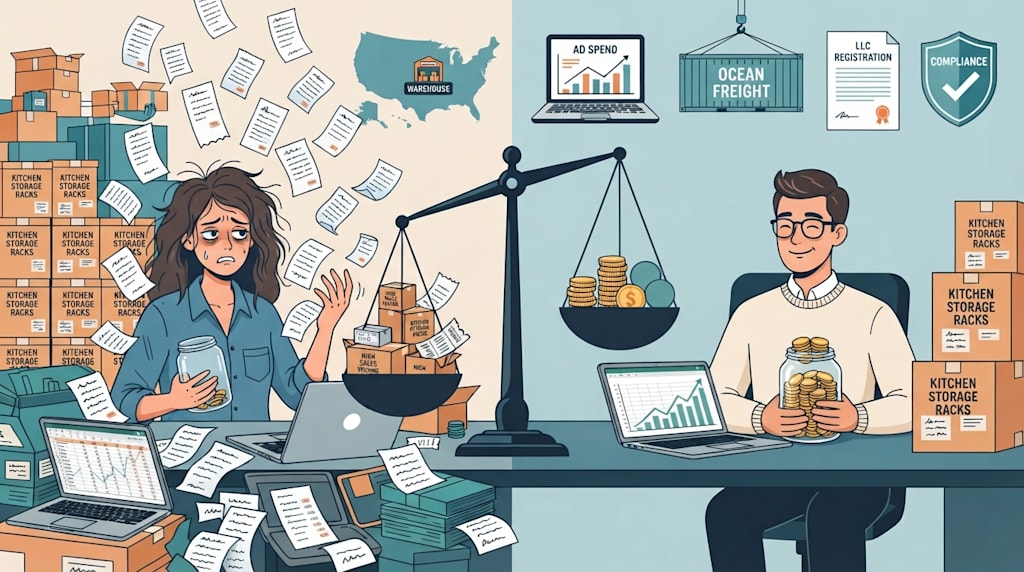
The Excel Sheet in Bantian
In Bantian, Shenzhen, the buildings lean close enough to share rain. A and B rented warehouses on the same floor. A shipped 300 orders a day. B shipped 40. At the end of the month, B’s net profit was higher.
A found B by the freight elevator, eating a cold baozi. “How?” A asked. “I move seven times your volume.”
B wiped his fingers on his jeans. “Come up. I’ll show you.”
B’s office was one room with a fan, a desk, and a laptop. He opened Excel. The columns ran past the screen: price, procurement, first-leg freight, commission, FBA, ads, returns, warehousing. He had filled every cell. At the bottom, A’s profit per unit was $2.10. B’s was $6.80.
A stared. “You sell the same rack.”
“Same rack,” B said. “Different math.”
He tapped the first column. “You saw a product doing 3,000 orders a month at $29.99. You found a supplier. I ran the model first.” He pointed. Price 29.99. Procurement 5.50. First-leg 2.00. Commission 4.50. FBA 4.50. Ads 5.00. Return loss 1.50. Left: $6.99. “That six ninety-nine doesn’t cover warehousing, labor, software, or company maintenance. If ads go from five to eight, profit drops to $3.99.”
A said nothing.
B opened another tab. “Product selection sheet. Price, procurement, first-leg, commission, fulfillment, ad cost, weight, package dimensions, return rate, warehousing, contribution profit per unit. Fill it before you contact a supplier. Then read the one- to three-star reviews.” He scrolled. Complaints for kitchen racks: hard installation, rust, wrong size. “If a supplier solves two, you have something. If they solve none, you compete on price. New sellers should pick moderate size, not easily damaged, simple return reasons. Heavy and large products get returned more. Logistics and after-sales eat the profit.”
A leaned back. “So I shouldn’t chase volume.”
“Sales volume belongs to someone else,” B said. “The profit sheet is yours.”
Next week, A ran ads. He spent $100 a day and brought in $500 in sales. Ad cost of sales: 20%. He felt good until he ran the numbers again. After product, logistics, and platform fees, his pre-ad profit margin was 18%. The ad spend was already losing money.
He called B. B said, “Calculate break-even first. Price thirty. After product, logistics, commission, nine dollars left. Nine divided by thirty is thirty percent. Once ad share reaches thirty percent, ad orders contribute no profit. If you want three dollars profit, ads can cost at most six. Target ad share twenty percent. Work backward from that. If competitors bid high, don’t follow.”
A started separating organic orders from ad orders. Ad orders rose. Overall profit did not. He checked whether ads were driving ranking and organic sales. Organic share kept falling. When he stopped ads, orders stopped. The listing had not learned to walk.
“Don’t bet traffic on one platform,” B said. “Amazon captures shopping demand. TikTok sparks interest. An independent site accumulates customers for repeat purchases. Each channel plays a different role. Don’t measure them all with the same ROI logic.”
A began shipping from China. It was fine for testing. Once orders stabilized, he recalculated. The same $39.99 product shipped from China took weeks. The same product from a US local warehouse arrived next day. Customer experience differed. Return rates and repeat purchases differed too.
B showed him how to go by order scale. Testing phase: small batch stocking, validate demand. Stable orders: build inventory based on sales and replenishment cycle. Orders across multiple platforms: use a US third-party warehouse that can unify inventory management. Watch inventory turnover days. Sell 300 units a month, hold 1,200 in the warehouse, that’s 120 days of inventory. If the product stalls, cash is stuck. Storage fees, removal fees, disposal fees. Each one eats profit. Don’t save on per-unit first-leg freight by stocking six months or a year at once. The freight savings won’t cover long-term storage and dead stock.
A asked about registering a US company. B said it was not mandatory for selling on Amazon US. Platforms may treat foreign and domestic entities differently in review, category approval, and local operating trust. Policies are not public. Don’t assume registration brings traffic. The value is at the operating level. A local entity to apply for a seller account, retain profits, do tax planning. USD receipts and payments. Sell $500,000 a year. Income in USD. Expenses across countries. With a US company, payouts, warehousing fees, ad costs, wholesale payments in one set of books. Cleaner. Easier tax filing. Local business cooperation. US wholesale, brand distribution, offline retail. The other side asks for company information, tax forms, bank details, business insurance. A US company helps establish a clear entity and contract relationship. Long-term brand development. Same product line across Amazon, independent site, social media, offline. The US company is the entity for brand operations and contract signing. Separate accounting. US, Europe, Southeast Asia at the same time. Mixed income and expenses make it hard to tell which market is profitable. Once US business has scale, use a separate entity.
A asked which type. B said an LLC fits most small and mid-sized sellers. If you plan to raise institutional financing later, evaluate a C-Corp. Not everyone should register the same type. After formation, ongoing obligations: annual reports, registered agent, tax filings. A foreign-owned US LLC may need Form 5472, Form 1120, depending on operations. Consult a licensed CPA or attorney.
Then A found a new product. A set of storage bins. He almost ordered. B stopped him. “Compliance starts at product selection. General home storage is different from children’s toys, food-contact materials, electronics. Some products must meet safety standards, labeling rules, testing or certification. If goods arrive in the US and cannot legally be sold, the loss far exceeds procurement cost. Check intellectual property first. Product images, packaging design, trademark name, appearance and structure. Understand sales tax and income tax separately. A platform collecting and remitting sales tax in applicable states does not mean you have no responsibility in all states. For independent site sales, inventory in other states, or employees in other states, judge sales tax registration and filing based on your situation. Compliance is a ticket to entry.”
A closed the supplier page. He opened Excel. He built a product selection sheet. He filled the first row: price, procurement, first-leg freight, commission, FBA, ads, returns, warehousing. He calculated profit per unit. Then he decided whether to sell.
The fan turned. The boxes waited. In Bantian, the night kept its heat.
About the Creator
Jin
Writer of reamstories
https://reamstories.com/jin
Enjoyed the story? Support the Creator.
Subscribe for free to receive all their stories in your feed. You could also become a paid subscriber, letting them know you appreciate their work.
Comments
There are no comments for this story
Be the first to respond and start the conversation.