
The Résumé on Top of the Stack: What Supervisors Reward After You Get In
A recommendation or an exam score gets you a chair at the interview table. The notebook, the instrument list, and the early arrival decide what happens next.
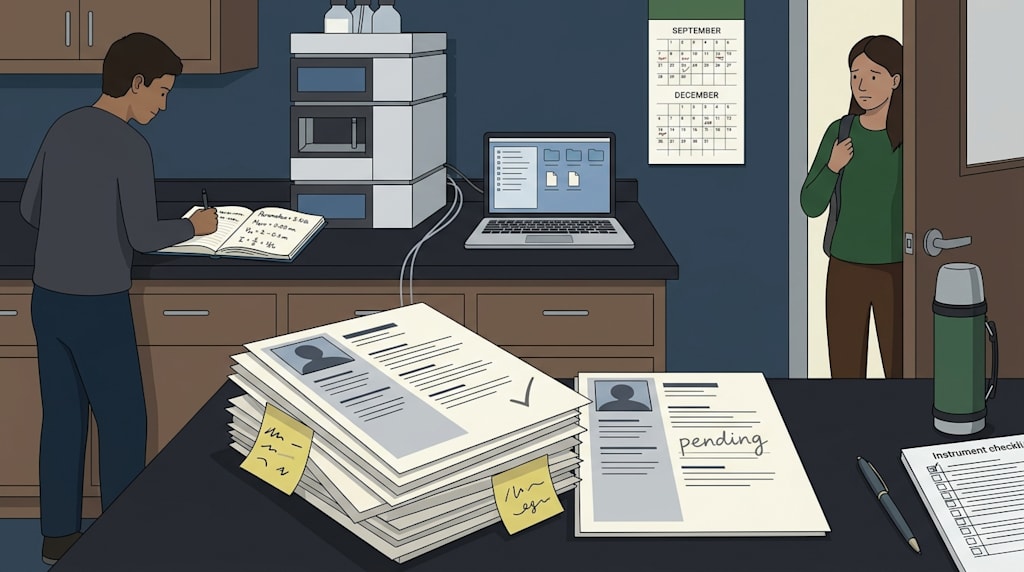
Late March, in the office after the re-examination interviews. A dozen résumés were spread across the desk. On the top one was a sticky note: recommended for admission without exam, undergraduate at a 985 university, leader of a College Students’ Innovation and Entrepreneurship project. Below it was another: postgraduate entrance exam, second place in the preliminary exam, second attempt. The supervisor moved his thermos aside and asked the young lecturer next to him, “Have you interviewed this recommended one? How are his hands-on skills?”
The young lecturer flipped two pages. “I asked. He said he’d used that liquid chromatograph, but he couldn’t explain the specific parameters.”
The supervisor grunted. He put the two résumés side by side, first drew a check mark on the recommended one, then wrote “pending” on the exam-taker’s. He checked the recommended résumé because the group needed someone to take over a senior student’s project, and this student could start in the summer. He marked the exam-taker’s pending because he had not yet found out whether the student could handle data.
Outside the office, the next batch of students was still waiting in the corridor. No one knew which résumé the pen inside would land on.
I. Who Gets Put on Top of the Stack
Which résumé a supervisor turns to first often depends on what kind of person he is short of this year. If the group needs someone to go to field sites, he first asks who has a driver’s license and who has done fieldwork. If it needs someone to write grant proposals, he first asks who has written literature reviews and who has organized data. If it needs someone to take over the senior student’s project, he first asks who has used that instrument and who can come early in the summer. Labels help at the door because they are a cheap signal: recommended students occupy slots early, their undergraduate backgrounds are verifiable, and their recommendation chains are clear. There are strong students among the exam-takers too, but the supervisor has to judge in a very short time, so school, score, and interview performance become proxy indicators.
Once the student is inside, the supervisor asks a different set of questions: Can the group-meeting slides be submitted on time? Has the literature I asked for been checked? After the instrument is turned on, can the parameters be adjusted? When the data are exported, is the naming a mess? These questions do not recognize labels.
Some supervisors prefer recommended students. Some prefer those who came in through the entrance exam, believing they can sit on a cold bench and withstand pressure. Some only want men because they need to move equipment and run field sites. Some prefer women because they think they are more careful and can sit still. Still others select by region, undergraduate school, or research experience. These preferences are not necessarily reasonable, but they are reality. Supervisors have the freedom to choose students, and students have the freedom to choose supervisors. In those twenty minutes at the interview table, the supervisor watches where your eyes drift, whether your voice has confidence, and whether you have anything in your belly. Students are also watching how fast the supervisor replies to emails, how late the group meeting runs, and what the senior students’ faces look like. Two-way selection is real.
II. Behind a Quota Are Deadlines
A recruitment quota is not an abstract honor for a supervisor. Behind it may be a research topic, a paper, a project mid-term review, a final acceptance, and a sum of funding. If he recruits the wrong person, the student can change supervisors, delay graduation, or change careers. The supervisor, however, has to face project delays, stalled projects, a worsened team atmosphere, and possibly a reluctance to recruit students in that direction for several years.
So when a supervisor selects people, he first looks at reliability and delivery. Things assigned get a response. Problems encountered get feedback. Literature can be read. Experiments can be done. Data can be organized clearly. What is written is at least readable. And the student does not create trouble when getting along with senior students. None of this sounds hard, but every year students get stuck on these most basic things.
I have seen a group where the supervisor asked in the first week of the new students’ arrival, “Who can operate that instrument?” A recommended student shook his head. The supervisor said nothing and turned to ask a senior student to train him. In the second week’s group meeting, the senior student asked him to read a paper. He asked, “Which one should I start with?” The senior student sent him the group’s paper list from the past five years. He replied “Received,” and then there was no follow-up. By the time of the thesis proposal, he was still asking, “What should I do?” By then no one remembered that he had been recommended. Everyone only knew that he was slow.
In the same group, another student who had come in through the entrance exam arrived early in the summer. The senior student asked him to help run a set of data. He took a notebook and wrote down the instrument switch order, software parameters, and file naming rules. After everyone else left that evening, he organized the raw data into a table and renamed the files as “date-sample-condition.” The next day the senior student opened the folder, paused, and said, “You’ve organized this more clearly than I do.” After that, the senior student was willing to call him when doing experiments, and the supervisor was willing to call on him when asking questions. The label did not help him. The notebook did.
III. Labels Work at the Door and Expire Once You Enter
The mistake recommended students most easily make is treating an admission ticket as a lifetime achievement. Three years of undergraduate GPA, competitions, and research, none were neglected. Being recommended should naturally mean being regarded highly. But a supervisor distributes favor according to what you deliver afterward, not according to admission tickets. Your being recommended only shows that you ran well at the undergraduate stage. Once you enter, if you cannot use the instrument, you cannot use it. If you have not read the literature, you have not read it. If you freeze when the supervisor asks you two questions, the label will not save you.
Exam-takers should not feel they have already lost either. What you lack is only a few months’ head start, not an arm or a leg. Being able to fight your way out of an exam taken by millions already proves your learning ability, execution, and pressure tolerance. What you need to do is shift the momentum from exam preparation into research mode. Before the semester starts, do not just celebrate. If you can enter the group early, enter early. If you can read the literature early, read early. From the moment you enter the group, everyone stands before the same line, and the supervisor looks at what you deliver afterward.
IV. How the Time Gap Becomes a Gap
Compared with exam-takers, recommended students have one hard advantage: the six-to-eight-month blank window after admission. Whether this advantage can be cashed in depends entirely on what you do with this period.
The recommendation system opens in September and October. Recommended students occupy the slots at that time. By the time the exam is held in December, scores come out in February, and re-examination and adjustment happen in March, many popular research groups are already full. The cause is timing and supply. A popular supervisor has two or three quotas and a mountain of résumés. Of course he prioritizes the batch that entered earliest and has the brightest background.
But if recommended students use the window to let themselves go, the gap can reverse. While exam-takers are still posting on Moments about the joy of high preliminary scores, recommended students have already settled on a research direction. While exam-takers are still asking about dormitory conditions, others are already soaking in the lab doing experiments with senior students. While you are still getting familiar with campus in September and figuring out which cafeteria window is good, others have already built the framework of their first paper. While you have just figured out what the group does in the first semester of your first year, others’ short papers may already meet the graduation requirement. The gap opens across months. It rolls out during the months you thought you could relax.
Conversely, exam-takers can catch up if they seize back the time. Enter the group early in the summer. Read through the senior students’ dissertations. Flip through the group-meeting slides. Go through the instrument list. After the semester starts, while others are still asking “Which paper should I start with?”, you can already point at a figure and say, “This direction was half done by the senior student; the data are on the hard drive.” The supervisor may not remember your exam score, but he will remember that you can pick up the conversation.
V. A Few Concrete Things
First, before the semester starts, download the group’s master’s and doctoral dissertations from the past ten years and read them one by one, taking notes on each. Look up what you do not understand yourself first, and mark what you cannot figure out. Then go through the high-level short papers published by the group in the past five years in the same way, and summarize them by research direction and timeline: What is the group’s classic direction? What is the latest direction? Who is doing what? How far have they gotten? Organize it all into a map. Once you have this map in your head, you have the group’s full atlas. Others are still groping in the fog; you already know where each road leads. Then start attending group meetings as early as possible. The information density at group meetings is higher than in papers. The latest developments, the real progress, and the supervisor’s temperament are all there.
Second, do not try to be a hero when choosing a direction. Many people want to make big news as soon as they enter and insist on choosing a brand-new direction the group has never touched. In the end most of them become cannon fodder. If a supervisor loses a student, it is not a big deal; he can recruit again. But you lose three to five years. A master’s thesis, and even most doctoral dissertations, do not require you to create the world from scratch. It is enough to stand on the shoulders of senior students and make an incremental contribution. Either keep the research object and change the method, or keep the method and change the research object. Make one approach solid. But standing on shoulders is not low-level repetition. The increment must address a real question; it cannot just be changing materials or parameters to churn out papers. Newton said he stood on the shoulders of giants. If you do not have Newton’s ability, then stand on your senior students’ shoulders first.
Third, if conditions allow, get into the lab as early as possible and help senior students do experiments and run simulations. How to use the instrument, how to prepare samples, how to process data, how to build models in software, learn them one by one until you can do them independently without the senior students. The most valuable part is data analysis. Volunteer for this work. Raw data are every graduate student’s lifeline; whoever has data sleeps soundly. While helping others analyze data, you practice the software, learn the routines, and accumulate a pile of raw data. When you do your own project, you will get up to speed frighteningly fast. But the boundaries must be clear: data ownership, authorship, and contributions should be agreed on in advance. Do not turn helping into freeloading or grabbing work. If senior students are unwilling to teach you, then keep your eyes open for work, be quick with your hands and feet, and treat people to a few good meals. The detours they have taken and the pits they have fallen into will basically come out at the dinner table. If that really does not work, go to the supervisor and honestly express your strong desire to learn. Borrow the supervisor’s mouth to arrange it. This trick works again and again.
Fourth, within two weeks of the semester starting, take the initiative to arrange a one-on-one conversation with your supervisor. Before the conversation, adjust your mindset. Do not treat yourself as a hired worker, and do not treat the supervisor as a lofty boss. A supervisor is first of all a responsible person and a resource controller. Students must first prove they are reliable, controllable, and able to deliver before talking about equal cooperation. A supervisor dreads the student who moves only when pushed and waits to be fed the whole time. Stupidity is easier to work with. When you talk, first introduce yourself: what you can do, what you are good at, what you want to do. Then take out the research context and direction thinking you organized during the vacation and explain it clearly with evidence. Even if you speak roughly, even if some of your understanding is wrong, it does not matter. What matters is that he sees your attitude and preparation. With this positive first impression as a foundation, the student-supervisor relationship will easily enter a virtuous cycle.
VI. Two-Way Selection
Supervisors select people by “can work,” but the definition of “can work” is set by the supervisor. Some supervisors want papers. Some want projects. Some want people to run field sites, move equipment, write proposals, and lead undergraduates. “Can work” does not necessarily mean strong academic ability; it may also mean obedience, stability, and resource fit. So do not treat a supervisor’s favor as a purely academic evaluation, and do not treat a supervisor’s rejection as a denial of you as a whole person.
Students are choosing supervisors too. Before the re-examination, ask the senior students: How late does the group meeting run? What day of the month is the stipend paid? How many people in the last cohort graduated on time? How fast does the supervisor revise papers? Does he yell at group meetings? These questions are far more concrete than “Do supervisors like recommended students or exam-takers?” When choosing a supervisor, look at character, resources, and advising style. Do not just think about “being favored.”
A supervisor’s favor is earned by you, paper by paper, data set by data set, all-nighter by all-nighter, with your own hands. Whether you are recommended or take the exam only determines the posture in which you enter the field. It never determines the posture in which you leave.
The stack of résumés was still on the office desk. The supervisor turned the exam-taker’s résumé to the last page and wrote a line in the remarks column: Come to the group next week and first go through the instrument list with the senior student. Then he picked up his thermos and shouted toward the door, “Next.”
About the Creator
Jin
Writer of reamstories
https://reamstories.com/jin
Enjoyed the story? Support the Creator.
Subscribe for free to receive all their stories in your feed. You could also become a paid subscriber, letting them know you appreciate their work.
Comments
There are no comments for this story
Be the first to respond and start the conversation.