
The Real Reason Lawyers Aren’t Called “Fashi”
Buddhist monks used the word first. Daoist priests borrowed it. A Qing diplomat turned it into a modern profession.
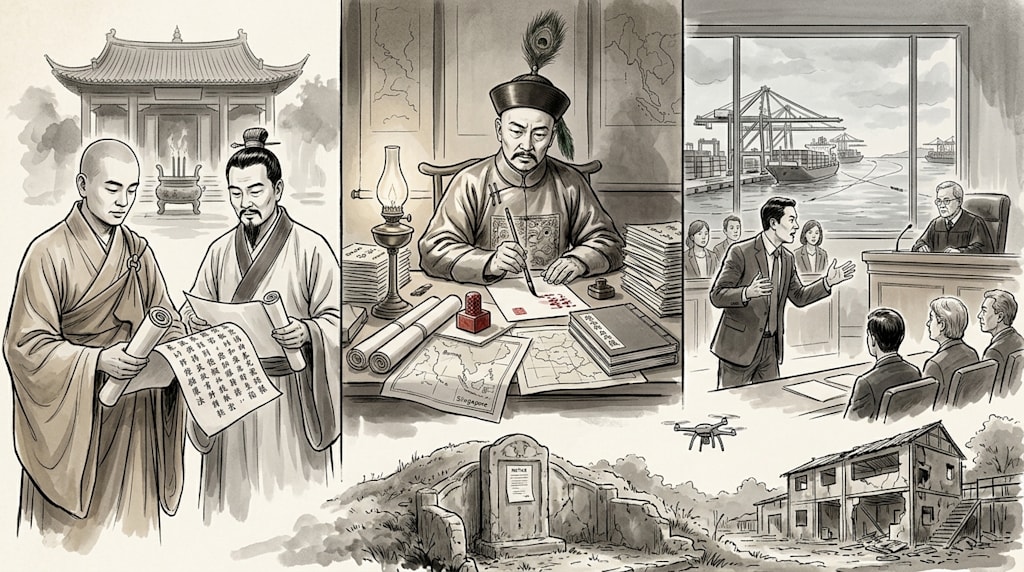
In the fourth year of Tongzhi, a man from Wuxi named Xue Fucheng was twenty-seven. He wrote a long memorial and asked to see Zeng Guofan.
He set out eight policies for governing the realm. Zeng Guofan read it and kept him in his secretariat. That year, the Taiping Heavenly Kingdom had just been crushed. Foreign warships still lay at Xiaguan, trailing black smoke over the Yangtze.
Xue Fucheng stayed with Zeng Guofan for several years, then went to Li Hongzhang. His daily work was reading provincial memorials, foreign newspapers, and customs ledgers, then writing reports for his superiors. His name did not appear on them. They were internal reference documents.
In the fifth year of Guangxu, Xue Fucheng wrote a book called Proposals on Foreign Affairs.
In it he discussed one matter: foreigners who committed crimes in China were not subject to Chinese law. If a Chinese and a foreigner committed the same crime, the Chinese was punished heavily and the foreigner lightly. If a foreigner killed someone, he often did not pay with his life. The consul sheltered him, sometimes sent him home, and the case quietly disappeared.
He gave an example. A foreigner killed a Chinese commoner. The local official wanted to try him. The consul said, This is a citizen of my country; you have no right to judge him. The man was released. The victim’s family received a little silver. They never saw the killer’s face.
Xue Fucheng said this could not continue.
He gave three reasons. First, justice was unfair, and the people’s resentment ran deep. Second, sovereignty was incomplete: foreigners lived here but were not governed by the authorities here. Third, Chinese-foreign trade was extensive. Without a reliable judicial environment, merchants would not dare do business. In today’s language, a good judicial environment is a good business environment.
He proposed a solution. Establish a Chinese-foreign court. The Qing government would appoint officials and hire “foreign lawyers” to help handle cases. The laws of both sides could be used. If necessary, Western law alone could be used.
He wrote: “The laws of the Westerners differ from ours, but the murderer dies, the thief is punished. There is no difference from our own.” Western law and our law differ, but murder requires life, theft requires punishment. Hiring foreign lawyers and trying foreigners under foreign law was still better than handing the man over to foreigners to try themselves.
The word he wrote was “foreign lawyer.”
The two characters lüshi existed long before Xue Fucheng.
When Buddhism entered China in the Eastern Han, scripture translation, preaching, ordination, and Dharma assemblies gradually produced a set of titles. Fashi, or Dharma Master, was a monk who mastered the Buddha’s teaching and could expound it. Weiyishi, or Master of Deportment, directed the rites of ordination and the movements of Dharma assemblies. Lüshi, or Vinaya Master, mastered the precepts, judged transgression and observance, and explained the discipline.
The Buddhist precepts were called lü. What counted as a violation, what counted as observance, how serious it was, how one confessed, how one was punished: all this required someone learned in the Vinaya. So lüshi meant master of the precepts.
Later Daoism borrowed this system. In the Liu-Song period of the Southern Dynasties, the Daoist Lu Xiujing set down rules for fasting and ritual. In his Writings on the Lantern of Vows, Precepts, and Punishments in the Dongxuan Lingbao Fast, he stipulated that fashi was the title of a Daoist priest who presided over ritual, converted people, and initiated them into the Dao. By the Tang, the Tang Liudian recorded that Daoist cultivators had three titles: “The first is fashi; the second is weiyishi; the third is lüshi.”
The Daoist lüshi still governed precepts. Only now they were Daoist precepts rather than Buddhist ones.
Fashi drifted toward religion and the occult. From a monk who preached sutras, to a Daoist priest who presided over ritual, to the folk image of a man who knows spells. When you say fashi, people think of a monk’s robe, a Daoist’s gown, ritual, talismans, incantations.
The character lü never changed. Buddhist precepts, Daoist precepts, state statutes all used lü. The Tang had the Tang Code with Commentary. The Ming had the Great Ming Code. The Qing had the Great Qing Legal Code. Lü meant norm, article, judgment, transgression and observance.
So when the late Qing needed to translate the Western lawyer, the word lüshi was ready at hand. Its old meaning was master of precepts. Its new meaning would be master of law. From precepts to statutes, from monastery to courtroom, the semantic bridge was already there.
Fashi would not do. It was too firmly occupied by Buddhism, Daoism, and folk religion. Songshi, or litigation master, would not do either. In ancient China, litigation masters wrote petitions, gave advice, and helped people go to court. Their social standing was low. Officials suppressed them. Common people called them “litigation sharks.” Modern lawyers have legal qualifications, courtroom defense, representation, professional ethics, confidentiality, and disciplinary mechanisms. They are not the same as ancient litigation masters.
So the late Qing chose lüshi. An old bottle for new wine.
In the fifteenth year of Guangxu, Xue Fucheng was fifty-one. The Qing government gave him the second rank of officialdom and appointed him minister to England, France, Italy, and Belgium.
When he first set foot on French soil, he finally saw how Western society worked. He went to watch lawyers in court.
In the courtroom, lawyers stood before the jury. They questioned witnesses one by one. They cited statutes one by one. The judge sat above, heard both sides argue, and only then gave judgment. Xue Fucheng wrote in his diary that when Westerners try a case, both parties have lawyers, each for his own side. After the debate, the judge strikes the balance.
He thought of the yamen in the Great Qing. The county magistrate sat in the hall. Both parties knelt below. The legal secretary stood to one side. The petition was handed up. The magistrate read it and ruled. No lawyers, no debate, no jury.
He wrote a great deal in Diary of My Mission to Four Countries. Later, Kang Youwei and Liang Qichao read it. It became one of the intellectual sources of the reform movement.
Xue Fucheng did not only write a diary. He once did the work of a lawyer on behalf of the Qing.
In the twentieth year of Guangxu, in London, he negotiated the Yunnan-Burma boundary. The British wanted to draw the line. Xue Fucheng cited the law of nations and argued point by point. He signed the Convention Between Great Britain and China Respecting the Boundary and Trade of Burma, recovering some border territory and preventing Britain from pushing directly into the interior of Yunnan.
He also cited the law of nations on the protection of overseas subjects and negotiated with Britain. A consulate was established in Singapore. It became a well-known case of a Qing diplomat defending rights by law.
He did not hire foreign lawyers in China to try foreigners. But he used the law of nations on foreign soil and won a foreign lawsuit.
In the twentieth year of Guangxu, Xue Fucheng completed the boundary negotiations in London, gave up his post as minister, and returned home. The ship reached Shanghai. He fell ill and could not rise. Then he caught an epidemic and died. He was fifty-seven.
In July of that year, the First Sino-Japanese War broke out.
Before he died, he wrote three documents. One was A Memorial on the Conclusion of the Yunnan-Burma Boundary Affairs. One was A Memorial Requesting the Establishment of a Consulate in Singapore. One was A Memorial Requesting Leave to Return Home Upon Completion of My Mission.
In the last, he asked the Guangxu Emperor to relieve him of his post and reported on his four years abroad. He summed up the general trend of the European powers. The foundation of Western wealth and strength lay in industry and commerce, legal institutions, and parliaments, not merely in ships and guns. He reminded the court that the powers surrounded China, that the changes were immense, and that reform and self-strengthening were necessary.
What happened afterward everyone knows. The reform failed. The Qing government did not build a rule-of-law state. Xue Fucheng did not push the Qing government to stop buying guns and ships and to value industry and commerce. The Qing’s guns and warships did not sink Japanese ships.
Extraterritoriality was not solved in Xue Fucheng’s lifetime. It could not be pushed through. This was not only because the powers were strong. The conservative mentality of his own people meant that the internal forces that could support his actions were extremely limited.
Later, the late Qing tried reform in exchange for the powers’ agreement to hand back judicial authority. In 1902, for example, Britain promised in a Sino-British treaty that if China’s laws and judicial system were improved, it would give up extraterritoriality. It was only words. Nothing came of it.
It was not until the Republican period that Germany, defeated in the First World War, lost its consular jurisdiction in China. Later, when the Second World War broke out and the Republic of China joined the Allies, Britain and the United States gave up their consular jurisdiction in China. Other countries followed.
Nearly a century passed. Then we had Made in China, the WTO. Our merchants went to foreign lands to do business, hiring foreign lawyers or Chinese lawyers. Foreign merchants coming to China had to consider whether to hire Chinese lawyers to take part in transactions.
Today we need to build a good judicial environment so that merchants dare to trade. A good judicial environment is a good business environment.
Xue Fucheng, a second-rank official, never realized the Qing government’s recovery of extraterritoriality. His plan did not land. But his thought had meaning.
Xue Fucheng did not hire foreign lawyers in China to try foreigners’ cases. But he cited the law of nations and won a foreign lawsuit on foreign soil.
Xue Fucheng did not complete legislation. But the times, through changes he could not foresee, let his thought take root, sprout, and finally run through by another road.
Xue Fucheng’s tomb is in Longsi Ecological Park, on the eastern slope of Junzhang Mountain, Binhu District, Wuxi, Jiangsu. It is a municipal cultural relic protection site. The surviving structure is three brick-and-wood rooms facing south, with a late Qing Wuxi magistrate’s protection notice embedded in the wall.
In 2013, an illegal tea-processing factory was built within the protection zone. It completely cut off the tomb area from the funeral hall and sealed the hall. In June 2018, the Binhu District People’s Procuratorate of Wuxi filed a case, used drones to collect evidence, and issued a procuratorial recommendation to the relevant departments. In June 2019 the illegal structures were demolished. In August 2020 the restoration was completed, and the historic appearance was recovered. The case was later listed by the Supreme People’s Procuratorate as a typical case of public-interest litigation for the protection of cultural relics and cultural heritage.
A man who once strove for judicial sovereignty, a century later, needed the law to protect his tomb.
Why is a lawyer not called fashi? Because fashi belongs to Buddhism and Daoism, while lüshi belongs to statutes and law. The word lüshi carries more than a profession. It carries the memory of a man writing by lamplight in Proposals on Foreign Affairs. It carries a fifty-seven-year-old man in a London courtroom. It carries an era trying to guard itself with law.
Xue Fucheng did not live to see extraterritoriality abolished. But the “foreign lawyer” he wrote down later became “Chinese lawyer.” He did not build a rule-of-law state. But in courtrooms today, lawyers still argue.
The tea factory in front of the tomb is gone. The funeral hall has been repaired. The notice is still there.
About the Creator
Jin
Writer of reamstories
https://reamstories.com/jin
Enjoyed the story? Support the Creator.
Subscribe for free to receive all their stories in your feed. You could also become a paid subscriber, letting them know you appreciate their work.
Comments
There are no comments for this story
Be the first to respond and start the conversation.