
The Quiet Resignation
Why Your Best People Leave Without Saying Goodbye

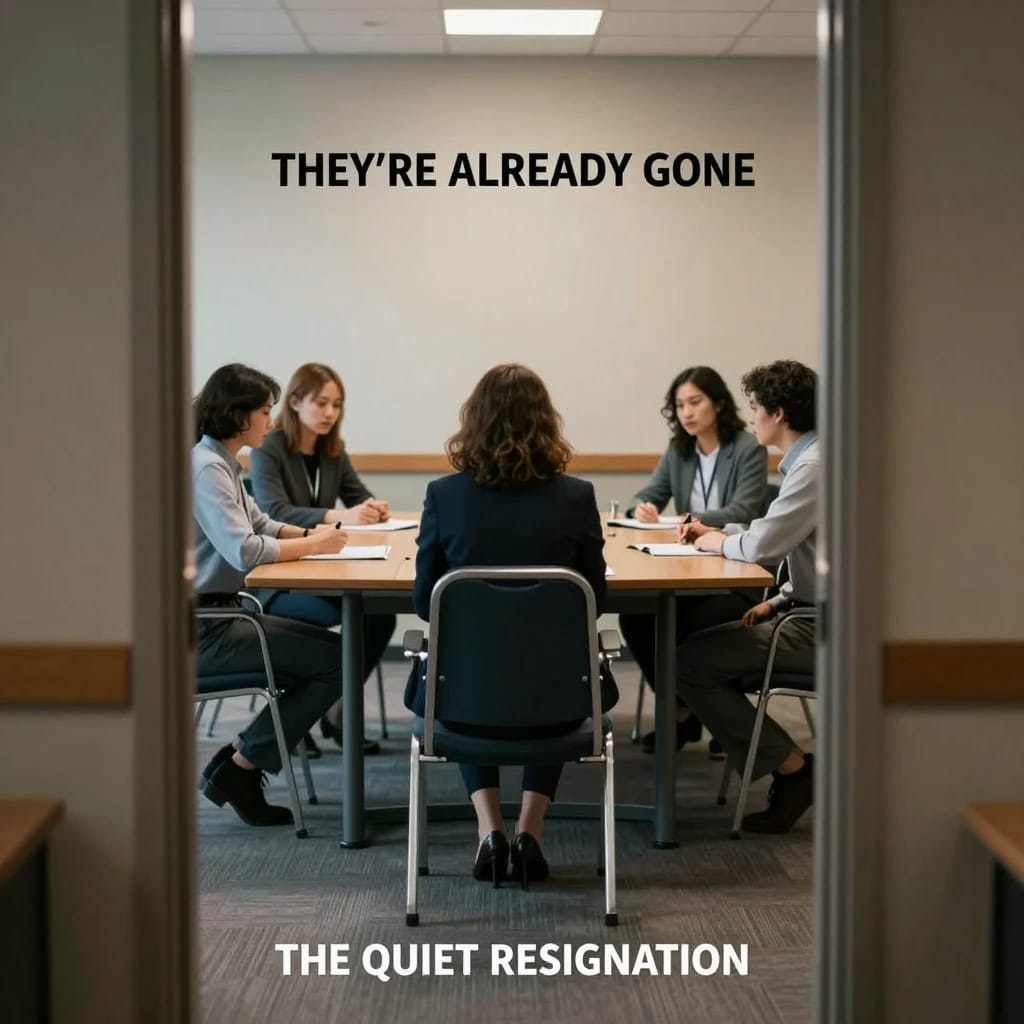
It's not burnout. It's not quiet quitting. It's something far more deliberate — and far more dangerous for teams who don't see it coming.
The Friday That Wasn't Surprising — Except to the Boss
Sarah closed her laptop at 4:47 PM on a Friday. She'd just shipped the quarterly report two days early. Her Slack status read "Out Monday — dentist." She'd set it three weeks ago, the same day she accepted an offer from a competitor she hadn't told anyone she'd been interviewing with.
Monday morning, her manager found a resignation letter in his inbox. Polite. Professional. Two weeks' notice. Standard.
He was stunned. Her team was devastated. The CEO, when she heard, called an emergency leadership meeting. "How did we not see this coming?" she asked the room.
The answer was simple: they weren't looking for it. And Sarah had spent eight months making sure they wouldn't.
This is the Quiet Resignation. Not the dramatic exit of a burned-out employee screaming into the void. Not the passive disengagement of quiet quitting. This is something else entirely — a deliberate, strategic, almost invisible departure planned and executed by high performers who are still, paradoxically, doing excellent work until their very last day.
They're not angry. They're not checked out. They're simply done. And they've been done for months while you thought everything was fine.
The Warning Signs Nobody Tracks
If you manage people, you've been trained to watch for disengagement. Missed deadlines. Dropped quality. Attitude shifts. Visible frustration. These are the red flags HR manuals warn about.
But the Quiet Resignation doesn't look like disengagement. It looks like peak performance — just... final.
Here's what actually happens in the six months before a high performer leaves quietly:
The Documentation Obsession
They start documenting everything. Processes that lived in their head suddenly get written down. Training materials appear. Handoff notes get drafted "just in case." To a manager, this looks like leadership growth. It's actually estate planning.
The Relationship Cooling
They stop fighting for things. The project they used to advocate passionately for? They'll accept the budget cut. The team structure they argued against? They'll nod and implement it. This isn't flexibility — it's emotional divestment. They're no longer trying to fix the organization because they've accepted they're leaving it.
The "Future" Language Disappears
Listen to how they talk about timelines. High performers still committed to a company use "we" language about next quarter, next year, the roadmap ahead. Those quietly resigning shift to "you" or "the team." They'll say "you guys should consider" instead of "we should." They stop booking conferences six months out. They don't volunteer for multi-quarter initiatives.
The Reference Maintenance
They reconnect with old colleagues. They update LinkedIn — subtly, not dramatically. They take coffee meetings they used to decline. They're not networking aggressively; they're warming up relationships they'll need in their next chapter.
Managers miss these signals because high performers are good at their jobs. They don't want to be managed out. They don't want drama. They want to leave with their reputation intact, their references glowing, and their bridges unburned. So they perform until the end. They just perform without the emotional investment that used to fuel the excellence.
Why High Performers Leave Quietly
Understanding the psychology behind the Quiet Resignation is essential for both preventing it and executing it well. There are four core drivers:
1. Professional Reputation Protection
High performers know their network is their net worth. They've spent years building credibility. The last thing they'll do is torch it with a dramatic exit, a Glassdoor rant, or a viral LinkedIn post about how toxic their workplace was. They understand that industries are smaller than they look, and that the manager they're frustrated with today might be at a company they want to join in five years.
They leave quietly because their reputation is a long-term asset they're not willing to depreciate for short-term emotional satisfaction.
2. Emotional Exhaustion from "Fixing"
This is the most common and least understood driver. Most high performers don't leave because they were never engaged — they leave because they were too engaged. They spent months or years trying to improve processes, advocate for their team, push back on bad decisions, and elevate standards. They burned political capital. They had hard conversations. They cared deeply.
And when nothing changed, they didn't get angry. They got tired. The Quiet Resignation is often the final stage of change fatigue. It's not "I hate this place." It's "I've tried everything I know how to try, and I'm out of ideas."
3. Strategic Patience
High performers are planners. They don't rage-quit because they can't afford to. They wait for the bonus to vest. They time their departure to avoid leaving their team in a critical crunch. They line up their next role before they pull the trigger. They calculate notice periods, project cycles, and financial runway.
This patience makes their departure invisible. They're not acting out. They're acting normal — while executing a plan.
4. The Identity Cost of Leaving Loudly
For people who've built their identity around being good at their job, leaving dramatically feels like admitting failure. The Quiet Resignation allows them to maintain a narrative of control: I didn't leave because I couldn't handle it. I left because I chose something better. This identity protection is powerful. It lets them frame the exit as a strategic upgrade, not an escape.
The Organizational Cost Nobody Measures
The Quiet Resignation is expensive in ways that don't show up on exit interview forms or turnover reports.
The Knowledge Vacuum
When a high performer leaves quietly, they take with them not just skills but context. The undocumented client relationships. The historical reasoning behind current processes. The intuition for what will and won't work. Because they documented the mechanics but not the judgment, their replacement inherits a manual without a mind.
The Morale Contagion
When the obvious complainer leaves, the team shrugs. When the rock — the person who always delivered, always stayed calm, always figured it out — leaves without warning, it destabilizes everyone. If they couldn't make it work, what chance do I have? The Quiet Resignation triggers a silent crisis of confidence that managers rarely detect until three more people start updating their LinkedIn profiles.
The Management Credibility Hit
When a top performer leaves quietly, it signals that leadership was out of touch. Other employees notice. They wonder: If they didn't know about Sarah, what else don't they know? This erosion of trust is gradual but real, and it affects engagement long before it affects retention.
For Managers: The Prevention Playbook
You can't stop every departure. But you can stop being surprised by them. Here's how to spot and prevent the Quiet Resignation:
Institute "Retention Risk" 1-on-1s
Separate from performance reviews. Separate from project updates. A monthly 30-minute conversation with one question at its core: "What would need to be true for you to want to be here in two years?" Not "What do you want to do next?" — that's a career conversation. This is a commitment conversation. It forces you to listen for what they're not getting, and it signals that you care about their future with the company, not just their output for the company.
Watch for the Estate Planning Phase
When someone starts documenting everything, don't just praise them. Ask: "This is great — what's prompting you to systematize this now?" Sometimes the answer is genuine leadership growth. Sometimes it's a test. Either way, you learn something.
Conduct "Stay Interviews"
Don't wait for exit interviews to ask why people stay. Ask your best people: "What keeps you here? What would make you leave?" Do this when they're happy, not when they're restless. The answers you get in month 12 are far more useful than the answers you'll get in month 22, when they're already mentally halfway out the door.
Map the "Fixer Fatigue"
If someone has been your go-to problem-solver, check in on their emotional bandwidth. "I know you've been carrying a lot of the improvement work — how are you feeling about the progress?" Acknowledge the effort. Validate the frustration. If they're burning out on fixing, you need to know before they decide the only fix left is their own departure.
For Employees: The Art of Leaving Well
If you're considering your own Quiet Resignation, there's a way to do it that protects your future while honoring your present. Here's the 90-day protocol:
Days 1–30: The Decision Phase
- Confirm your next step (new role, sabbatical, pivot — know what you're leaving for, not just what you're leaving from)
- Financial runway check: Can you survive 3–6 months if the next thing takes time?
- Reference audit: Who will speak for you? Have you maintained those relationships?
Days 31–60: The Transition Phase
- Begin documentation (not suspiciously, but thoroughly)
- Take on no new long-term commitments
- Reconnect with external network (coffee, not job-seeking language)
- Update LinkedIn subtly — skills, not "Open to Work"
Days 61–90: The Exit Phase
- Give notice with gratitude, not grievance
- Offer a transition plan, not just a date
- Complete handoffs with excellence (your last project is your first reference call)
- Exit interview: honest but diplomatic. This isn't your TED Talk. It's your closing statement.
The Golden Rule of Quiet Resignation
Leave in a way that lets you come back — not to this job, but to these people. Industries are small. Reputations are long. The way you exit is the first chapter of your next story.
The Reframe: Why This Is a Maturity Signal
The Quiet Resignation isn't a betrayal. It's not a failure of management or a flaw in employee loyalty. It's a maturity signal in both directions.
For the employee, it signals professional self-awareness: I know what I need, I know this isn't it, and I know how to move without destruction.
For the manager, it signals a gap in emotional intelligence: I was measuring output when I should have been measuring commitment.
The best teams aren't the ones where nobody leaves. They're the ones where departures are seen coming, prepared for, and even celebrated — because a team that can handle someone leaving well is a team people want to stay with.
The worst teams? They're the ones where the quarterly report ships two days early, the Slack status says "Out Monday — dentist," and the manager spends the next six months wondering why he didn't ask Sarah what she needed before she decided to get it somewhere else.
About the Creator
Muhammad Sabeel
I write not for silence, but for the echo—where mystery lingers, hearts awaken, and every story dares to leave a mark
Enjoyed the story? Support the Creator.
Subscribe for free to receive all their stories in your feed.
Comments
There are no comments for this story
Be the first to respond and start the conversation.