
The Pressure You Can’t Name Is the One That Drains You
A time coach’s case study on turning vague workplace anxiety into one hour of work
1. The Project He Delayed for Two Years
I had a client, a university teacher, who had delayed an annual research project for two years.
He paid several thousand yuan to work with me as a time coach. In our first meeting, he talked about his child’s college entrance exam. In the second, he talked about his wife’s complaints. In the third, he talked about a new research topic from a partner institution. He would not talk about the project.
In our fourth conversation, he finally said: “I bought a little more time for that project. What exactly should I do?”
I asked what made him most anxious.
He said he could not name it. He felt he should be doing the project, but he kept not doing it. Every time he thought about it, he got irritated. When he sat at the computer, he did not know where to start.
Many people know that feeling. You think you should do something, but you do not know how. You may not even know what. All you know is that you are annoyed, tired, and ready to bolt.
That kind of anxiety does not build skill. It drains energy. It has no shape, no boundary, and no endpoint. You cannot act on it. You can only chew on it.
2. Two Kinds of Gaps
Pressure starts with a gap between what you want and what is real. The gap needs work before it closes.
There are two kinds of gaps.
The first is concrete.
Your boss asks for a report. You know what to do: write the report. A client changes the requirements. You know what to do: follow the new requirements. Your mortgage is due at the end of the month. You know what to do: find a way to earn money.
That is explicit pressure. You know what the gap is. You know what to do. You know when it will end.
Explicit pressure gives you a task list. It is tiring, but you know where the next step is.
The second gap is vague.
“I feel I am not good enough.” What is the gap? I do not know.
“I feel everyone is stronger than me.” What should I do? I do not know.
“I feel my approach may be wrong.” When will this end? I do not know.
That is hidden pressure. You do not know what the gap is. You do not know what to do. You do not know when it will end.
Explicit pressure gives you action instructions. Hidden pressure gives you anxious feelings. Explicit pressure makes you act. Hidden pressure makes you spin.
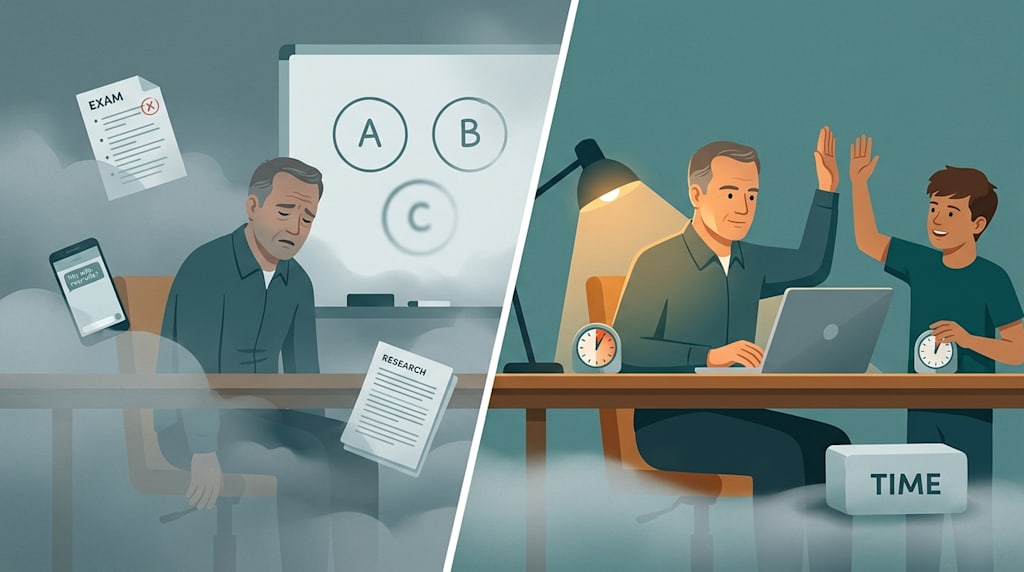
Back to my client. On the whiteboard, there were three things:
A: the project milestone his boss was pushing.
B: the family responsibilities his wife expected him to shoulder.
C: the project no one was pushing, but he knew he should do.
A and B had people pushing him. They had endpoints, and he knew what to do. C had no one pushing him, but he knew he should do it.
What was this “should”? It was vague anxiety. “I should finish the project.” “I should work harder.” After handling A and B yesterday, he was already tired and found it hard to do C. Today would probably be the same. Over months and years, C remained undone, and the cost showed up. He felt he had missed opportunities. Late at night, when he thought about the expected dream falling apart, the pressure became intense.
What made it worse: he did not know what to do today, how much would count as done, or what would happen after it was done.
His anxiety was vague, so his action was paralyzed. He avoided the project every time. He did not forget it. The fading, vague C was harder to face than A and B. At least with A and B, he knew what to do.
3. Why Anxiety Turns Vague
Hidden pressure stays hidden because three things cover it.
Peer pressure. A colleague gets promoted. A friend buys a house. Someone on social media is traveling the world. You feel anxious. But what are you anxious about? You do not know. You only know everyone seems stronger than you. You do not know what you want, what to do, or how much success would count as success.
Ten thousand people can show you a hundred thousand lives you want. Comparison has no finish line, so anxiety never ends.
Comparing with yourself. Last year you earned 1 million yuan. This year you earned 900,000. You worry that you are regressing. Yesterday you memorized 10 words. Today you memorized 10 more, and you feel you have not grown.
What does this anxiety point to? You do not know. You only know you are still not good enough. You do not know what “good enough” means.
The executive coach Dan Sullivan describes the difference between Gap thinking and Gain thinking in his book The Gap and The Gain. Most people use Gap thinking. They look at how far they are from their ideal and from other people. That gap always exists, so they always feel anxious. Successful people use Gain thinking. They look at progress already made.
This year you earned 900,000. Over the past two years you earned 1.9 million. That is Gain. Sullivan’s method is simple. For most people, the goal is the horizon. The faster you run, the farther it retreats. You never catch it. For successful people, the goal is a milestone. It can be measured. It has a beginning and an end.
Gap thinking makes you anxious. Gain thinking makes you act.
Path dependency. You thought you had mastered the pattern of success: study hard, get into a good university, find a good job, buy a house, get married. Then you discover that path no longer works.
What are you anxious about? You do not know. You only know your method may be wrong. You do not know what the right method is. This anxiety makes you doubt everything. Was my past effort wasted? Is my current choice wrong?
The only way to break this anxiety is action. Edison said he had not failed ten thousand times. He had proved ten thousand methods that did not work. The antidote to path dependency is not to think everything through before setting out. It is to test with small actions.
4. When Pressure Breaks You and When It Builds Skill
“Pressure makes people grow” is only half true.
Pressure itself is not nourishment. The ability to process pressure, plus the ability to recover, is the nourishment. The same pressure makes some people stronger and breaks others. Several variables sit in between.
Clarity. Can you define the gap? A problem that can be named can possibly be solved. “My boss is pushing for a report” is explicit pressure. Writing the report is enough. “I feel I am not good enough” is hidden pressure. You do not even know what the gap is. Pressure that cannot be acted on most easily turns into internal friction.
Control and autonomy. Do you have a little room to choose? With the same overtime, you may be able to decide which part to do first, what standard to meet, and when to ask for help. Then pressure is more likely to become skill. If goals keep changing, evaluation is vague, and you can only react passively, exhaustion is more likely.
Match between ability and challenge. A challenge that is just beyond reach is growth. One that is permanently out of reach is a blow. Moderate challenge plus support is the growth zone. High challenge, low support, and no recovery is the collapse zone.
Feedback. Is there small feedback? Doing one hour of project work every day, even if you advance only a little, produces the feedback “I am moving.” A long-term “should do” with no feedback only builds helplessness.
Social support and psychological safety. Can you ask? Can you seek help? Are mistakes accepted? Hidden pressure often comes from the self-judgment “no one is pushing me, but I should.” If the organizational culture is also vague and full of internal competition, people easily internalize management problems as self-attack.
Recovery and boundaries. Do you recover after pressure? Growth is pressure, recovery, and challenge again. Without sleep, boundaries, and rest, pressure only erodes cognition and emotion.
Meaning and attribution. Do you explain pressure as “I am becoming stronger,” or as “I am not good enough, so I deserve this”? The first leads to action. The second leads to shame and internal friction.
Do not romanticize hidden pressure. Some hidden pressure is not a problem of personal processing ability. It is an organizational problem: vague leadership goals, unclear responsibilities, overtime competition, opaque evaluation. What individuals can do is clarify upward, set boundaries, record output, ask for help, and assess the environment. If there is long-term high consumption, low support, and no feedback, changing the environment is also a solution. Attributing structural problems entirely to “I do not know how to transform pressure” is a toxic story.
5. Turn Vague Anxiety into Concrete Action
The next question is practical. How do you turn vague anxiety into concrete action?
Step one: write the anxiety down.
Take a piece of paper and write down what you have been anxious about recently. Not explicit pressure like “my boss is pushing the schedule.” Write the vague anxieties: “I feel I am not good enough,” “I feel everyone is stronger than me,” “I feel my method may be wrong.”
By writing it down, you turn hidden pressure into explicit pressure. The process of writing turns vague feelings into concrete words.
“I feel I am not good enough” becomes “I feel my public speaking skills are not good enough.”
“I feel everyone is stronger than me” becomes “I feel my colleague Xiao Wang communicates better than I do.”
The anxiety becomes concrete.
Step two: move from Gap to Gain.
Ask yourself two questions.
Question one: What do I actually want? This is your Gap. Not “what should I want.” Not “what others think I should want.” What do you actually want? For example: “I want to give a successful presentation at the annual meeting.” “I want to learn the way Xiao Wang speaks that makes people comfortable.”
Question two: What do I already have? This is your Gain. Do not only stare at the gap. For example: “I have already presented three times at department meetings.” “Last time I communicated with a client, the other person said I was very professional.”
Gap makes you anxious. Gain makes you act.
Step three: turn the goal into today’s action.
Set a small action, not a big goal.
Do not say “I want to improve my public speaking.” Say “Tonight from 8 to 9, I will practice a three-minute self-introduction once.”
Do not say “I want to learn Xiao Wang’s way of speaking.” Say “This week I will observe Xiao Wang speaking three times and note down his wording.”
The move here is to shift anxiety from result to process. Vague anxiety focuses on results: I am not good enough, others are stronger than me. Concrete action focuses on process: what do I do today, what do I practice today. Results are vague. Processes are concrete.
Last year you earned 1 million yuan. This year you earned 900,000. Gap thinking says, “I earned 100,000 less this year. Where did I go wrong?” Gain thinking says, “In this environment, my performance is basically stable, and large orders accounted for 90% this year.” The first makes you anxious. The second makes you grounded.
6. What He Did Next
After I drew the diagram, he was quiet for a long time.
Then he said: “I understand. I have been anxious about ‘I should do the project,’ but I never thought about ‘what should I do today.’”
“Since the anxiety is vague, no wonder the action is paralyzed.”
He asked: “So what should I do now?”
I said: “Tonight from 20:00 to 21:00, just work on the project. Do anything. Even just open the document and look at it. Write something aimlessly. When the time is up, stop.”
A week later, he told me: “I have been doing a little project work every night for five days. Even though it is only one hour a day, I am no longer anxious.”
I asked why.
He said: “Because I know what I am doing. It is no longer ‘I should do the project.’ It is ‘I did one hour of project work today.’ My anxiety has become concrete, and my action has become concrete.”
Then he added: “By the way, things with my son have changed too. During that one hour of project work, my son and I do paired Pomodoro sessions. When the timer rings, we high-five. I used to worry a lot about his state, but now I find he is actually studying quite happily. Seeing me so focused, we went from fellow sufferers to comrades-in-arms. My wife says she wants to sign up too.”
7. Three Moves You Can Make Today
Write the anxiety down. Take a piece of paper and write down what you have been anxious about recently. By writing it down, hidden pressure becomes explicit pressure.
Move from Gap to Gain. Do not only stare at the gap, at how far you still have to go. Look at what you already have, at what you have already achieved.
Turn the goal into today’s action. Set a small action, not a big goal. Do not say “I want to finish this project.” Say “Tonight from 8 to 9, I will work on this thing, and stop when the time is up.” Twenty-five minutes is fine. One hour is fine. What matters is not how much you do. What matters is that you start.
Is hidden pressure growth or internal friction? It depends on whether you can turn vague anxiety into concrete action.
Vague anxiety makes you drain yourself. Concrete action makes you grow.
One more thing. If the environment is vague, high-pressure, and low-support for a long time, do not rush to blame yourself for not knowing how to transform it. Clarify what you can. Break things down. Act. Ask for help. Set boundaries. If none of that works after you have done it, leaving is also a clear-headed form of growth.
About the Creator
Jin
Writer of reamstories
https://reamstories.com/jin
Enjoyed the story? Support the Creator.
Subscribe for free to receive all their stories in your feed. You could also become a paid subscriber, letting them know you appreciate their work.
Comments
There are no comments for this story
Be the first to respond and start the conversation.