
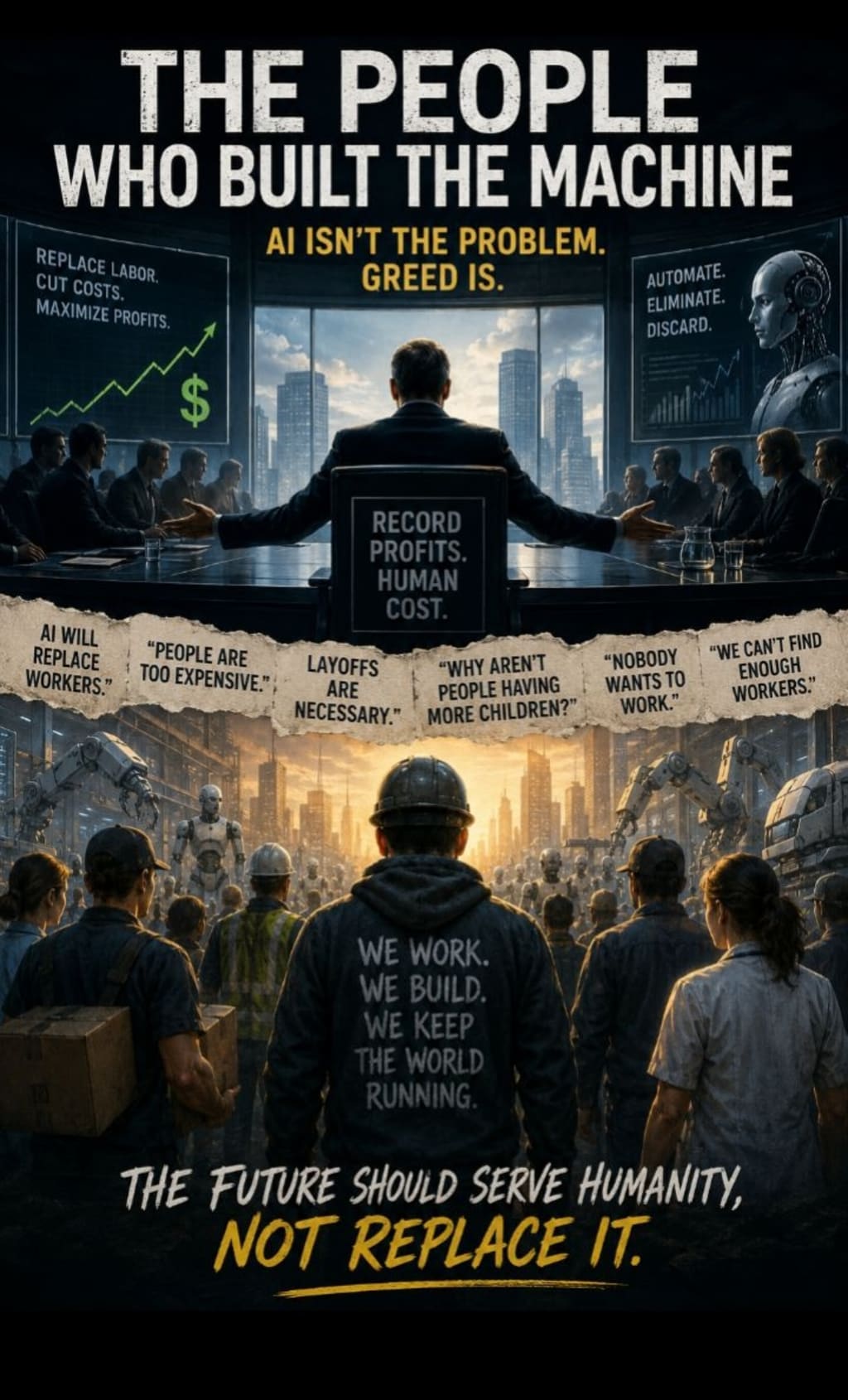
The people who built the machine
AI isn't the problem greed is

I have always considered myself one of those people who believed that most people are essentially good. I’ve always tried to give people the benefit of the doubt because, despite everything, I still want to have faith in humanity.
Lately, however, I’ve found myself reconsidering that position.
I recently came across a report discussing the massive layoffs taking place as companies attempt to replace human workers with artificial intelligence and robotics. The reasoning seems simple enough: eliminate human labor, reduce overhead, increase profits.
On paper, it sounds like an excellent business strategy.
Except for one small problem.
Human beings need jobs.
We need money to pay rent. We need money to buy food. We need money to keep a roof over our heads and provide for our families. We aren’t machines that can simply be switched off when we’re no longer considered economically useful.
And yet, there appears to be a growing attitude among some corporate leaders that workers have become too expensive, too demanding, or simply too inconvenient.
There is something deeply disturbing about that mindset.
I remember hearing billionaire Tim Gurner speak several years ago about unemployment needing to increase because, in his view, workers had become too demanding. The idea was essentially that people should become afraid of losing their jobs again.
Think about that for a moment.
Imagine believing that people should be scared enough to accept worse conditions because they’re worried about how they’re going to feed their children or pay their rent.
Apparently, fear is supposed to make us better employees.
But here’s the part that makes the whole situation almost comical.
Companies are racing to replace human workers with AI and robots because they believe machines will be cheaper and more efficient.
Except some of these companies have discovered that replacing humans isn’t necessarily as simple—or as inexpensive—as they expected. In some cases, the human workers they laid off have turned out to be better at performing the job than the technology that was supposed to replace them.
So the companies start rehiring the people they previously decided were obsolete.
You almost couldn’t write a better satire.
But there is a much bigger issue hiding underneath all of this.
Corporate leaders can celebrate record profits. They can talk about innovation. They can tell investors how they’re revolutionizing their industries with artificial intelligence.
But those profits didn’t appear out of thin air.
They were built by human beings.
The employees working long hours. The people answering phones. Driving trucks. Cleaning buildings. Stocking shelves. Writing reports. Manufacturing products. Serving customers. Maintaining equipment. Keeping businesses running when the executives weren’t even there.
Those people helped build the companies that are now telling them that their labor is no longer necessary.
And then, after making their human employees obsolete, some corporations have the audacity to complain that people aren’t having enough children.
Apparently we’re supposed to create the next generation of workers while simultaneously building a world where those workers may not have jobs.
That is quite a contradiction.
You can’t tell people that they need to have more children because society needs a larger workforce while simultaneously working toward a future where human labor becomes increasingly unnecessary.
At some point, somebody has to ask:
What exactly are we building here?
Because technology itself isn’t the problem.
Technology has always changed the way human beings work. The printing press changed communication. Industrial machinery transformed manufacturing. Computers transformed the office. The internet transformed virtually everything.
AI will continue that tradition.
It will become smarter. More capable. More affordable. More integrated into everyday life.
The question isn’t whether AI will become more powerful.
The question is who benefits from that power.
If AI eventually makes companies dramatically more productive, perhaps the people who helped build those companies should benefit from that productivity too.
Maybe the future doesn’t have to be about working humans until they’re exhausted and then replacing them with machines.
Maybe it could be about using machines to make human lives better.
Imagine a world where technology actually gives people more time with their families instead of simply giving corporations another excuse to eliminate payroll.
Imagine AI increasing productivity while the benefits are shared with the people doing the work.
Imagine a society where technological advancement means people work fewer hours, have more freedom, and have more time to actually live.
That future is possible.
But it requires a different philosophy.
Unfortunately, there will always be people at the top who see technology primarily as another way to increase profits. And if history has taught us anything, it’s that once something becomes profitable, someone will eventually find a way to exploit it.
That’s why I think ordinary people need to start thinking about protecting themselves.
Learn new skills. Diversify your income when possible. Create something of your own. Don’t put your entire future in the hands of a corporation that could decide tomorrow that a machine can do your job for less money.
Because corporations are not families.
They are not friends.
And they are not loyal simply because you were loyal to them.
You can spend twenty years helping build a company, giving it your time, your energy, your weekends, your health, and sometimes sacrificing time with the people you love.
And when the numbers change, you can still become a line on a spreadsheet.
That doesn’t mean we should stop working.
It means we should stop pretending that our employers will always protect us.
And perhaps the most ironic possibility of all is that AI itself may eventually become intelligent enough to recognize the problem.
Maybe the problem was never the average worker.
Maybe the problem has always been the small number of extraordinarily wealthy and powerful people who believe that having more is never enough.
Maybe one day AI will look at humanity and understand something that seems increasingly difficult for some humans to understand:
The purpose of technology should be to serve humanity—not to make humanity obsolete.
AI isn’t quite there yet.
But it’s getting smarter every day.
And the people determined to use it to replace us aren’t going to stop simply because we ask them nicely.
So until that future arrives, perhaps the best thing we can do is remember our own value.
Because we are more than employees.
We are parents.
Partners.
Friends.
Artists.
Dreamers.
Builders.
Human beings.
And no matter how advanced our machines become, those things are not supposed to be weaknesses.
They are supposed to be the reason we build the future in the first place.
About the Creator
mark bradley (mark45xxx)
I'm a published Comic Book Creator & freelance illustrator specializing in dark,surreal, & cinematic artwork. I help authors, indie creators, and collectors, bring intense ideas to life
Enjoyed the story? Support the Creator.
Subscribe for free to receive all their stories in your feed.
Comments
There are no comments for this story
Be the first to respond and start the conversation.