

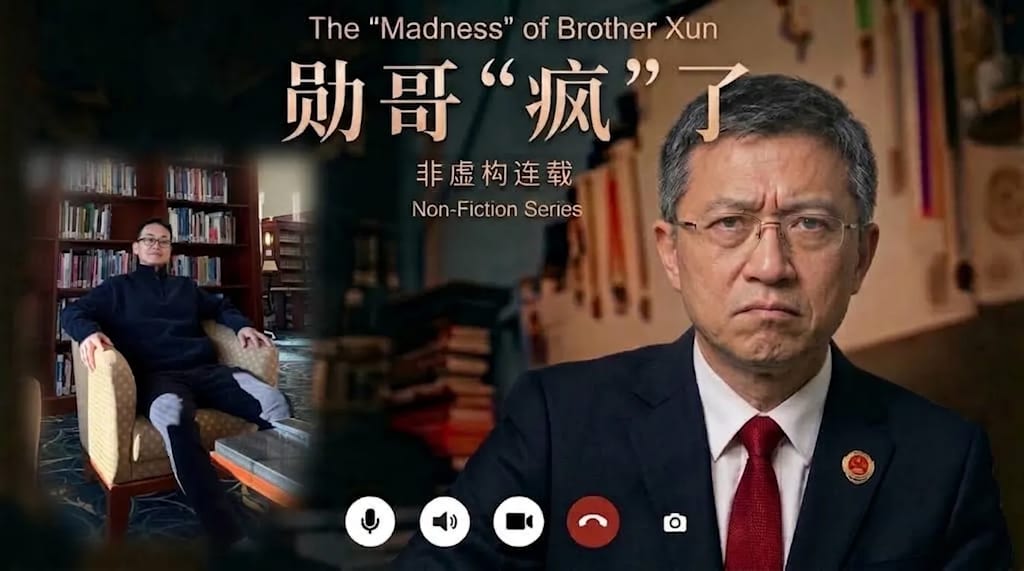
💡 中文原版: 点击此处阅读中文版
This is a work of narrative nonfiction based on real events.
Every person sitting in the courtyard that night came from a medical background. So, I cleared my throat and began telling the story carefully, from the very beginning. It was a patient’s story I had carried in my memory for over twenty years.
At first glance, it was simply an intriguing, difficult case. But only much later did I realize that while some medical conditions have clear diagnoses, certain human heartaches offer no easy answers.
It was 2002. I was working in the Department of Neurology when I admitted a patient around sixty-five years old.
The old man had been a lifelong bachelor. The family members accompanying him were his three adopted sons. His condition was bizarre: his speech was slurred and difficult to parse, his jaw twisted involuntarily from side to side, and he could barely swallow his food. Yet in his otherwise vacant eyes, a flash of sharp alertness would occasionally gleam.
Our initial diagnosis was suspected Meige syndrome, but many clinical findings simply did not line up. We performed a lumbar puncture, but the cerebrospinal fluid showed zero abnormalities. The entire department spent a week debating the case, yet we remained completely stumped.
The three adopted sons were exceptionally devoted to their father. Seeing him undergo the lumbar puncture had pained them deeply. When I suggested repeating the procedure to recheck, all three pleaded with us to avoid it if there was any other way.
I hesitated too. We had been investigating for a week with no progress — his symptoms persisted, and our symptomatic treatments yielded nothing.
Should we just run a comprehensive, blanket screening on everything?
Of course, that meant spending more money.
The three sons agreed without a second thought: “Run every test you need!”
Back then, routine admissions did not automatically include screening for sexually transmitted infections like syphilis or HIV. I asked the sons if they wanted to include those tests.
All three laughed. They told me their father was an honorable man. He had raised the three of them single-handedly for decades, had never married, worked his fields at home his whole life, and had never traveled beyond the local hills. How could he possibly have contracted a venereal disease?
I asked if he had any history of blood transfusions or unsterilized injections.
None.
So we kept searching elsewhere. Another week passed in total stalemate.
The department held another case conference and finally decided to test for syphilis and HIV — they were the only two boxes we hadn’t checked.
And then — the results came back.
He tested positive for syphilis.
Good heavens. After all that, it turned out to be an atypical case of neurosyphilis. The result felt almost absurd.
The three sons were in absolute disbelief. How was that possible? But the lab report was indisputable, leaving everyone bewildered.
Once the cause was identified, we started targeted treatment, and his condition improved day by day. The three sons remained as attentive as ever, keeping the diagnostic details strictly between themselves and the medical team.
Driven by medical curiosity, I wanted to understand when the old man had actually contracted the infection. They say sincere care opens any door, so I began dropping by his bed to chat as his speech gradually regained clarity.
Bit by bit, we built a rapport of trust.
One afternoon, the old man suddenly lowered his voice and leaned in:
“Dr. Cai, you’re young. The truth is… back during the war, I was a deserter.”
I was stunned. A deserter? If that was true, how on earth was the Civil Affairs Bureau giving him a monthly veteran’s stipend of 200 yuan?
The old man continued: “My comrades covered for me. Plus, I had earned a couple of Second-Class Merits.”
I grew even more confused. How could someone earn Second-Class Merits and still be a deserter? And if he held merit citations and had comrades looking out for him, why was he only receiving 200 yuan a month?
The old man sighed softly: “The families of my fallen comrades were only getting 200 yuan a month too. I survived, and I get 200 yuan every month. I’m content.”
Then, he began to recount a story in a raspy, rambling voice — one I have never been able to forget.
“Dr. Cai, you’re young, so you probably don’t remember what Chairman Mao(Mao Zedong) used to say. He said: ‘First, fear no hardship; second, fear no death.’ When I first enlisted, I found it strange. Why put hardship first? Did that mean suffering was more terrifying than dying?
Press enter or click to view image in full size
First, fear no hardship; second, fear no death.
Later, when we were mobilised for the front, I was filled with ideological fervor, ready to defend the nation. We marched toward the border on foot. Along the mountain roads, dozens of military trucks were returning from the frontlines. The roads were rough. Every time a truck bounced over a rut, streams of dark blood sloshed out from the tailgate, soaking the dirt road. We all knew those trucks were filled with the bodies of our fallen brothers. Panic began to set in.
At one point, a truck hit a boulder and jolted violently, sending a severed arm and leg flying out onto the road. We new recruits completely panicked.
Our political instructor ordered an immediate halt for emergency ideological education. Stirring military anthems echoed along the mountain pass. After singing and studying, we convinced ourselves: We are defending our country. What is there to fear about death? If we die, we become martyrs. The state takes care of our families. One martyr brings glory to the whole bloodline!
And so, we conquered our fear of death and marched onward.
We kept walking. But then, we met the wounded retreating from the front.
They staggered along, leaning on one another. Some were missing arms; others were missing legs. Most horrific of all were the men whose lower jaws had been entirely blown away. We were petrified — what we truly feared wasn’t dying anymore. It was surviving as a mangled wreck.
The instructor halted us again. This time, he handed each of us a photograph of a nude woman.
Why? Defend the nation. If you die, you are a martyr; if you live and return, you are a hero — and beautiful women love heroes.
We stared at those photos, our blood boiling, and the fear of mutilation evaporated. Singing loudly once more, we pushed forward along the rugged trail. Whenever terror crept back in, we would pull out the photos, steal a glance, and find our nerve again.
Eventually, we reached the front line. Gunfire and artillery shells exploded right beside our ears. At first, I jumped at every blast. The veterans just chuckled at us. Later, I realized why: if you could hear the explosion, it meant you were still alive, so there was nothing to fear. If you couldn’t hear it, you were already dead — and there was nothing to fear about that either.
Gradually, I became desensitized to the sound of combat. But the fear of surviving as a cripple remained. Aside from clutching my photograph, I bundled myself up in heavy armor: a steel helmet, ten hand grenades, rows of ammunition, a rifle, and a fixed bayonet. I was terrified of running out of firepower when the moment came.
That gear weighed dozens of pounds, and we marched tens of kilometers a day. Whenever the instructor called a break, I could lean my chin on the butt of my rifle and fall asleep instantly while standing. I was so utterly exhausted. I had never imagined a human being could sleep standing up.
That was when I finally understood why Chairman Mao said, ‘First, fear no hardship.’ Hardship. Prolonged, agonizing hardship really was far more nightmarish than a quick death.
Eventually, I gave up. I threw away my helmet, keeping only my rifle, a single belt of ammunition, and one grenade. That last grenade wasn’t for the enemy — it was meant to take myself out if I was about to be captured or mangled. After shedding all that weight, marching became much easier.
Then came our first real engagement with the Vietnamese soldiers.
That day, a squad of enemy soldiers had holed up inside a cave. Our political instructor lobbed a heavy charge into the cave entrance and sealed it with rocks.
BOOM!
The instructor ordered us to clear the rocks. The sickly stench of charred flesh billowed out. He looked around and called out: ‘Who’s going down there to drag them out so we can identify their ranks?’
Everyone exchanged glances. Nobody moved.
The instructor shouted: ‘Whoever goes down gets a Second-Class Merit!’
I thought to myself: They’re already dead. It’s just a bad smell. So I scrambled down into the dark.
I found a charred Vietnamese officer and yelled up: ‘Reporting to the instructor! It’s an officer!’
He called back: ‘Drag him up! We can’t record the Merit without physical proof.’
I steeled my nerve and grabbed the man’s arm. But the burnt flesh was as soft as overcooked meat — it sloughed right off in my hand. I squeezed harder, gripped the exposed white bone beneath, and hauled him up out of the cave. The instructor inspected the officer, calculated the probable enemy unit size, and officially cited me for a Second-Class Merit.
We pressed on, wiped out a small enemy pocket, and reached a small river. On the riverbank, a Vietnamese woman was washing clothes alongside a young child. We scouted the perimeter, confirmed no apparent threats, and signaled for our armor unit to advance.
Yet the moment our lead tank reached the bank, it was shattered by an anti-tank rocket.
We swept the bank again in a panic. There was nothing there except the woman and the child. Thinking it was a long-range ambush, we cleared the armor to send a second tank. Then, to our horror, we realized the truth: the woman washing clothes was a distraction, while the child was firing anti-tank weapons hidden among the river rocks!
Enraged, we swarmed forward and seized the woman and the child.
Someone muttered, ‘Let’s see if she looks like the women in the photos.’
A few soldiers tore off her clothes right there. A crowd gathered round to gawk, forgetting all about vengeance for a brief, surreal moment.
Then a crew member from the destroyed tank arrived, his eyes bloodshot from crying. He slammed his rifle butt into the woman and child, knocking them unconscious. A tank lurched forward and ran them over.
The soldier still wasn’t satisfied — he had the driver reverse and pivot over them a dozen times until both were ground into raw paste.
That night, nobody could touch their food. Usually, when combat fatigue hit, pulling out the nude photos would lift our spirits. But that night, not a single man took out his picture.
The instructor yelled: ‘Whoever finishes his meal first gets a Second-Class Merit!’
The terror of surviving as a monster rushed back into my head. Hero? Beautiful women? I didn’t care about any of it anymore. A single thought consumed me: I have to get out of here. I can’t go another step.
I forced down my dinner through sheer nausea. The commander gave me another Second-Class Merit.
In the dead of night, I slipped away alone into the dark.
Halfway down the mountain trail, I looked back and saw our camp erupt in flames. The Vietnamese militia had mobilized the entire local village for a night raid, bombarding the camp with homemade mortars and firebombs. Terrified, I cowered in the tall grass beside a boulder, not daring to move.
Only when dawn broke and the chaotic noises died down did I remember the grenade still in my pocket. I had to go back.
When I reached the camp, almost the entire unit had been slaughtered. Only a handful of comrades were still breathing, their injuries horrific. The militia had used iron ball bearings as shrapnel — the metal shot had shredded their limbs, torsos, and faces, leaving them dying in agony rather than killing them outright.
I searched the ruins. The instructor was gone.
I found one of my squad mates lying in the dirt, his face paper-white, gasping for air. An iron ball had punched straight through his sternum, missing his heart by millimeters. I could literally see his heart pulsing behind his shattered chest wall.
When he caught sight of me, he begged me to put an end to his agony.
I closed my eyes and pulled the trigger.
Then I picked up another comrade whose injuries were slightly less critical, slung him over my shoulder, and carried him back toward the rear medical station.
By the time we reached the rear, the war was over. I confessed everything about deserting my post. But the surviving comrades fiercely testified on my behalf, verifying that I had fought on the frontlines and confirming the Merits I had earned. In the end, I was spared court-martial and discharged back home to farm.
Back in my village, the elders tried setting me up with local women, and the local officials offered support, but I could never wipe the memory of that mother and child by the river from my mind. So, I stayed single and raised three orphans on my own. It wasn’t until my eldest son married and gave me my first grandson that the ghosts of the past finally began to fade. Only then did I occasionally pull out those old photographs to comfort my old age.
On my sixtieth birthday, my three sons pooled their money to give me a generous cash gift. I was so happy that day. Thinking of all my dead comrades, I realized how extraordinarily lucky I was just to be alive.
Late that night, I walked out along the village paths. Just like I used to march during the war, I started singing military songs and jogged all the way into the city lights.
The city was blazing with neon and color — I felt as if I had reclaimed my youth. I spotted a hair salon with red lights, went in, and indulged myself for once. Then, just like the night I deserted the army, I jogged all the way back to the village under the cover of darkness. Nobody ever knew I had left.
Dr. Cai, I reckon that’s when I caught the sickness. A few days later, I came down with a fever, so I took some over-the-counter cold meds. Then symptoms appeared down there, but I washed the area with strong tea, and it cleared up. I never imagined that more than twenty years later, the poison would creep into my brain, slurring my words and twisting my jaw like this…”
I stopped speaking.
The courtyard fell into an absolute, heavy silence.
Just moments earlier, people had been interjecting with questions or casual remarks. Now, nobody said a word.
After a long pause, someone let out a barely audible sigh.
And once again, everyone’s thoughts drifted back to Brother Xun.
On the surface, the two stories shared no direct connection. One had unfolded in a hospital ward over two decades ago; the other concerned the man we had spent all evening trying to comprehend.
Yet somehow, as the old soldier’s tale ended, Brother Xun’s shadow hovered over every mind in the yard.
Night had fully settled in, and the evening chill deepened. The old veteran’s story was like a jagged stone dropped into a deep well — it stirred a violent splash, then left behind only an ominous silence.
By unspoken consent, nobody probed deeper into the details of the soldier’s confession, nor did anyone utter another word about Brother Xun’s final fate. On a night so saturated with absurdity and tragic destiny, some truths, once spoken aloud, were more than enough.
It was getting late. One by one, our guests rose to take their leave. Tea cups were gathered and carried into the kitchen. After a few muted farewells, footsteps faded down the lane beyond the courtyard gate.
Chantel and her husband Jason bade us goodnight and left first. Liza quietly wrapped her shawl tighter around her shoulders and melted into the darkness. Gorey’s wife, Angie, gave me a subtle nod, cleared the cold tea from the table, and left for her parents’ house, leaving her husband behind.
The courtyard, vibrant only half an hour ago, suddenly felt desolate, leaving only Gorey and me.
The tea on the table had long gone cold. The bamboo chairs creaked softly in the night breeze.
Gorey showed no intention of leaving. He sat in the dark, his phone screen repeatedly pulsing with incoming messages, casting a cold glow across his impassive face.
He clearly still had something else to tell me.
Certain things could never be shared in front of a crowd — not even in front of one’s own wife.
(To be continued)
About the Creator
Dingnan Cai
我是《勋哥疯了》的作者阿男,也是剧中人阿男。 I’m Ah-Nan, the author of The Madness of Brother Xun and the very "Ah-Nan" you read about in the story.
Enjoyed the story? Support the Creator.
Subscribe for free to receive all their stories in your feed.
Comments
There are no comments for this story
Be the first to respond and start the conversation.