
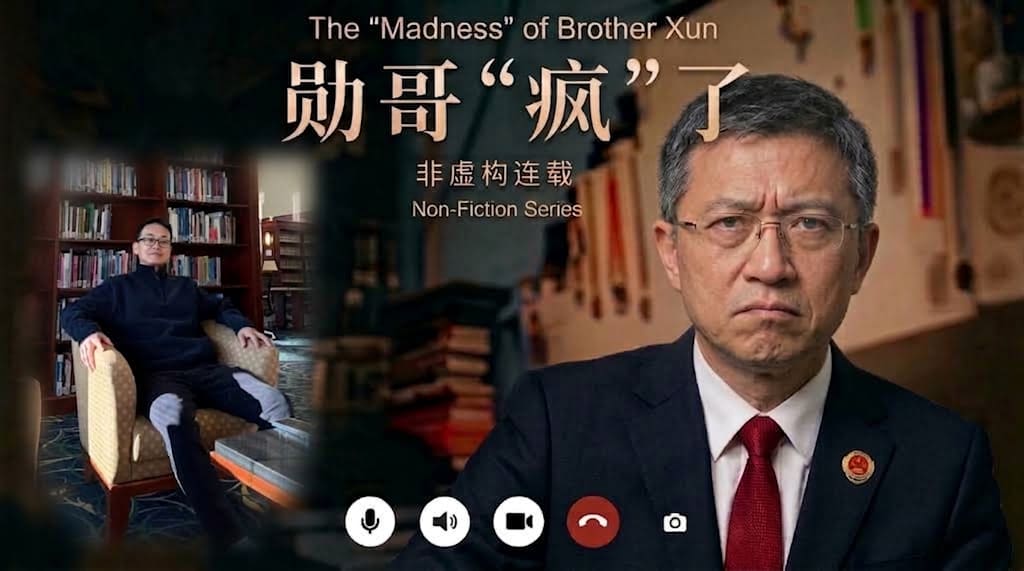
The “Madness” of Brother Xun
Non-Fiction Series #01

💡 中文原版: 点击此处阅读中文版
This is a work of narrative nonfiction based on real events.
Before putting these words on paper, I did something I believe was essential: I obtained the explicit consent of the person at the center of this story.
I am Anan (pronounced like ‘Ah-Nan’ ), as I am known among friends. My real name is Dingnan Cai (known as Dean Tsai in English). I am the author of this account, and I have chosen to use my real name.
The other central figure is Brother Xun (pronounced like ‘Shoon’ ), Suixun Chen is his real name. Brother Xun and I were classmates in high school for only one week. Later, he graduated as the top student in the humanities track and went on to East China University of Political Science and Law. I was in the science track, somewhere down the rankings,I have long since forgotten exactly where,and went on to medical university.
After graduating from East China University of Political Science and Law, Brother Xun joined the Tilton Municipal Procuratorate and went on to rank first in the city in that year’s national judicial examination. At the time, he served as the first deputy head of the Anti-Corruption Bureau. He was exceptionally quick-minded, rigorous in his reasoning, and at the height of his professional powers. Within Tilton’s legal and political system, he was widely regarded as one of its most capable investigators.
Then, one day at noon, Brother Xun led his team in a swift operation to arrest a businessman who was a key figure in the case. But intervention from someone higher up came faster than anyone expected. The arrest was about to take place at midday. By two oclock that afternoon, an order had come down: Brother Xun was being transferred directly to the Policy Research Office to “work on documents.”
After what appeared to be an unusually decisive arrest operation, his real authority was suddenly taken away.
Yet that transfer produced another version of Brother Xun, the man people would later jokingly call the “First Talented Playboy.”
Once he arrived at the research office, Brother Xun single-handedly started an internal newspaper for the procuratorate. And once he began writing, there was no stopping him. He refused to bend. He refused to bow his head. Instead, he buried himself in writing a book.
He would spend the next ten years doing it.
Over those ten years, working almost entirely on his own, he compiled roughly 1.6 million Chinese characters of documentary records, provisionally titled At the Top of the City.
1.6 million Chinese characters.
This was not a novel, nor was it “creative writing” in the literary sense. It was closer to a vast archive: case files, evidence, accounts of investigations, relationships among the people involved, timelines, and an enormous body of documentary records from his decade of work as a prosecutor.
If these materials, and the evidentiary chains behind them, can ultimately be verified one by one, the people and networks of interests they implicate would plainly warrant a second look.
Then came the reform that introduced a new system of ranked prosecutors. In that reshuffling, Brother Xun was pushed even further toward the margins. A man who had once been a full-fledged prosecutor ultimately became an assistant prosecutor.
In 2021, during the period when Brother Xun was said to have “lost his mind,” people from all sides began searching for the original manuscript of those 1.6 million characters.
I remember an old acquaintance who worked for the local Discipline Inspection Commission coming to see me specifically about it. He put his request very politely:
“Anan, now that things have gotten this big, the people above us are asking questions. If you have the original manuscript, you should hand it over to us as soon as possible. Put the evidence on the table. That’s the only way to save Brother Xun.”
I simply looked at him and said nothing.
A question had already begun forming in my mind: If I handed over the manuscript, would Brother Xun lose the last card he had left to protect himself?
I never asked the question aloud.
In 2026, Brother Xun and I spoke by video call while I was in the United States. Getting his permission was a condition of my writing this book.
I asked him, “Brother Xun, I want to write about what you’ve been through all these years. I’m thinking of calling it The “Madness” of Brother Xun. What do you think?”
He burst out laughing on the other end of the screen.
“Perfect! Absolutely perfect! Write it. Of course you should write it!”
After a pause, he added, half joking and half serious, “That makes two books between us. I’ve got my 1.6-million-character At the Top of the City, and you’ve got The “Madness” of Brother Xun documenting my story. Once they’re published, who knows? Maybe we’ll each win a Nobel Prize in Literature! If we both win one, we’ll have money. You’ll be in America — you’ll have an easier life.”
Brother Xun understood perfectly well that moving your entire family to the United States when you’re nearly fifty is anything but easy.
I laughed.
But after the laughter faded, my heart sank.
With his explicit authorization, Brother Xun and I will both use our real names. As for other figures within the system, I reserve the right to use homophones, titles, pseudonyms, and other forms of anonymity where necessary.
Yet when I actually sat down to write, I found myself stuck on a strangely absurd question.
“Brother Xun has gone crazy.”
In Chinese, it is just five characters. Short. Sharp.
But what happens when you put it into English? How, exactly, should it be said?
Driven mad — driven to insanity?
Made to look insane — made to appear as though he were crazy?
Or declared mentally ill — officially labeled as mentally ill?
English has passive voice. It has the perfect tense. It has the progressive tense. Yet there seems to be no grammatical construction that quite captures this particular experience: a person who is not insane is forcibly defined as one by a system because he speaks the truth and records what he believes to be true, and that very designation then becomes evidence that his testimony cannot be trusted.
This is not simply a question of grammar.
It is not even a medical question.
It is a question of power.
In a system where the narrative has already been turned upside down, the person who remains clear-headed and grounded in common sense may be the easiest one to label “abnormal.” Once the words “mentally ill” are forcibly attached to someone, his reports, testimony, writings, and even decades of professional credibility can all be reinterpreted overnight.
You may wonder: How did this prosecutor, once the top scorer in the city’s judicial examination, supposedly “completely lose his mind” in the official narrative?
Press enter or click to view image in full size
Online image / Municipal Government Building №3
Let me tell you about something I witnessed myself.
In July 2024, I went to the municipal government building carrying my wife’s application materials for senior accountant certification. I needed an official stamp.
Government offices officially reopened at 2 p.m. I arrived at the General Office around 1:40. It was the middle of summer, and quite a few young employees who hadn’t gone home for lunch were hanging around their offices, enjoying the air-conditioning and playing video games.
I walked in and casually said that I was there to see a certain official. In fact, I didn’t know the man at all. I also knew that government officials typically took afternoon naps and usually didn’t return to their offices until after three.
While I waited for someone to deal with my paperwork, I sat down at the tea table as though I belonged there. I took out the tea I had brought with me, boiled some water, and made myself a cup.
The period between two and three in the afternoon was the most relaxed time in the entire government building. People gradually began clocking in for the afternoon shift. Seeing me well dressed, sitting comfortably at the tea table as if I knew the place, and hearing that I was there to see a government official, they naturally assumed I was either an acquaintance of some official or an important visitor with business to conduct.
Not a single person came over to question me.
A little after two, several people gradually gathered around the tea table. Cigarettes came out, and the conversation drifted from work to the usual gossip about people and personnel.
I took a sip of my tea and asked casually, as though it were nothing more than idle curiosity:
“What’s happened to Brother Xun at the municipal procuratorate? How’s he doing these days?”
For a moment, the air seemed to stop.
A heavyset man dressed in black looked at me and leaned closer conspiratorially.
“You mean that guy they call ‘Brother Xun’?”
The corner of his mouth curled into a grin.
“He’s completely lost it.”
I pretended not to be particularly interested.
“Oh? What happened? How did he lose it?”
The heavyset man in black took a sip of tea and set his cup down firmly on the table.
“Oh, he really was talented back then. First in the judicial examination, after all. Proud as hell. But once you’re inside the system, what good does talent do?”
He took another drag on his cigarette and leaned back.
“He watched people who came in with him get promoted one after another, and he started panicking. He wanted to find himself a powerful patron and get ahead, so he actually divorced the wife he’d been married to for years and turned around and shamelessly pursued the deputy chief prosecutor’s only daughter. Flowers every day. Waiting outside her door. Sending her all kinds of mushy messages. But did she want him? Of course not. She rejected him outright.”
He jabbed a finger against the tabletop.
“That rejection killed his whole plan to buy his way into office. So he started playing dirty. He wrote anonymous letters reporting several of his competitors. Then the special investigation team looked into it — and guess what? Every single accusation was fabricated. False reports, all of them!”
He shook his head.
“The leadership was furious and suspended him for investigation. His career was finished. He took the blow too hard. That’s when he really went over the edge.”
I continued pouring his tea and looked at him.
“Trying to get promoted through connections, reporting colleagues — aren’t those things pretty common in government offices? How does that make someone crazy?”
The heavyset man in black glanced around, leaned a little closer to me, and lowered his voice.
“You don’t understand how dirty things are inside.”
He then began spilling a series of intimate and vicious details. He said that after Chen Suixun was suspended, he had “completely developed schizophrenia.” He kept several dogs at home, and, supposedly, even resorted to them to satisfy certain “physical needs”…
At that point, he deliberately paused, wearing the kind of smile I had often seen in government offices — a mixture of contempt and morbid curiosity.
Finally, he told me that the leadership had felt sorry for him and had personally paid to have him sent to a psychiatric facility for involuntary inpatient treatment.
I blurted out in shock, “Wait. Are you saying he wasn’t ‘made mentally ill’ by the system?!”
The heavyset man in black shook his head.
“Outsiders don’t understand what really happened!”
He said that some people on Chinese social media had been making a fuss about it, claiming that he had been persecuted by the system. The authorities had supposedly had no choice: “He wasn’t cured yet, so they had to let him out first.”
He took another sip of tea and added that the deputy chief prosecutor’s daughter had once printed out hundreds of pages of her WeChat conversations with Suixun Chen and submitted the thick stack to the special investigation team “to prove that he had clearly been mentally disturbed for a long time.”
He spoke with absolute certainty, as though the entire story had already been established by a complete body of evidence.
At that instant, a burning heat shot up my back, racing along my spine to the base of my skull. A moment later, it had turned into cold sweat.
The powerful air-conditioning in the government office blew across me, icy against my skin.
I could no longer sit there.
I excused myself and left. I didn’t even bother finishing the paperwork that had brought me there. I walked quickly toward the exit.
When I stepped out of Building №3 of the municipal government complex, I went from the blast of artificial cold into the blazing July sun of Tilton. Outside, the heat was suffocating.
And yet, at that moment, I was shaking with cold.
Under the blazing sun, tears suddenly began streaming down my face. I could not stop them.
As I walked, I kept thinking: Brother Xun, are you all right? How could they do this to you? How could they make up such things about you?
Brother Xun was not crazy. At least the Brother Xun I spoke with on the phone two years earlier, shortly after he came out of the psychiatric hospital, absolutely was not.
But what frightened me most was not whether he was crazy.
It was this: after years of being stigmatized, if even some of his former colleagues had come to accept, almost instinctively, that he had always been a “crazy man,” then how much of a chance did he really have left to prove that he was sane?
I didn’t know.
I knew only this: in that already-tilted city, a person labeled “mentally ill” must face alone a machinery of power far larger than the illness itself.
And the most chilling thing about that machine is not that it can lock a sane person inside a psychiatric hospital.
It is what happens after he walks back out.
By then, everyone around him may already have grown accustomed to accepting the identity that was imposed upon him.
I am not trying to turn Brother Xun into an invincible hero. Nor am I trying to vent anyone’s anger on their behalf.
I simply want to write down, one by one, the experiences and details that have been buried beneath the currents of power.
Let time answer the questions:
Who, exactly, was the person who truly lost his mind?
And in a city where the rules have already tilted, who was the first to lose his way?
(To be continued)
About the Creator
Dingnan Cai
我是《勋哥疯了》的作者阿男,也是剧中人阿男。 I’m Ah-Nan, the author of The Madness of Brother Xun and the very "Ah-Nan" you read about in the story.
Enjoyed the story? Support the Creator.
Subscribe for free to receive all their stories in your feed.
Comments
There are no comments for this story
Be the first to respond and start the conversation.