
The Logo Won’t Save You
How new grads should choose between a big-company edge role and a small-company core role
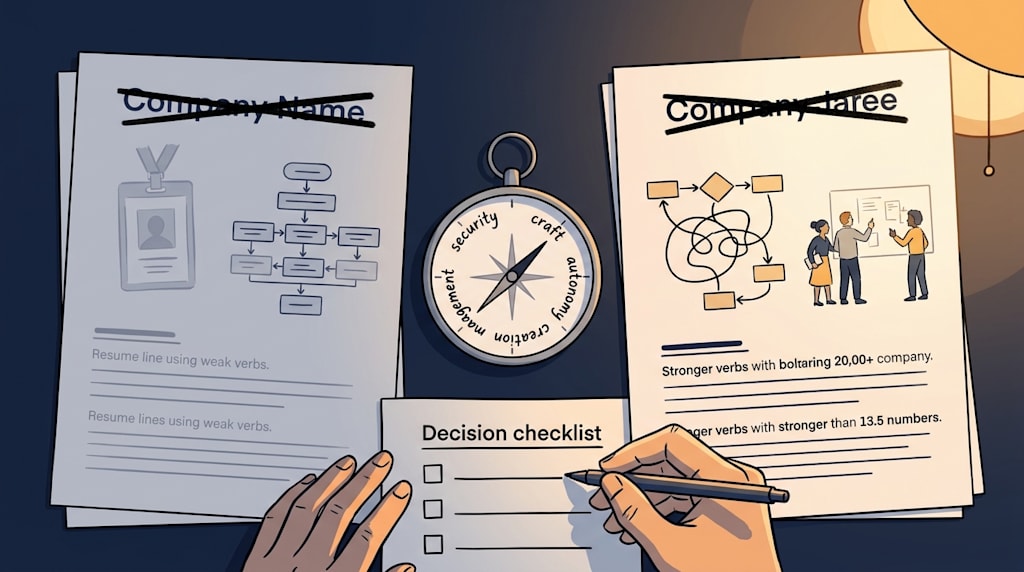
At two in the morning, two screenshots sit side by side. On the left is a marginal role at a big company. The badge looks impressive, and the business unit name takes ten seconds to say. On the right is a core role at a small company. The office sits next to a residential building, and the founder says you will be the backbone. You zoom in. You zoom out. You still cannot decide.
Start with a screen that removes bad options. Compare only what survives.
1. Remove the options that look good and teach you little
For a marginal role at a big company, ask three questions. Has the business made money in the last two years? Is it a profit center or a cost center? Has this business line been cut before?
If the answers are losing money, cost center, and cut before, the risk exceeds the normal cost of a marginal role. In your first year, you may hit downsizing. Your resume may end up with lines like “responsible for daily operations of a module” and “coordinated cross-department processes.” Those lines collapse under two follow-up questions.
Brand value has a depreciation rate. When the business shrinks, the brand shrinks faster.
For a core role at a small company, ask three questions. How does the company make money? Where is it stronger than competitors? How many customers did the founder meet last week? How many old employees left in the past six months?
If the founder dodges customers, prices, and delivery, and says “we understand young people” or “we are building an ecosystem,” the core role is probably odd jobs for three people. If the company fails, you take away no verifiable results. HR finds that harder to handle than an employment gap.
Only the options that survive this round enter the next round.
2. Drop the labels and use three tests
Test one: distance to the business result.
The boundary between a core role and a marginal role is whether your output affects revenue, a key product metric, or a customer decision. In a marginal role, you learn the approval flow. When someone asks what you accomplished and which result you owned, you freeze. In a core role, you face cost, customer explanation, and delivery.
Close to the result does not mean do everything. A core role has a responsibility boundary and measurable output. A fake core role has no division of labor. You fight fires. You know a little about everything and nothing deeply.
Test two: skill demand outside the company.
Search your job title. Read twenty job descriptions. Circle the skills that repeat. How many match your daily work? Custom internal tools, approval systems, and niche processes may not exist outside the platform. A small company may build industry judgment, client delivery, and a 0-to-1 loop. Those skills can be probed and priced.
There is a reverse risk. If your work depends on company relationships or founder decisions, and the model is unvalidated, your full-chain experience looks like odd jobs. A portable core role shows quantified output and a reusable method.
Test three: the resume line you will write in two years.
Write two lines for each role. Ignore the company name. Look at verbs and results. “Maintained, coordinated, supported” sits on one side. “Owned, led, delivered, grew X%” sits on the other. The right side wins if the numbers hold. If it only says “participated in 0-to-1,” it is just as hollow.
Send the lines to a senior stranger. See which line gets a follow-up question. Choose that side.
3. How the experienced-hire market will see you in three years
At the resume screen, a marginal role at a big company wins. The brand helps. The pass rate rises. A small unknown company gets downranked. That is a short-term dividend.
At the deep interview, the situation may reverse. A big-company marginal role without core understanding fails when the interviewer asks, “When this metric is abnormal, which three variables do you check first?” A small-company core role can explain the 0-to-1 logic and the numbers, and that creates an edge.
For management or entrepreneurship, full-chain 0-to-1 work is required. Small-company core experience wins if the result is verifiable and transferable. If the company fails and the model was never validated, HR sees odd jobs.
The premium comes from visible business results and complete loop participation. A big-company marginal role can train you to stop asking what else you can do. A small-company core role can leave you with internal odd jobs when the company fails.
4. Career anchor: which risk can you pay for
Schein’s career anchor theory helps you identify the cost you will feel and the benefit you will cash. It is not a personality label.
Security and stability. You feel lasting anxiety about job hunting in six months. Startup mortality conflicts with that need. Big-company protection is utility. Choose a marginal role in a profitable business that is not on the optimization list. Then move toward the core link.
Technical and functional. Your satisfaction comes from depth. Small-company generalist demands dilute depth. A core role may combine product, operations, and client contact. It looks full. Your anchor is depth. An expert track at a big company fits if the role has depth.
Autonomy and independence. You dislike reporting and meetings. Big-company process drains you. Small-company autonomy is a reward if the company is not a one-man operation. Otherwise you get no management and no backup.
Entrepreneurial and creative. You need to make something. Big-company certainty may feel like boredom. Do not equate small company with 0-to-1. A small copy of an existing business does not test creation. Confirm that the business is in a growth or validation phase.
Managerial. Either side works. A big company offers a clear but crowded track. A small company offers scope faster. A team under ten people has limited external pricing power.
Self-test sentences:
“If I had to give up my profession and manage people, would I feel bad?” Technical and functional.
“If I stayed an individual contributor with no command authority, would I feel stifled?” Managerial.
“If someone required fixed desk time and three weekly meetings, even if results did not change, would I be annoyed?” Autonomy.
“If the company could fail and I might job hunt in six months, would I be anxious enough to affect my life?” Security.
“If the three-year path were completely predictable, would I feel safe or bored?” Entrepreneurial.
5. Decision order
Step one: run the screen. For a big-company marginal role, check for a losing business, strategic margin, and possible whole-team cuts. Be cautious. For a small-company core role, check whether you can explain the money, the difference, and the founder’s front-line presence. If you cannot, the label fails.
Step two: write the resume you will have in two years. Write three lines for each role. Look at verbs and results. Choose the line that survives follow-up questions.
Step three: sit with your anchor. Which cost can you tolerate: instability anxiety, process control, diluted depth, or a predictable path? Choose that cost and stop comparing.
Print both offers. On the left, write three lines you can write in two years. On the right, write the same. Cross out the company names. Look at the six lines. Keep the side with harder verbs, specific results, and more follow-up room. If neither side has hard verbs, keep interviewing. Do not sign fast.
The one that stands after the names are crossed out is where your first job should go.
About the Creator
Jin
Writer of reamstories
https://reamstories.com/jin
Enjoyed the story? Support the Creator.
Subscribe for free to receive all their stories in your feed. You could also become a paid subscriber, letting them know you appreciate their work.
Comments
There are no comments for this story
Be the first to respond and start the conversation.