
The Leadership Skill Nobody Talks About: How to Read a Room and Keep Your Power
What Canglang Zhishui taught me about managing up, managing down, and staying clean while everyone else plays dirty.
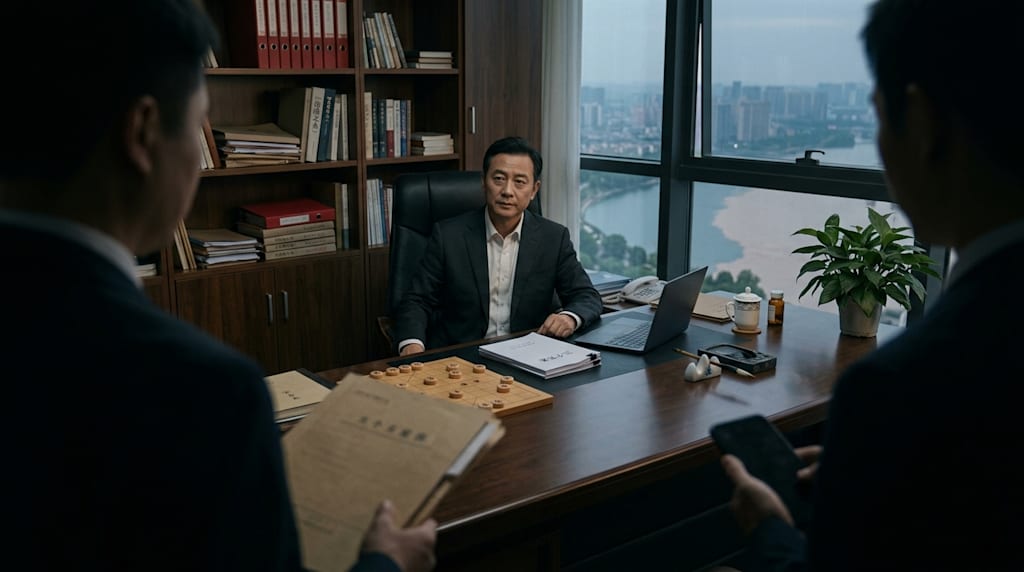
Chengfu: the quiet skill of political maturity
Lessons from Canglang Zhishui on managing up, managing down, and keeping your hands clean.
A leader with chengfu does not walk around with a dark face and a long silence. That is a stage villain. The operator is quieter. He reads the room. He keeps his temper. He keeps his mouth. He keeps his eye on the result. He bends when bending is useful. He stands when standing is necessary. He does not announce the plan. He moves.
Canglang Zhishui gives three case studies. Ma Chuzhang, the director. Chi Dawei, the man who learned late. Ding Xiaohuai, the man who learned too fast and paid for it. Read them not to copy Ma, and not to become Ding. Read them to see the machinery.
1. First layer: stable emotions, layered information
A person without chengfu wears emotion on the face and hangs information on the lips. Happy, he forgets himself. Angry, he loses control. Praised twice, he opens his chest. Provoked twice, he slams the table. In an office, such a person is either used or sacrificed.
The first gate is emotion.
In Canglang Zhishui, Chi Dawei sits on the cold bench for years. After that, he learns to hide joy and anger. He watches Ma Chuzhang. Ma never tells subordinates his mood. Ma never casually evaluates other leaders. That information barrier makes subordinates unable to guess his next move. Guesswork makes them careful.
How to do it:
First, do not take a public position. In sensitive matters, such as personnel changes and policy direction, stay silent or use fog. “We will study it.” “Follow procedure.” “I hear everyone.” These are not evasions. They buy time to watch and judge.
Second, use emotion as a tool. A person with chengfu has emotions. He shows severity when pressure is needed. He shows warmth when recruitment is needed. But the core emotions, anxiety, rage, delight, stay private. Emotion is a card, not the hand.
Third, build information walls. Subordinates get the minimum needed to do the job. Peers get courtesy and distance. The boss gets filtered information that protects your image. Information is power. Control the flow, control the room.
One bottom line: no lying, no forgery, no harming. Layering information is strategy. Spreading rumors is self-destruction.
Ma did not evaluate other leaders. Chi watched. That silence made people guess. Guesswork made them careful. That is the first layer.
2. Managing up: do not obey blindly
Many people think chengfu means bowing to the boss. The opposite is closer.
In Canglang Zhishui, Ma Chuzhang receives an order to cut staff and reorganize. He does not question it in public. He turns the vague instruction into concrete action. He uses the order to adjust the power structure, move people, place allies, and call it “optimization.”
That is the difference between absolute obedience and creative execution.
Absolute obedience: boss says do it, you do it, you report back, you ask nothing. Creative execution: you accept the task first, then find room to move inside it. You break the boss’s broad vision into measurable, reportable projects. You take the executor’s role. The boss feels you are useful and easy to use.
Three methods:
Accept first, adjust later. Even when a task is unreasonable, do not fight in public. Public confrontation is expensive. Take it, then shift direction during execution with facts and options.
Report with choices. Do not wait for the boss to ask. Report progress on a regular rhythm, especially difficulties and risks. Bring two or three solutions. Let the boss choose, not answer an open question. You carry the decision risk and dissolve it with a professional plan. The boss saves energy. You become important.
Credit up, responsibility down. In reports, say “under Director X’s guidance.” When problems appear, take the execution shortfall. Do not push it to the boss. It looks like a loss. It is the cheapest investment. The boss needs safety and control. Give him both, and he needs you.
Build momentum. Later, Chi Dawei wants reform. He does not lecture the director. He uses academic seminars and internal meetings. He makes reform a topic everyone discusses. Then he speaks as if following the mood. That is zaoshi, creating the weather before you sail.
Stay irreplaceable. Ma Chuzhang survives because he holds core resources: special relations with the higher department, exclusive reading of complex policy, recipes for hard problems. The boss must rely on him. A leader with chengfu trains subordinates, but does not let them replace him. Core skills, key contacts, critical information stay in his hands. Do not hand over your experience along with the files.
Avoid illegal benefits. Legal trust is enough. Know the boss’s work style, hobbies, family situation. If he likes calligraphy, send a good inkstone. If he values numbers, make a clean analysis. No bribes. No private deals that can be photographed. The goal is to lower his decision cost, not to become his liability.
3. Managing down: be respected, not feared
Toward subordinates, a leader with chengfu is more complex. He is not simply harsh or kind. He uses enwei bing shi, reward and punishment together, with precision. The goal: people cannot leave him easily, and they do not dare betray him.
Ma Chuzhang handles Chi Dawei with cold first, then warmth. He lets Chi sit on the cold bench. Chi tastes powerlessness. When Chi wakes up, Ma gives him a key post and resources. Cold makes him hungry. Warmth makes him grateful. The sequence tightens loyalty.
The big stick: rarely angry. When angry, thunder. Target a specific event. Make the person feel pain. Punish in public to warn others. After punishment, comfort in private. Let the person think: the leader is still for me.
The carrot: precise. Give the core task to the most obedient. Give awards and promotions to your own people. Scarcity drives competition and loyalty. Average rewards create average effort.
Uncertainty: people cannot guess who will be rewarded or punished next. They stay alert. They move closer to the leader to find certainty.
But a higher level exists: transparent rules. People know what can and cannot be done. They know the reward and the consequence. Inside the rules, give freedom. Outside the rules, give nothing. This lowers the cost of cooperation. It does not rely on fear.
Information isolation and divide-and-rule are common tools. Ma lets Ding Xiaohuai handle external liaison. He lets Chi Dawei handle internal reform. Neither knows the other’s core task. No one can see the whole board. No one can form a rival force. This works short term. Long term, it breeds distrust, blocked information, and weak innovation.
Emotional performance is another tool. Chi Dawei, after becoming a leader, learns to act. He criticizes a subordinate in a meeting. After the meeting, he holds the person’s hand and says, “I am doing this for you. I hate that you cannot grow.” The subordinate feels both fear and gratitude. Remember birthdays and family details. Help with a child’s school admission. Do not promise to change the system. Promise help inside the system.
Fuzzy rules are dangerous. Ma Chuzhang does not set clear, measurable evaluation standards. Evaluation rests on his impression. People spend energy reading the boss, not doing the work. A better method is direction shouquan, direction and boundary management. Give direction, not method. Let subordinates stumble. Then step in to guide or correct. This shows the leader’s wisdom and creates dependence.
Myth-building is the last armor. Ma is packaged as a far-sighted leader. His decisions are not questioned. His past becomes legend. Challenge his authority, and he strikes hard. He controls the background information of key decisions. Subordinates think: “The director must know something I do not.” Over time, they doubt themselves before they doubt him.
But myths break. Ma retires. His power system collapses.
4. Peers and self: distance, records, bottom line
Toward peers, a person with chengfu does not open his heart, and does not make enemies.
He keeps courtesy, not intimacy. He cooperates, but leaves records. He exchanges value, but does not take sides. He knows peers are both partners and rivals. Today’s friend can be tomorrow’s opponent. Today’s opponent can be tomorrow’s ally.
So he does not evaluate peers in public. He does not join gossip. He does not spread unverified information. At key nodes, he writes things down. In cooperation, he clarifies responsibility. When interests are divided, he asks for a fair share without an ugly fight.
Drinking does not build trust between peers. Repeated reliable cooperation does.
Toward himself, the highest protection is being irreplaceable. Do not be the fool who hands over the files and the experience with them. Your value is the resource in your hand: network, information, technology, clients. Become the sole interface in a key link. Become the recognized expert in a niche. When a problem appears, the boss thinks of you first.
Train subordinates. But do not let them fully replace you. Core skills and key contacts stay with you. This protects your survival. It does not protect your ego.
Ding Xiaohuai had cunning, but no bottom line and no scale. He moved fast, pleased the right people, and became a sacrifice. Chengfu must match ability and scale. Otherwise it is small cleverness.
The highest chengfu is invisible. People do not feel it. Big wisdom looks dull. But do not perform dullness. Perform reliability. Perform calm. Perform the ability to get things done without noise.
5. Boundaries: overreliance backfires
In a complex organization, moderate chengfu protects you, pushes work forward, and balances interests. It is political wisdom and emotional intelligence. A leader with no chengfu may fail to win resources for the team.
But overreliance destroys the organization. Trust disappears. Information stops moving. Innovation weakens. Employees follow the boss, not the facts. The team turns inward and fights itself.
Ma Chuzhang’s power system collapses when he retires. Ding Xiaohuai’s patron falls, and Ding ends as a sacrifice. Personal tactics build a tower on sand. Loyalty bought by exchange is a paper boat.
Lasting chengfu rests on institutions, credit, ability, and shared interests.
6. Action list
Daily: Delay emotion. In public, do not rush to take a position, choose a side, or explode. Big decisions wait overnight. Speak less. Do not lie, but do not tell everything. Know who is listening, how much to say, when to say it, and where to stop.
Weekly: Report upward once, with options. Let the boss choose, not answer an open question. Map stakeholders. For each key person, write down: what he wants, what he fears, what he holds, where his bottom line sits.
Monthly: Strengthen one irreplaceable skill or resource. Network, information, technology, clients. Pick one and go deep. Review your credit account. Did you overpromise? Did you damage long-term trust? Did you follow the boss instead of the facts?
Quarterly: Check whether you are addicted to tactics. Chengfu is a tool. It is not a goal. If the team starts to burn itself, adjust. Guard the bottom line. No illegal acts. No harming people. No betrayal of core trust.
Closing
The water of Canglang can be clear or muddy. Wash your hat when it is clear. Wash your feet when it is muddy. Do not let the water get inside your shoes.
Then go back to the desk. Write the report. Bring three options. Keep your mouth shut until the room is ready.
That is chengfu.
About the Creator
Jin
Writer of reamstories
https://reamstories.com/jin
Enjoyed the story? Support the Creator.
Subscribe for free to receive all their stories in your feed. You could also become a paid subscriber, letting them know you appreciate their work.
Comments
There are no comments for this story
Be the first to respond and start the conversation.