
The Internet Doesn't Want Justice. It Wants Someone to Punish.
One accusation can become a public verdict. But who takes responsibility when the crowd gets it wrong?

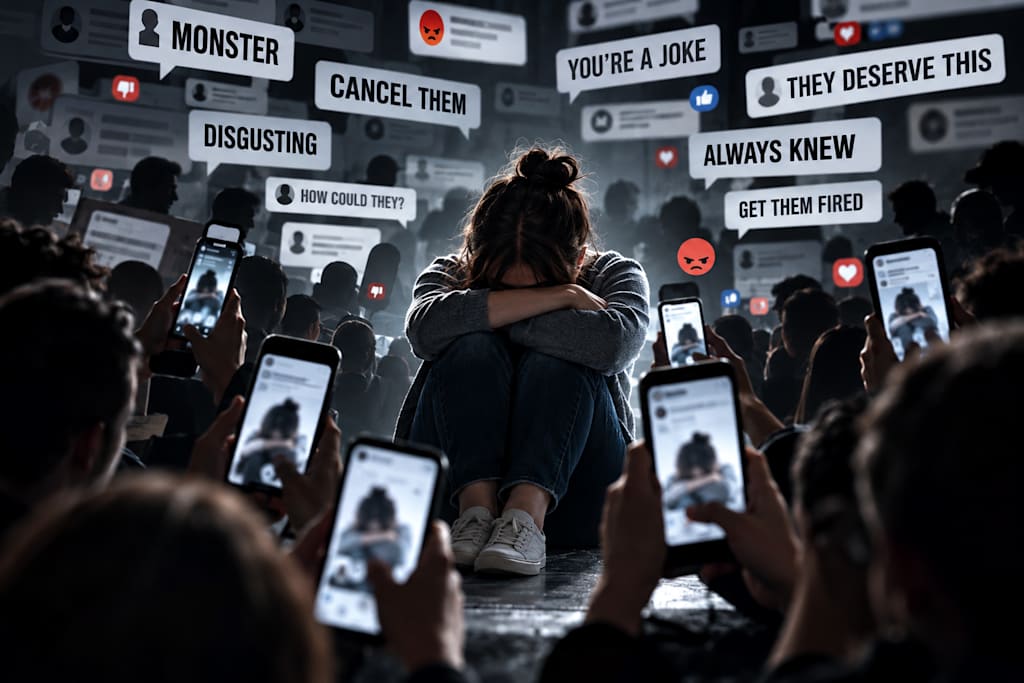
What Happens When the Internet Decides You're a Monster?
You don't need to commit a crime to become the internet's favorite villain.
Sometimes, all it takes is a video without context. A screenshot without the conversation that came before it. An accusation repeated so many times that people stop asking whether it's true.
One minute, you're a stranger going about your life. The next, thousands of people have decided they know exactly what kind of person you are.
They know your motives. They know your character. They know what you deserve.
They know all of this from a handful of posts written by people who may never have met you.
And they are furious.
Your name becomes a punchline. Your old photographs become evidence. People who have never spoken to you begin explaining your entire personality to one another. Someone finds your workplace. Someone else tracks down your family. Every new detail, no matter how irrelevant, becomes another piece of a story the crowd has already decided to believe.
Maybe you did something wrong. Maybe you owe someone an apology. Maybe you caused genuine harm.
Or maybe the story being told about you is missing the very information that would change everything.
The internet isn't particularly interested in that distinction once the spectacle begins.
It has a villain now.
And villains aren't supposed to have explanations.
The Accusation Becomes the Verdict
There is a dangerous moment when an accusation stops being something people discuss and becomes something they treat as an established fact.
It happens quickly.
Someone posts a story about an unpleasant encounter. A video circulates showing a person behaving badly. A former friend shares screenshots of private conversations. Within minutes, the comments begin filling with declarations of guilt, demands for consequences, and confident explanations of what kind of person the accused has always been.
Notice that last part.
Not just what they allegedly did. Who they have always been.
A single incident becomes a personality diagnosis. One mistake becomes proof of a lifetime of secret cruelty. Suddenly, strangers are connecting unrelated details, digging through years of social media posts, and assembling a character profile from whatever scraps they can find.
The investigation comes after the verdict, if it comes at all.
And that is the problem.
An accusation can be serious enough to deserve attention without being sufficiently established to justify every conclusion people draw from it. Taking a claim seriously should mean examining it carefully, not abandoning the examination altogether.
There is a difference between listening to someone who says they were harmed and declaring that every detail of their account has been proven. There is also a difference between withholding judgment until the facts are clearer and dismissing someone because their experience makes us uncomfortable.
Both distinctions matter.
Unfortunately, certainty performs better online than patience.
A post that says, "We should find out what happened before deciding," isn't nearly as satisfying as one that declares, "I always knew they were trash."
One invites thought. The other invites applause.
And when thousands of people are competing to demonstrate that they stand on the right side of a controversy, thought can become an inconvenient accessory.
The question isn't whether accusations should be taken seriously.
It's this: Why have we started treating the act of taking an accusation seriously as permission to stop asking questions?
Context Is the First Casualty
Imagine having your worst ten seconds broadcast to millions of people.
You are exhausted. You're angry. You say something cruel. You react badly to a situation nobody watching the clip fully understands.
Someone records it.
The video begins after the argument has started and ends before anyone knows how it was resolved. It shows your face, your words, your worst moment. It doesn't show the hours leading up to it, the conversation that prompted your reaction, or what happened after the camera stopped recording.
The clip is real.
Your behavior is real.
But is the story people tell about it complete?
The internet has made it extraordinarily easy to confuse documentation with understanding.
A video documents what a camera captured. A screenshot documents what appeared on a screen. Neither automatically explains everything that happened before, after, or outside the frame.
A screenshot of a cruel message might accurately reveal someone's behavior. It might also omit the surrounding conversation needed to understand a dispute. A short clip might expose genuine abuse. It might also misrepresent a complicated interaction. The difference depends on the evidence, not on whichever interpretation generates the most outrage.
Context doesn't automatically excuse bad behavior. Sometimes the full story makes the original conduct look even worse.
But context can change what an event means, how responsibility should be assigned, and what consequences are appropriate.
Online, however, context is often treated as a defense offered by guilty people.
Try explaining that a situation was more complicated than a viral post suggests. You might immediately be accused of making excuses. Point out that a claim hasn't been verified, and someone may assume you're protecting the accused. Ask whether a punishment fits the offense, and suddenly you're defending the offense itself.
It becomes a world of false choices.
Either you condemn the person immediately, or you must support whatever they allegedly did.
Either you join the crowd, or you become part of the problem.
But human beings and human conflicts rarely fit neatly into a ten-second video.
We know this when we're dealing with our own lives. We want people to hear our side of the story. We want them to understand what we meant, what we knew, what we were dealing with, and what we wish we had done differently.
We want the benefit of being seen as whole people.
Why are strangers denied that same basic consideration the moment they become a trending topic?
The Psychology of the Pile-On
The internet doesn't just give us the ability to judge people. It creates an environment where judgment can become a form of entertainment, social bonding, and public performance.
Outrage is contagious. When a post attracts thousands of angry reactions, those reactions become part of the message. The sheer volume of condemnation can make an allegation feel more certain, even when the number of people repeating it tells us nothing about whether it's true.
A thousand people repeating an unverified claim are still repeating an unverified claim.
But numbers have a psychological pull. When everyone around us seems convinced, questioning the consensus can feel uncomfortable. We may assume other people know something we don't. We may fear being associated with the wrong side. Or we may simply enjoy the feeling of belonging to a group that has identified a common enemy.
Psychologists have studied related phenomena, including conformity, social identity, and moral outrage. Research on online behavior has also explored how social rewards can encourage people to express outrage more frequently.
The result is a particularly combustible combination: a story that provokes strong emotion, an audience eager to demonstrate its values, and a platform where reactions can be rewarded with attention.
Now add the algorithm.
Content that provokes anger, fear, or disgust can generate vigorous engagement. People comment to condemn the accused. Others share the post to warn their friends. Still others circulate it because they disagree with the original interpretation and want to argue about it.
Even criticism can help a controversy spread.
The result is a feedback loop. More engagement brings more visibility. More visibility brings more reactions. More reactions make the story appear increasingly important, which attracts even more attention.
Eventually, people who know nothing about the original incident are participating in the judgment.
They haven't spoken to the people involved. They haven't examined the available evidence. They may not even have read beyond the headline.
But they have an opinion.
And online, having an opinion is often mistaken for having done the work required to reach one.
There is another uncomfortable element here: public condemnation can make us feel morally secure. When we identify someone else's behavior as unacceptable, we reinforce our own sense of what is right. We signal to others that we recognize the difference between good and bad.
There is nothing inherently wrong with condemning harmful behavior. Moral judgment is necessary. Speaking up against abuse, exploitation, discrimination, and cruelty can be important.
The problem begins when condemnation becomes less about preventing harm and more about demonstrating our own righteousness.
At that point, the accused person becomes a prop in a performance about the audience.
The question is no longer simply, "What happened, and how do we address it?"
It becomes, "How loudly can I prove that I hate the right person?"
And those are two very different conversations.
The Pleasure of Having Someone to Hate
Nobody likes to think of themselves as cruel.
Most people would recoil at the idea of gathering in a public square to humiliate a stranger. We like to imagine that we would be the person who intervened, the person who questioned the mob, the person who insisted that everyone deserved a fair hearing.
Yet give the same crowd a smartphone, a viral accusation, and a comment section, and ordinary people can participate in behavior they might never tolerate face-to-face.
They make jokes about someone's appearance. They celebrate the possibility of losing a job. They search for embarrassing photographs. They contact relatives who had nothing to do with the alleged offense. They turn private pain into public entertainment.
And they do it while telling themselves they are standing up for what is right.
That is what makes online pile-ons so disturbing. Cruelty doesn't always arrive wearing the face of cruelty. Sometimes it arrives dressed as moral responsibility.
A person who joins the pile-on may genuinely care about victims. They may sincerely believe the accused person has done something terrible. They may have experienced similar harm themselves and feel an understandable anger toward behavior that reminds them of it.
Those feelings can be real.
But sincere motives don't automatically make every action justified.
You can oppose abuse without sending death threats. You can believe a victim deserves support without encouraging strangers to harass the accused person's children. You can call for professional consequences without celebrating the prospect of someone becoming homeless.
And you can change your mind when new information emerges without betraying your principles.
The trouble is that once a crowd has invested itself in a villain, new information becomes a threat to the story it has built.
Evidence that supports the accusation gets celebrated. Evidence that complicates it gets dissected, dismissed, or ignored. The accused person's apology becomes proof of guilt. Their denial becomes proof of dishonesty. Their silence becomes an admission. Their attempt to explain becomes manipulation.
What, exactly, are they supposed to do?
If every possible response becomes further evidence of guilt, the judgment has stopped being a genuine evaluation of behavior. It has become a closed system that protects its own conclusion.
There is no meaningful way to defend yourself against a verdict that cannot be revised.
And when people begin enjoying the punishment itself, the original harm can become almost secondary.
The crowd has found someone to hate. Letting go of that person means surrendering the emotional satisfaction of the hunt.
That is a much more uncomfortable truth than simply admitting that social media can be mean.
Sometimes, the question isn't whether we are right to be angry.
It's whether we have become so attached to our anger that we no longer care what we do with it.
The Villain Has a Family
This is the part that tends to disappear when a person becomes the internet's favorite monster.
They have a family.
They may have children who use the same surname. A spouse who wakes up to strangers sending accusations. Parents who discover that people have found their home addresses. Siblings who are suddenly expected to explain, defend, or denounce someone else's behavior.
They have friends who are forced to decide whether remaining silent will be interpreted as loyalty to wrongdoing. Coworkers who have to navigate a workplace suddenly surrounded by controversy. People who knew the accused long before the internet decided that one story explained their entire existence.
These people may be completely uninvolved in whatever happened.
They may be horrified by the accusation. They may believe it. They may have complicated feelings about the person at the center of it. They may be privately confronting behavior they never knew existed.
They are still human beings.
And they do not become legitimate targets simply because someone they love has been accused of doing something wrong.
The villain has a family. The villain has a neighbor. The villain has a child who might not understand why strangers are suddenly cruel to them at school.
The villain has people who will receive the phone calls, read the threats, and sit awake wondering whether someone online is serious about showing up at their house.
The villain has a mother who may see strangers discussing her child as though they are discussing a fictional character.
That doesn't mean the accused person deserves sympathy regardless of what they have done. It doesn't mean victims should be asked to protect the reputations of people who harmed them. It doesn't mean families should be used as a shield against legitimate consequences.
It means responsibility should not be contagious.
If someone commits a serious offense, they should be held accountable for their own conduct. Their relatives do not automatically share that guilt. Their children do not inherit it. Their friends do not become accomplices merely by having known them before the controversy.
Yet online audiences routinely blur these boundaries.
Someone finds an old photograph of the accused person's partner and begins questioning their relationship. Someone tracks down a sibling's account and demands a public statement. Someone posts identifying information about a family member because they believe the family deserves to be embarrassed, too.
What purpose does that serve?
Does harassing a person's child help establish the truth? Does threatening their spouse repair the harm suffered by a victim? Does publishing a relative's private information make the public safer?
Or does it simply give an angry audience more people to punish?
There is a difference between informing the public about relevant facts and dragging uninvolved people into a spectacle. There is a difference between discussing someone's public actions and treating every person connected to them as fair game.
And there is a difference between wanting justice and wanting everyone associated with a hated person to suffer.
We should be able to recognize those distinctions without being accused of defending wrongdoing.
Perhaps the most revealing test of our outrage is what happens when the target's behavior becomes complicated by the existence of people we can clearly see are innocent.
A child. A grieving parent. A partner who had no knowledge of the alleged conduct. A sibling who is trying to keep their own family out of the controversy.
Do we suddenly remember that human beings are more than the worst thing someone has said about them?
Or do we decide those people are acceptable collateral damage?
If we believe accountability is supposed to address harm, then the suffering of uninvolved people should concern us. If our response creates additional victims without making anyone safer or repairing anything, we need to ask what we are actually accomplishing.
The internet is very good at turning a person into a symbol.
Symbols don't have children. They don't have frightened partners. They don't have elderly parents checking the locks after reading a threat. They don't have ordinary lives that continue long after the hashtag disappears.
Real people do.
And the moment we forget that, our demand for accountability can become another excuse to hurt people.
Accountability or Exile?
To criticize online punishment is not to argue that people should escape the consequences of their actions.
Some behavior deserves serious consequences. Abuse, exploitation, fraud, harassment, and other harmful conduct should not be dismissed simply because the person responsible has a sympathetic backstory or an audience willing to defend them.
Victims should not have to remain silent to preserve an offender's reputation. People who speak publicly about misconduct may be doing something necessary, particularly when formal systems have failed them.
Public scrutiny can expose wrongdoing. Collective pressure can force institutions to address problems they would otherwise ignore. Social media can help people find support, share evidence, and warn others about genuine risks.
Those are real benefits.
But accountability and public humiliation are not interchangeable.
Accountability asks what happened, who was harmed, what responsibility belongs to whom, and what consequences might address the harm or prevent it from happening again.
Punishment for its own sake asks how much suffering can be inflicted on the person everyone has decided to hate.
Sometimes those responses overlap. A person may face legitimate professional consequences and also experience disproportionate harassment. A public statement may be necessary while the threats directed at the speaker's family remain indefensible.
The existence of one justified consequence does not justify every other consequence that follows.
Consider the apology.
We tell people to acknowledge their mistakes, take responsibility, and demonstrate that they understand the harm they caused. Yet when someone does apologize, the response can be immediate dismissal.
The apology is fake. The tears are manipulative. The explanation is self-serving. The timing is calculated.
Sometimes those criticisms are warranted. Apologies can be insincere, strategically timed, or designed to avoid consequences. A statement expressing regret is not proof of meaningful change, and victims are not obligated to forgive someone simply because they apologized.
But what happens when we decide in advance that no apology can ever be accepted?
What happens when a person takes responsibility, makes amends where possible, changes their behavior, and spends years demonstrating that change, only to discover that the internet has preserved their worst moment as a permanent identity?
If nothing they do can ever matter again, what exactly are we asking them to do?
We cannot demand that people improve while insisting that improvement is irrelevant. We cannot tell someone to make amends and then treat every attempt to do so as further evidence of manipulation.
That doesn't mean every offense deserves forgiveness, or that every person who claims to have changed actually has.
It means consequences should be considered in relation to the conduct, the harm caused, the risks that remain, and the evidence of change. The passage of time does not erase serious harm, but time and changed behavior should not automatically become meaningless, either.
There is an important distinction between remembering what someone did and insisting that their worst act must define every day of their remaining life.
One can protect victims, acknowledge the seriousness of past conduct, and recognize genuine rehabilitation without pretending that none of these considerations ever conflict.
The internet often prefers a simpler arrangement.
You are good until you are bad. Then you are bad forever.
There is no room for uncertainty, growth, contradiction, or the possibility that a person can do something harmful without being nothing but harmful.
That is a satisfying story.
It is also a poor way to understand human beings.
What Happens When We Get It Wrong?
Let's consider the possibility that makes a public pile-on especially dangerous.
The crowd is wrong.
Perhaps the accusation was fabricated. Perhaps a video was deliberately edited to conceal the most important part of an interaction. Perhaps a screenshot was genuine but presented in a misleading way. Perhaps two people experienced the same event differently, and a viral retelling turned a complicated conflict into a simple story of hero and villain.
Or perhaps the accusation was substantially true, but the details spreading online were not.
These are different situations. They should not be treated as interchangeable. But they share one disturbing possibility: a person can be subjected to consequences based on a version of events that does not accurately reflect what happened.
By the time corrections arrive, the damage may already be done.
An employer may have received hundreds of complaints. A family may have been threatened. Friends may have distanced themselves. A business may have lost customers. Private information may have spread beyond anyone's ability to retrieve it.
The person at the center of the controversy may issue a correction, produce evidence, or receive a public retraction.
But corrections rarely recreate the conditions that existed before an accusation went viral.
People who saw the original post may never see the update. Those who shared the accusation may not return to acknowledge the mistake. Some may quietly change their minds without saying anything. Others may insist that the accused person must still be guilty of something.
The internet moves on.
The consequences remain.
This is not an argument that false accusations are more common than genuine ones, nor that every disputed claim should be met with suspicion. The frequency and nature of false claims vary by context, and a lack of public proof is not itself proof that an allegation is false.
It is an argument for proportionate confidence.
We should be able to say that a claim deserves investigation without pretending the investigation is complete. We should be able to acknowledge someone's account of harm without claiming knowledge we do not possess. We should be able to revise our conclusions when credible new information emerges.
And we should be particularly careful when our actions can contribute to consequences far beyond the original discussion.
Sharing a post is an action. Naming someone's employer is an action. Publishing private information is an action. Encouraging thousands of strangers to contact a person is an action.
The fact that these actions take seconds does not make their effects insignificant.
Before sharing a damaging allegation, it is worth asking whether the source is credible, whether the material is authentic, whether important context is missing, and whether sharing it serves a legitimate purpose.
Sometimes speaking publicly is necessary. Sometimes silence protects people who have done harm. Sometimes sharing verified information can help others recognize danger.
But there is a difference between informing people and recruiting an audience to punish someone.
We should be capable of making that distinction.
And when new evidence proves that we were wrong, we should be willing to say so.
Not privately congratulate ourselves for being open-minded. Not quietly delete a post and hope nobody notices.
Say so.
A correction cannot erase the damage, but refusing to correct a mistake compounds it.
If we demand accountability from the people we condemn, we should be willing to practice it ourselves.
The Questions We Don't Like Asking
Perhaps the most uncomfortable part of online outrage is that it rarely requires us to imagine ourselves on the other side.
We see the accusation. We form an opinion. We react.
The person at the center of the story remains an abstract figure, someone we can discuss without considering what it would feel like to have our own life reduced to a handful of screenshots.
But imagine it.
Imagine that a conversation you had years ago is shared without the messages that came before it. Imagine that a mistake you made in your twenties resurfaces after you have spent years trying to become a better person. Imagine that a stranger publishes a claim about you, and thousands of people repeat it before you have a chance to respond.
Imagine that you really did behave badly.
Would you want your conduct examined honestly? Would you want the people you harmed to be heard? Would you accept reasonable consequences?
Or would you also want people to consider the full circumstances, distinguish between what happened and what was invented, and allow your actions after the incident to mean something?
Now imagine that the accusation is wrong.
Would you expect people to wait for evidence? Would you hope that someone would question a misleading video? Would you want the people sharing the accusation to correct themselves?
Would you want strangers to remember that your family had nothing to do with it?
Most of us would ask for some version of fairness.
We would want people to look beyond the headline. We would want our words to be understood in context. We would want an opportunity to respond. We would want our worst moment to be considered alongside the rest of our lives.
We would want to be seen as human.
That doesn't mean we should assume everyone accused online is innocent. It doesn't mean our personal discomfort should outweigh the experiences of people who have been harmed. It doesn't mean every demand for evidence is made in good faith.
It means we should be willing to extend the same standards of honesty, proportion, and care to strangers that we expect when our own reputations are at stake.
Here are a few questions worth sitting with:
Does an accusation deserve to be believed, investigated, or both?
If someone genuinely does something terrible, does that make every claim about them fair game?
Should people lose their livelihoods over something they did years ago, even if they have changed? What if the conduct was serious, the harm lasting, or the risk ongoing?
Why do we demand apologies and then sometimes refuse to consider whether they represent genuine change?
If you share a damaging accusation without checking it, are you helping expose wrongdoing or helping spread misinformation?
And perhaps the hardest question of all:
Would you be as confident in your judgment if your own worst moment were stripped of context and shown to millions of people?
These questions do not have universal, one-size-fits-all answers. The appropriate response depends on what happened, what evidence exists, who was harmed, and what consequences are necessary.
That is precisely why they deserve more than a comment section's worth of certainty.
The Internet Doesn't Forget. It Just Gets Bored.
There is something deeply unsettling about the permanence of public condemnation.
A person can apologize. A court case can conclude. An employer can make a decision. A controversy can fade from the news cycle.
Yet the original accusation may remain searchable for years.
A future employer discovers it. A new acquaintance finds an old thread. Someone who knows nothing about the circumstances encounters a screenshot and assumes that the story is settled.
The person is forced to explain an event that everyone else has forgotten, or defend themselves against a version of events they cannot make disappear.
Of course, preserving information can serve an important purpose. Records of serious misconduct may protect others, and a person's desire to move on does not automatically outweigh the public interest in knowing what happened.
Some consequences are necessary precisely because the harm was severe.
But permanent visibility is not the same as permanent accountability.
A system that never distinguishes between a serious pattern of abuse and an isolated mistake, between verified evidence and an unsubstantiated rumor, or between genuine rehabilitation and empty promises is not carefully measuring responsibility.
It is simply preserving punishment.
And there is an uncomfortable contradiction in the way we talk about change.
We encourage people to learn from their mistakes. We tell children that bad behavior does not make them bad forever. We believe people can recover from addiction, confront their prejudices, repair damaged relationships, and become more responsible versions of themselves.
Then someone becomes a viral villain, and suddenly the possibility of change seems almost offensive.
The internet doesn't necessarily demand that you remain the person you were.
It may simply refuse to acknowledge that you are no longer that person.
There are circumstances where public memory serves justice. There are others where it becomes an endless sentence imposed without any clear standard for completion.
Distinguishing between them requires judgment, patience, and a willingness to accept complexity.
Those are not always the qualities that make a controversy go viral.
We Are All Part of the Audience
It is tempting to blame the platforms.
The algorithms reward engagement. The design encourages immediate reactions. The comment sections make it easy to mistake volume for consensus. The distance between the screen and the person being discussed can make cruelty feel strangely consequence-free.
These systems deserve scrutiny.
But they cannot explain everything.
A platform does not force us to write a cruel comment. An algorithm does not personally compel us to send a stranger's private information to thousands of people. A trending hashtag does not require us to celebrate someone's suffering.
We make choices within these systems, even when those systems are designed to influence our attention and behavior.
Sometimes we share an accusation because we believe it. Sometimes we share it because we are angry. Sometimes we share it because everyone else is sharing it, and we don't want to feel as though we are standing on the wrong side.
Sometimes we join the jokes because the target seems so universally hated that we assume our contribution cannot possibly matter.
One comment won't destroy a life, we tell ourselves.
One share won't make a difference.
One joke is just a joke.
But public pile-ons are made of individual decisions. Each person may feel insignificant in the crowd, while the combined effect can be devastating.
This does not mean everyone who comments on a controversy is equally responsible for everything that follows. Criticizing harmful conduct is not the same as threatening someone's family. Sharing verified information is not the same as spreading a fabricated claim. The nature and consequences of our actions matter.
Still, we should resist the comforting idea that responsibility disappears when enough people participate.
The crowd is not some mysterious creature that descends upon the internet from nowhere.
It is made of people.
People who have jobs, families, friends, and ordinary lives. People who would be horrified to discover that their own children were being threatened by strangers. People who believe in fairness until fairness becomes inconvenient. People who can show tremendous compassion to someone they know and remarkable cruelty toward someone they have decided not to understand.
People like us.
That is why the most important question is not simply whether the internet has become cruel.
It is whether we have learned to excuse our own cruelty whenever we believe the target deserves it.
What would happen if we stopped treating the intensity of our anger as proof of the accuracy of our judgment?
What if we could condemn harmful behavior without inventing additional reasons to hate someone? What if we could support victims without pretending we know facts we haven't verified? What if we could correct misinformation even when the misinformation was directed at someone we disliked?
What if we could admit that a person did something wrong without deciding that everything about them, and everyone who loves them, must therefore be worthless?
None of those questions requires us to abandon accountability.
They require us to take accountability seriously enough to distinguish it from revenge.
Before You Share the Next Villain
The next time a stranger appears on your screen with thousands of people calling them a monster, pause.
Not because they are necessarily innocent. Not because victims should be ignored. Not because accountability is unimportant.
Pause because you are being invited to participate in a judgment that may have consequences you will never have to witness.
You may never see the person lose their job. You may never hear about the family that receives the threats. You may never discover that the story was wrong, incomplete, or more complicated than the version you shared.
You get the outrage. Someone else gets to live with the aftermath.
And if the internet gets it wrong, the crowd rarely gathers again to apologize.
The comments move on. The algorithm finds another villain. The next outrage arrives, hungry for attention.
But the person at the center of the last story is still there, living in the wreckage.
We should be able to condemn cruelty without becoming cruel ourselves. We should be able to believe victims without abandoning evidence. We should be able to demand accountability without pretending that humiliation is justice.
Most of all, we should remember that the ability to destroy someone's reputation is not proof that we understand them.
Sometimes, the monster really is a monster.
Sometimes, the story is more complicated.
And sometimes, the ugliest thing about the entire spectacle is how quickly ordinary people stop caring which one it is.
Because the internet doesn't need to know who you are. It only needs to decide who you are.
And once the crowd has made up its mind, the truth can find itself fighting for attention against the very thing that should matter most: the truth itself.
About the Creator
Lilithea Adasia
I dig where others look away. 🖤 True crime, paranormal mysteries, uncomfortable truths, and the beautifully broken human experience. I chase the stories others bury and ask the questions others avoid. Come curious. Leave questioning.
Enjoyed the story? Support the Creator.
Subscribe for free to receive all their stories in your feed.
Comments
There are no comments for this story
Be the first to respond and start the conversation.