
The Incompetent Middle Manager Is Not a Bug. He's a Feature.
Why your CEO keeps the guy who knows nothing, does less, and survives everything.
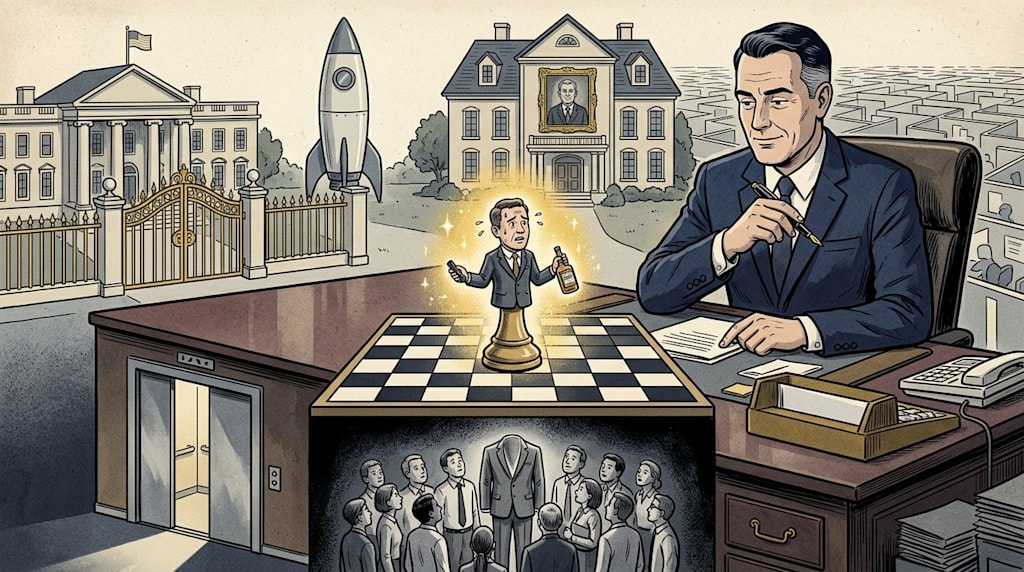
The ecological niche of the incompetent middle manager
Why the CEO keeps Mark around
Monday, 8:40 a.m. Richard walks into the conference room. His stainless-steel tumbler hits the table with a dull thud. Mark clicks to slide 17 and says, “On a go-forward basis, we need to socialize the headwinds.” Richard says nothing. He draws a small circle in his notebook. Mark continues: “Of course, the front-line teams are working hard, but we need to align our data taxonomy.” Richard caps his pen. “You handle it.”
After the meeting, Mark goes to Richard’s office. The door closes for twenty minutes. When it opens, Mark is carrying a bottle of Blanton’s.
That is the daily life of the incompetent middle manager. He knows nothing about the business. He is a master at shifting blame. He takes credit before anyone else can. His mind is the size of a thimble, and his talent for calculation is Olympic. You ask yourself: How did this guy get promoted? Is Richard blind?
Richard is not blind. Richard needs him.
1. Richard’s exam is not your exam
You grade Mark on whether he can lead the team to victory, absorb pressure, share the upside, and command respect.
Richard grades Mark on whether he is obedient, controllable, useful for dirty work, unlikely to turn on him, willing to take the fall, and reliably “his guy.”
These are two different exams.
You use business logic: competence, performance, fairness, efficiency. Richard uses power logic: loyalty, safety, control, balance, convenience.
In Richard’s equation, the top terms are not business efficiency. They are:
power safety × board satisfaction × faction balance × risk transfer × execution × personal ease
Business efficiency is one variable. It is often last.
Mark is bad at business, but he can contain the team, carry messages, handle dirty work, absorb blame, and watch enemies. To Richard, Mark is competent. The star performer who asks questions, has a following, and demands market rate is dangerous. Richard is not stupid. They are taking different exams. You test competence. He tests loyalty. You test performance. He tests safety.
2. The middle manager’s first customer is not you
Many people in corporate life share a fantasy: If I do good work, leadership will see it. Good work is only the ticket. Whether you get selected depends on whether you meet the boss’s real needs.
What is Mark? Mark is a router of power, a filter of information, a shock absorber, and a firewall of responsibility.
He does not rush to the front line to finish the work. He transmits Richard’s will downward. He filters the situation upward. He holds down conflict and blocks risk. He gives credit upward and pushes blame downward. He makes Richard feel unbothered, reassured, and convenient.
These are not things that highly competent business people necessarily do well. Business stars have opinions, pride, and professional ego. They refuse to say things they do not mean. They refuse to do disgusting things. Mark does well.
So Mark’s real skills are not doing the work. They are speaking precisely in meetings, claiming credit in decks, throwing people under the bus when problems appear, choosing sides without hesitation, and being ruthless when the moment requires it.
To you, this is incompetence. To Richard, this is usefulness.
3. Mediocrity is safer than excellence
Richard is human. What does he fear?
He fears a subordinate who is too competent, because that person may overshadow him. He fears a subordinate who is too popular, because that person may become uncontrollable. He fears a subordinate who is too independent, because that person may be hard to steer. He fears a subordinate who is too expensive, because that person may never be truly loyal. He fears a subordinate who is backed by someone else, because that person may not be his.
At that moment, Mark is safe.
Mark has no independent kingdom, no strong bench, no market premium. Without Richard, he is nothing. So he depends upward. He performs loyalty. He obeys. He is a tool.
A controllable mediocrity beats an uncontrollable star.
Call it power arithmetic. Moral judgment is a different conversation.
A star may bring 100 points of performance and 50 points of risk. A mediocrity may bring 30 points of performance and zero points of risk. If Richard cares more about safety, he picks Mark.
Many organizations do not live by market competition. Profit comes from licenses, resources, policy rents, monopoly, legacy, or regulatory capture. Performance is weakly tied to individual ability. Selection focuses on obedience, avoiding scandal, and being “one of us.” Without external market pressure, the only competitive strategy left is upward management. Scheming and calculation become assets.
4. Doers vs. talkers
Richard cannot directly see the front line. He sees reports, presentations, relationships, and impressions.
Competence is hard to verify. Loyalty is easy to perform. Performance is hard to attribute. Attitude is easy to see. Problems are easy to hide. Slides are easy to make beautiful.
So the upward manager gets chosen. The doer gets ignored. This is adverse selection: the performer rises, the producer stays. You see Mark doing nothing. Richard sees Mark reporting well, signaling on time, and disciplining the room. You see credit-stealing. Richard sees authority protection. You see pettiness. Richard sees political sensitivity, execution capacity, and dirty-work ability.
Information asymmetry gives incompetence a stage. The more layers, the more decay, the more room for water to rise.
5. Unattributable output is the best camouflage
In a large conglomerate, a project’s success is strategy, leadership, teamwork, and market conditions. Failure is execution, the front line, external change, and headwinds.
What did Mark do? Reporting, coordinating, documenting, covering. It looks like no output, but the system needs it.
The more layers, the harder it is to attribute individual contribution. Unattributable output is the best camouflage for incompetence.
Mark can claim wins, blame the system, explain failures as objective, and package success as personal ability. He is always right, always safe, never holding the bag. In this ecology, good slides, polished speeches, and blame-shifting do well. The actual doer, too specific, too attributable, holds the bag.
6. Four soils, four kinds of incompetence
Different people fit different ecological niches. The type of niche is determined by the environment. Some environments inevitably grow the Mark crop.
First: profit does not come from market competition.
Regulated monopolies, licensed utilities, energy, defense contractors, some banks. Profit comes from birthright, not ability. Performance is weakly tied to individual skill. Selection cares about obedience and avoiding scandal. Without market pressure, the only game is upward management. Scheming and calculation are assets. Business ability is not the core competence. Political ability is. Whoever serves the boss best rises. Whoever brings business logic to a political ecology looks naive.
Second: hypergrowth companies.
Cash-burning startups, franchise roll-ups, aggressive store openings. Flood, speed, mixed quality. Headcount grows fast. Standards loosen. If you can talk, you get a shot. Luck and timing matter. Some grow into the role. Some hit their ceiling and are exposed. When the tide goes out, the naked are already promoted.
Third: family business or founder autocracy.
Nepotism is the norm. Selection criteria are blood, hometown, old loyalists, shared hardship, and loyalty. In the West, a founder’s son-in-law runs procurement. A CEO’s college roommate is head of strategy. A founder’s dog has an office and a title. The more competent the founder, the less he needs competent middle managers. Middle managers only execute and signal. Over time, the middle layer degenerates collectively.
Fourth: massive headquarters or bureaucratic machine.
Information decay. A message passes through seven hands before it reaches the top. Middle output becomes reporting, coordinating, documenting, and covering your ass. Slide masters, meeting stars, and blame-shifters do well. The more layers, the harder to attribute contribution. Unattributable output protects incompetence.
7. Peter Principle, Parkinson’s Law, and switching costs
The Peter Principle says: A person good at one job gets promoted until he is incompetent. More commonly: A person good at political jobs gets promoted to higher political jobs. “Good” is defined politically, not commercially.
Parkinson’s Law says: Layers create work for each other. More incompetents need more incompetents to coordinate, report, document, and cover.
Then there is switching cost. Mark may be a faction’s man, an old loyalist, or the result of a deal. Firing him offends a chain of people, exposes bad judgment, and leaves no replacement. As long as he does not blow up, Richard maintains the status quo. He can be replaced. Replacement is more trouble. Richard knows he is incompetent. Incompetence has its uses.
8. The incompetent manager’s “competence”
The incompetent leader is never incompetent in every dimension. His “competence” fits what the environment rewards.
Mark is bad at business but loyal. Bad in character but obedient. Bad in ability but able to absorb blame. Bad in vision but good at purging. Bad in performance but good at reporting. Bad in innovation but good at maintenance. Bad in leadership but good at surveillance.
To you, these are liabilities. To Richard, they may be assets.
Do not simply ask, “How did he get promoted?” Ask: What does this environment reward?
If the environment rewards obedience, obedience is ability. If it rewards faction, faction is performance. If it rewards decks, PowerPoint is a hard skill. If it rewards covering your ass, not holding the bag is a core competence.
9. Do not fight politics with competence
If your environment gives low returns to competence and high returns to politics, you have two choices: adapt to the rules, or move to an environment where competence is worth more.
The worst strategy is to bring business logic into a political ecology. You think you are proving yourself. They think you are breaking the rules. You think you are creating value. They think you are stealing the spotlight. You think you are being objective. They think you are challenging power.
Identify your niche:
Does profit come from the market or from a license?
Is the company in growth or maturity?
Is selection based on performance or loyalty?
Is information transparent or decayed?
Are there many layers? Can contribution be attributed?
Is the CEO a professional manager or a founder?
Understand the reward system, and you understand promotion. If the environment rewards incompetence, incompetence is the honor roll. If it eliminates competence, competence is the sacrifice. If it does not need business, business is a hobby.
Decide: stay and adapt, or leave.
10. Replace Mark, and you get another Mark
Stop asking why Richard appointed Mark. Ask what the organization rewards.
If it rewards obedience, faction, reporting, and CYA, Mark is top of the class. If the soil grows this crop, replacing one Mark grows another. Mark is a product of the environment. His appointment succeeded because he met the environment’s requirements.
You call him incompetent. Richard calls him useful. You think he does not deserve it. Richard thinks he fits. You see a person. Richard sees a piece.
Pieces do not need to be smart. They need to be obedient, useful, and non-threatening.
To change this, you must change the soil: profit source, metrics, information channels, accountability. Otherwise, every Mark you curse is a crop grown by the system.
You either adapt to the soil, or you find different soil. Do not fight politics with competence. That is the worst play.
After work, Mark steps into the elevator with a new intern. The intern asks, “Mark, why does Richard trust you?” Mark looks at their reflection in the elevator doors. “Because I don’t make his life harder.”
The elevator arrives. The doors open. Mark steps out. The intern stays inside. The doors close.
About the Creator
Jin
Writer of reamstories
https://reamstories.com/jin
Enjoyed the story? Support the Creator.
Subscribe for free to receive all their stories in your feed. You could also become a paid subscriber, letting them know you appreciate their work.
Comments
There are no comments for this story
Be the first to respond and start the conversation.