
The Hospital Was Profitable on Paper. Then the Cash Ran Out.
Two spreadsheets, forty cases of dusty medicine, and a heating bill for a campus nobody uses: this is what happens when a public hospital is treated like a cash cow.
One
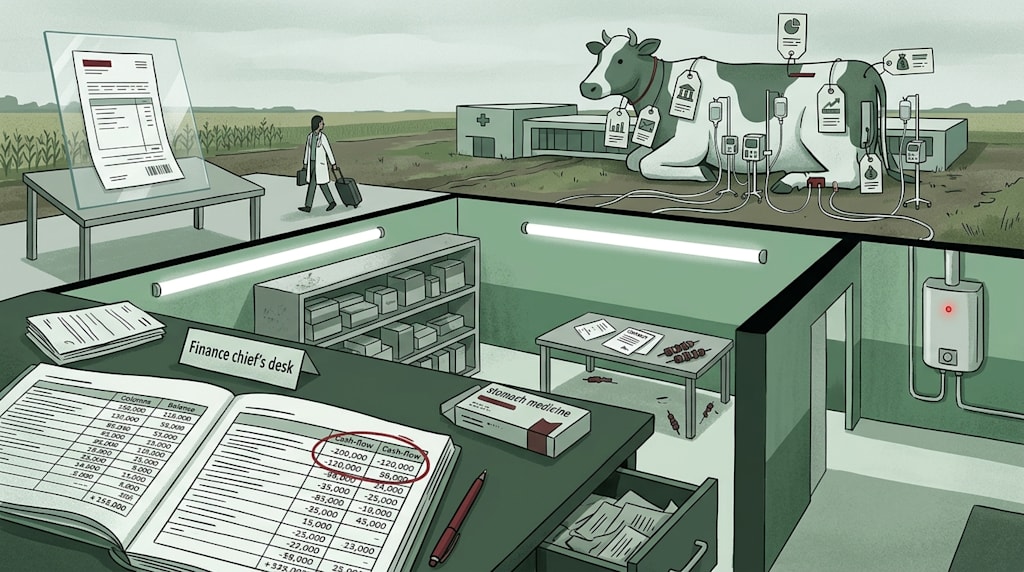
Old Zhou, the finance section chief, had two spreadsheets laid side by side on his desk.
The one on the left showed a positive figure in the operating balance row: 73,000 yuan. The one on the right showed net cash flow from operating activities in the negative: minus 4.6 million. He drew a circle around that column in red pen. The circle was very round, like the perfect marks a teacher stamps in a school exercise book. Then he capped the pen with a click, stood up, and went to get water.
The water room was at the end of the corridor. Passing the health insurance office, he saw the door open. Xiao Liu was on the phone, voice low: “…Right, still twenty-four months. After provincial pooling, the rhythm changed… I know, I know. Talk to the distributor again…”
Old Zhou did not stop. The indicator light on the water heater was red. While waiting for the water to boil, he stared at that red dot for a while. On his way back, Xiao Liu had hung up and the door was closed.
The two spreadsheets sat side by side on the desk for the rest of the afternoon.
Two
On the innermost shelf of the pharmacy warehouse, third tier from the wall, stood more than forty cases of Shenxiong Glucose Injection. After zero markup, every vial dispensed meant a loss, but the centralized procurement quota was not finished, so Old Sun the warehouse keeper could not return them. Every week he dusted them with a feather duster, then ticked the ledger to indicate “in stock, intact, untouched.”
Old Sun had been in this line for twenty-seven years. He had lived through the era of the 15 percent markup. Back then the pharmacy was a profit center. The director praised the pharmacy section at meetings for its “big contribution.” Now the pharmacy was a cost center. The director demanded that the pharmacy section “control waste.” Old Sun said: same room, same people, not even the shelves had changed, but the rules had flipped.
The feather duster was bought at a supermarket for 9.9 yuan. Old Sun paid out of his own pocket and did not claim reimbursement. He said the reimbursement process took three months, and it was not worth it for 9.9 yuan.
Three
Old Zhao, head of the equipment section, signed three maintenance contracts this year. Before signing each one, he asked the same question: “Twenty-four months for payment. Can you hold out?”
The first was an agent for Siemens. The sales manager was silent for a few seconds, said he would go back and discuss it with finance, and then never got back to him. The second was a domestic manufacturer. The salesperson slapped his chest and said no problem. The contract was signed, the equipment installed. Half a year later the salesperson jumped ship, and the first thing his replacement said was: “Section Chief Zhao, can we talk again about that payment cycle?” The third was a local distributor. The boss had known Old Zhao for more than ten years. After signing, they went for barbecue. By the third bottle of beer, the boss said: “Old Zhao, it’s not that I can hold out. It’s that I have no choice.”
Old Zhao did not answer. He put a skewer of beef tendon in his mouth and chewed for a long time.
Four
Under the glass top of the director’s desk were two sheets of paper. One was a photo of the countdown board for the branch hospital’s opening. The number had stopped at “delayed 487 days.” The other was a demand letter from the heating company: three heating seasons’ fees for the new campus, plus late penalties, totaling more than two million.
The new campus was in the development zone. Around it there was nothing but cornfields and wasteland. When the city first planned it, they said a university town, residential developments, and a subway extension would be built there. Later the university town moved to another district, the residential developer ran off, and the subway extension remained on paper. The director had resisted at the time, saying they should wait. The city said: “Put up the framework first. Supporting facilities will come gradually.” The framework went up. The supporting facilities did not come.
The other hospital did not resist. The building was finished, the branch campus built, and then it stood there for two years without daring to open. A neurologist from that hospital said over drinks: “If they tell me to go to the branch, I’ll give up my permanent post and go south to make money in a private hospital. Treating patients is treating patients. With skills in hand, I won’t starve anywhere.”
The remark got back to the main hospital. The director read it aloud at a leadership meeting. Then he said: “He’s telling the truth. It sounds harsh because it is.”
Five
At one point last year, the Women’s and Infants’ Hospital had nothing left that could be mortgaged. They wanted a loan to pay salaries. The bank looked at the statements and said: with your debt-to-asset ratio, where is the collateral? The director said equipment could be mortgaged. The bank said it was specialized equipment, hard to liquidate. The director said the building could be mortgaged. The bank said the building sat on allocated land and could not be mortgaged. In the end the city stepped in as guarantor, and they barely secured a loan to pay three months of wages.
The district and county TCM hospitals were worse off. A few years earlier, they had built new campuses for traditional Chinese medicine capacity building. The construction itself left them deep in debt, and then the industry winter hit. Now they barely ran beyond a skeleton service. The outpatient building was new, high-ceilinged, and mostly empty. Only two registration windows were open, and one had a “temporarily closed” sign. The director said: opening one window loses the electricity cost of one window; two is the limit.
Six
The city held one coordination meeting. The agenda was “relief for public hospitals.” On the last page of the meeting minutes, two signature slots were left blank: one for the finance bureau, one for the health insurance bureau. The finance bureau said the medical insurance fund was tight. The health insurance bureau said fiscal subsidies had not arrived. Each was waiting for the other to move first. The hospital director sat in the middle, the cash-flow-negative spreadsheet in front of him, and hardly said a word from beginning to end.
When the meeting broke up, Old Zhou ran into an acquaintance from the health insurance bureau in the corridor. The acquaintance patted him on the shoulder and said: “Old Zhou, hold on a bit longer. Things will get better after provincial pooling.” Old Zhou smiled and said: “Yeah. Holding on.”
On the drive back to the hospital, Old Zhou did some math in the car: the hospital’s days payable outstanding was now 670 days; its days sales outstanding was 720 days. The difference was fifty days. Those fifty days were what the hospital itself was fronting. It was fronting the suppliers’ money; the suppliers were fronting the upstream manufacturers’ money; the upstream manufacturers were fronting the banks’ money. Everyone in the supply chain was carrying the delay, waiting to see who would fail first.
Seven
Last month Old Sun dusted the more than forty cases of Shenxiong Glucose Injection again. This time he did one extra thing: he tore open the seal on the outermost case, took out one box, and checked the expiry date. Seven months left. He put the box back. He did not reseal the tape, just left it loosely closed.
The domestic equipment installed half a year ago had a three-year maintenance contract. Yesterday Old Zhao got a call from the manufacturer saying next quarter’s inspection might be postponed and the exact time would be announced later. Old Zhao asked how long the delay would be. The other side said: “Hard to say. Depends on payment collection.”
The heating company’s demand letter for the branch campus was still under the director’s glass desk top, next to the photo of the countdown board. Last week the director told the office to take down the countdown board. The office said the board was made by the city and whether to remove it had to be checked with the city. The director said: then take down the photo first. The photo was removed, leaving an empty space under the glass. Beneath it was an old sticky note, on which the previous director had written four characters: Act Within Your Means.
The paper had yellowed, but the handwriting was still clear.
Old Zhou’s two spreadsheets were still side by side on his desk. The left one showed a balance of 73,000; the right one showed a net outflow of 4.6 million. Every day before leaving, he would look at them once, then stack them together, align the edges, and put them in the drawer. The next morning he would take them out again and lay them side by side.
In the drawer there was also a box of stomach medicine, in a foil blister pack, half eaten.
About the Creator
Jin
Writer of reamstories
https://reamstories.com/jin
Enjoyed the story? Support the Creator.
Subscribe for free to receive all their stories in your feed. You could also become a paid subscriber, letting them know you appreciate their work.
Comments
There are no comments for this story
Be the first to respond and start the conversation.