
The High-End Lie: You Can’t Buy Real Service With Marble
Low wages don’t just hurt workers. They quietly hollow out the luxury you paid for.
Low Pay, No High-End
I
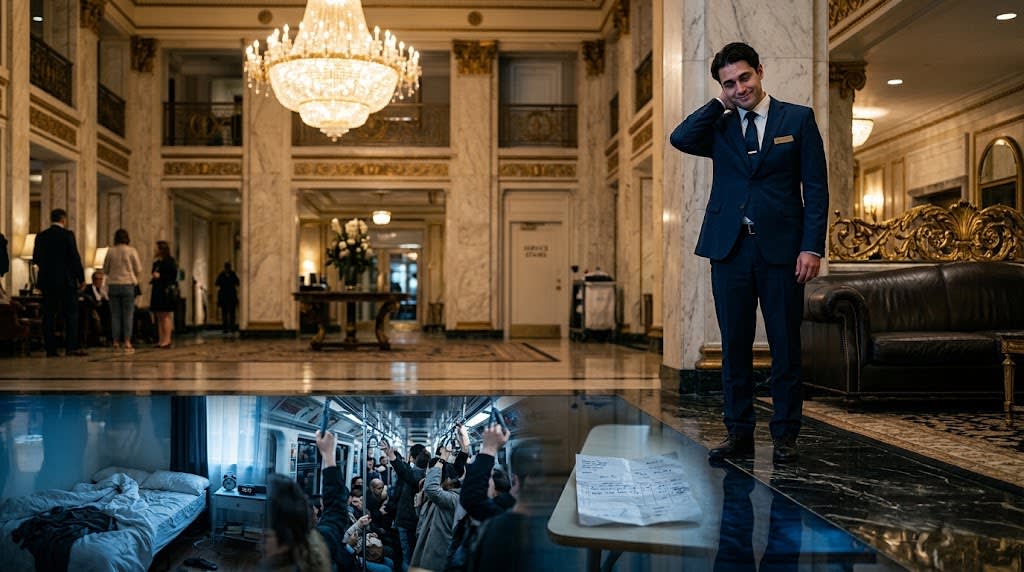
Last winter, I was waiting in the lobby of a hotel that called itself the "city's living room." The marble floor was polished enough to reflect the ceiling. A crystal chandelier hung above like frozen rain. The sofa was leather, and when you sat in it, it let out a soft sigh. A waiter passed with a tray. On the tray were two glasses of sparkling water. He set one in front of me. Condensation slid down the glass and left a dark ring on the coaster. He smiled. The curve of his mouth looked measured with a ruler. Then he turned and walked away, back straight, steps even. At the corner, his shoulders dropped. He raised a hand and rubbed the back of his neck.
That moment, I remembered a comment I had read online: a high-end place that pays its service staff low wages is still a low-end place.
II
It sounds like emotion. It is accounting.
The "high-end" quality of a place comes from two things: hardware and service. Hardware is bought with money. Marble, crystal lights, leather sofas, fragrance systems, background music. If the budget is there, anyone can buy them. Service is made by people. People are not machines. People need to eat, rent a home, support a family, commute, sleep. People need equal return for their effort before they can steadily, reliably, and without resentment give kindness.
Service is not a set of standard actions. Smiling, bowing, greeting, serving, clearing, seeing guests off. These can be written into an employee handbook, trained, assessed. The service people remember is emotional labor. It is the waiter who sees you are tired and quietly dims the light. It is the front desk who remembers you once said you are allergic to lily pollen, so this time there are no lilies in the room. It is the security guard who sees you carrying bags and quickens his step to open the heavy door. None of these actions are written in the manual. They cannot be written into it. They come from a person's willingness to look once more, think one step further, walk two extra steps. Willingness has conditions.
III
When I was choosing a kindergarten for my child, I visited five or six. One had a beautiful campus: a standalone building, a sandbox and vegetable garden outside, children's drawings along the hallway, and a reception teacher who smiled like a flight attendant. Tuition was not cheap. It was 6,800 yuan a month. I asked casually, "What is the teachers' salary, roughly?" The reception teacher paused. She said she was not clear, but their teachers were very responsible. Later I asked someone else. The lead teacher took home 3,500. The assistant took 3,000. The intern took 2,800.
I gave up on that one. The salary told me what the campus could not.
I knew a teacher with 3,500 yuan, after rent, food, and subway fare, has almost nothing left. She may leave home at 6:30 in the morning and get back at 7 at night. In between, she watches twenty children, writes lesson plans, faces inspections, answers parent messages, and settles disputes between children. She gets tired. She gets annoyed. She has moments when she thinks, "What am I doing this for?" She may still love children and still teach seriously. But she cannot give that relaxed, surplus, heartfelt tenderness. That kind of tenderness requires life to be gentle to her first.
Education happens in every interaction between teacher and child. The sandbox and the garden are only the setting. If the money does not flow to the teachers, the pretty campus is only a shell.
IV
In my community, the property management fee is 480 yuan a month. Next door, it is 90 yuan. Housing prices are similar. Location is similar. Building age is similar.
The cleaning lady in our community starts mopping at seven in the morning. She mops the lobby, then the elevators, then the hallways. While she mops, she hums. Sometimes it is "Sweet Honey," sometimes some Huangmei opera from who knows which decade. She knows most of the owners. She knows who has a dog, who just had a baby, which elderly person has bad legs. On rainy days, she puts down anti-slip mats in the lobby. When she sees someone carrying groceries, she presses the elevator button for them.
An owner from the community next door once complained to me. Garbage is not cleared until the third day. The grass in the green belt grows knee-high. The security booth is often empty. Packages are dumped at the gate. He said the fee is cheap, but living there is miserable.
Our fee is several times higher, and our property staff's income is several times higher. When the money arrives, the people stay, and their hearts stay. The cleaning lady has worked there for six years. The security captain for eight. There is an unspoken familiarity between them and the owners. Rules did not force it. Daily kindness accumulated it.
V
People worship Pang Donglai online. Its stores are not luxurious, and its locations are not prime. Its hardware is far inferior to many high-end supermarkets and boutique shopping districts. But it gives respect, pay, rest, and dignity to frontline staff. Cleaners, cashiers, salespeople. Everyone can earn a decent income through their labor, get full holidays, work under a system that does not exploit them. When employees have confidence, service has warmth. See a customer carrying something heavy, step forward to help. See an elderly person or a child, be patient. If there is a product problem, solve it sincerely. No rule or assessment forces these actions. A person who has been treated well will treat others well. This is how people work.
Many high-end places cannot learn from Pang Donglai because they want Pang Donglai's service without Pang Donglai's cost. They are willing to spend millions on decor but unwilling to give a waiter a two-thousand-yuan raise. They value stone, light, and brand over people. That ranking of values is itself low-end.
VI
Cost does not disappear. It moves.
You pay a high price to enter a high-end place. If the company spends most of that money on rent, decor, marketing, and shareholder profit, and refuses to pay frontline staff a decent wage, then the company does not bear the cost of service. It transfers the cost to the employees, who subsidize profit with low pay and emotional exhaustion. Or it transfers the cost to you: tips, service fees, or a fake high-end that is polite on the surface and cold underneath. Or it transfers the cost to the future: turnover, declining reputation, brand devaluation. It is only a matter of time.
The smile you see at the front desk. If behind it is a person living in a far-suburb rental, commuting two hours, afraid of being complained about and fined, that smile is borrowed. Borrowed things must be returned.
VII
High pay is not a cure-all. Bad management, internal friction, lack of training, toxic culture. Even with high pay, service can be bad. High pay is the foundation. The rest of the building still has to be built. But without a foundation, no building can stand. Low pay plus high pressure cannot sustain high-end service for long. In the short term, young enthusiasm can hold it up. In the long term, good people leave, those who remain are tired, and service slides into perfunctoriness.
Wages are the most direct expression of respect. Treatment is the solid confidence behind service. Low pay corresponds to cheap labor and perfunctory service. Decent pay corresponds to professional dignity and devoted service. If a place maintains its high-end exterior by suppressing frontline wages for a long time, its high-end is incomplete and unsustainable. It treats customers as tourists of a luxury shell and employees as parts that keep the shell running.
VIII
I went back to that "city's living room" hotel three months later. The lobby was the same. The crystal chandelier was the same. The leather sofa was the same. But the waiters had changed. The one who brought me water was a young boy. He moved fast. A few drops splashed out when he set the glass down. He smiled halfway, then stopped. His eyes had already drifted to the next table.
I asked, "Where is the tall guy from before?"
He said, "He left. Went to a mall as a sales assistant. Base pay is five hundred more."
I held the glass. Condensation was still sliding down. I remembered the tall guy rubbing his neck at the corner. That action was small. So small you would not notice unless you were looking. But in that action was a whole ledger: his wage, his commute, his rent, his exhaustion, the remaining balance of his patience for this job.
The crystal chandelier was bright. The marble was bright. The leather sofa was bright. But one neck-rub dimmed all of it.
A place becomes high-end through distribution. Decor alone cannot do it. Money flows where dignity flows. Dignity flows where service can grow.
Low pay, no high-end.
About the Creator
Jin
Writer of reamstories
https://reamstories.com/jin
Enjoyed the story? Support the Creator.
Subscribe for free to receive all their stories in your feed. You could also become a paid subscriber, letting them know you appreciate their work.
Comments
There are no comments for this story
Be the first to respond and start the conversation.