
The Hidden Cost of Choosing the Wrong European City
(And How I Stopped)

There's a specific kind of disappointment that lands on day two of a European city break. You're standing in some square, looking at some cathedral, and you realize — without being able to say it out loud — that you don't really want to be here. You wanted the idea of being here. The reality turned out to be a different thing.
I felt that for the first time in Munich, in late September.
Beautiful city. Spotless trams. Beer halls doing exactly what beer halls do. But it was already cold, my budget was draining faster than I'd planned, and every dinner became a small financial calculation. I kept telling friends back home that the trip was great — because that's what you say about Munich. Privately, I wished I'd gone almost anywhere else for half the cost.
Four days. Around €1,400. Which would have been fine if those four days had been the best four days of my year. They weren't even the best four days of that month.
That trip is when I started paying attention to a question I'd been avoiding: why do I keep picking cities I've heard of, instead of cities that would actually suit the trip I want?
The branding problem
Most European cities arrive in your head pre-packaged. Munich means beer and order. Paris means romance. Barcelona means architecture and slightly chaotic nightlife. Prague means cobblestones and a good exchange rate from a decade ago.
These mental shortcuts feel like knowledge. They aren't. They're marketing, mostly — accumulated from films, Instagram carousels, articles written by people who flew in on a press trip in 2017. They tell you what a city is famous for, not what it's actually like to spend four days there now, at your budget, with the energy levels you have at your age.
I'd been picking trips based on this stale branding for years. Munich because it sounded "serious." Amsterdam because it sounded "fun." Vienna because it sounded "cultured." I was effectively letting tourist boards from twenty years ago plan my holidays.
The trip that flipped it
The next time I had to choose, I tried something different. I had a long weekend free in November and €600 to spend. My defaults would have been Vienna or Salzburg — Christmas-market season, everyone goes, everyone's heard of them.
Instead I sat down with the Kubik trip website — a small travel platform that compares European cities by actual data, not by reputation. Cost per day. Safety signals from real reviews. How a city scores on gastronomy, walkability, transport, things people who actually went there said about it.

Two cities I'd been mildly ignoring kept appearing near the top: Bologna and Catania.
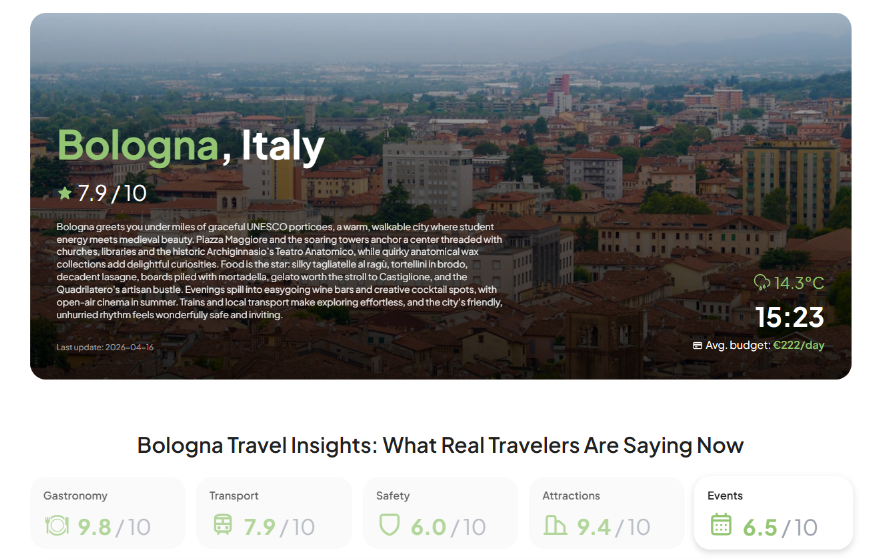
Bologna I knew about in theory — the food is famous — but I'd always quietly classed it as "expensive Italy." The data said otherwise: around €260 a day, scoring 7.9 overall, better than half the cities on my usual shortlist.
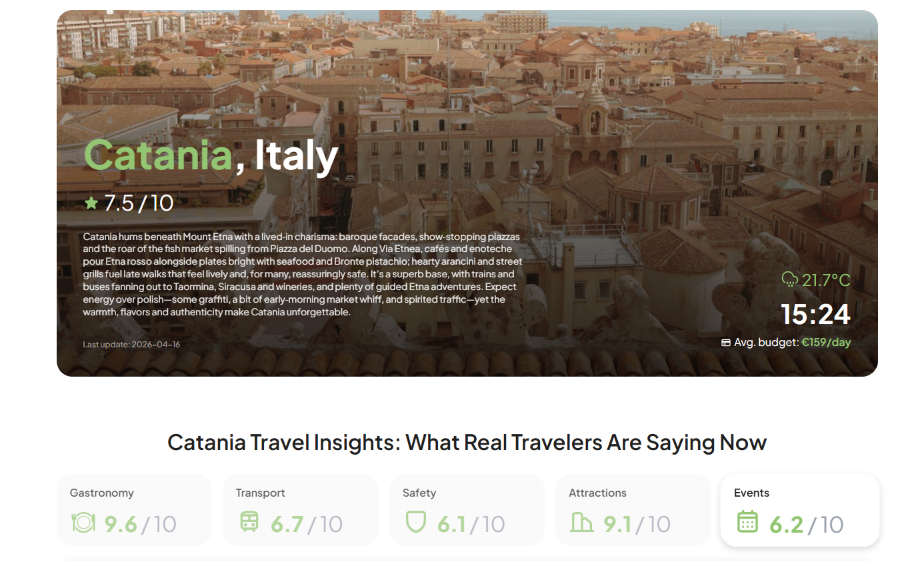
Catania I'd never seriously considered. It scored 7.5 on around €185 a day. €185. For Sicily. That number didn't match anything in my mental map of European prices.
I went to Bologna. Three days of eating tortellini in tiny rooms, walking under the porticoes when it rained, paying about €60 for a dinner that would have been €140 in Munich. The trip cost €580. I came home not just having enjoyed myself, but without that low-grade financial unease that follows you back from expensive cities for weeks.
What I'd been getting wrong
It wasn't the platform that changed anything, really. It was admitting something uncomfortable: my instincts about European travel were outdated by about a decade.
Cities I'd written off as boring were the ones travelers were rating highest. Cities I assumed were affordable had quietly become expensive. The cheap-versus-pricey map I'd been carrying in my head — Eastern Europe cheap, Western expensive, Mediterranean somewhere in the middle — wasn't true anymore. Krakow now costs more per day than Catania. Glasgow scores higher than half the cities people fly through it to get to. Lille beats Munich on basically every metric except sausage availability.
I'd been making trip decisions on a map that no longer existed.
The actual cost of getting it wrong
Here's the thing nobody mentions: the real cost of a disappointing European trip isn't the money. It's the trip you didn't take. The four days you spent in Munich being mildly unhappy were four days you couldn't spend in Naples being delighted. The thousand euros that vanished in Vienna couldn't be spent on a longer week in Porto.
A bad trip is opportunity cost wearing a wool coat.
If you travel two or three times a year, that adds up. Over a decade, it's the difference between having seen a wide, weird, varied Europe — and having seen Munich four times because that's where your defaults kept sending you.
What I do now
I haven't become rigorous about this. I'm not running spreadsheets. I just don't book a city anymore without spending ten minutes comparing it against two or three alternatives I hadn't considered.
Sometimes I still pick the famous one. Sometimes the data confirms my instinct and I book Munich anyway. But more often than not, I end up somewhere I'd never have chosen on my own — Bologna, Catania, Lille, Bilbao — and those have become the trips I actually remember.
The cities you've heard of aren't the wrong choice. They're just one choice, dressed up to look like the only one.
The day I stopped letting them dress up like that was the day my travel stopped disappointing me.
About the Creator
Enjoyed the story? Support the Creator.
Subscribe for free to receive all their stories in your feed.
Comments
There are no comments for this story
Be the first to respond and start the conversation.