
The Great Pyramid Silence: What the Stones Aren’t Telling Us
Uncovering the engineering secrets and hidden chambers that defy 4,500 years of conventional history.

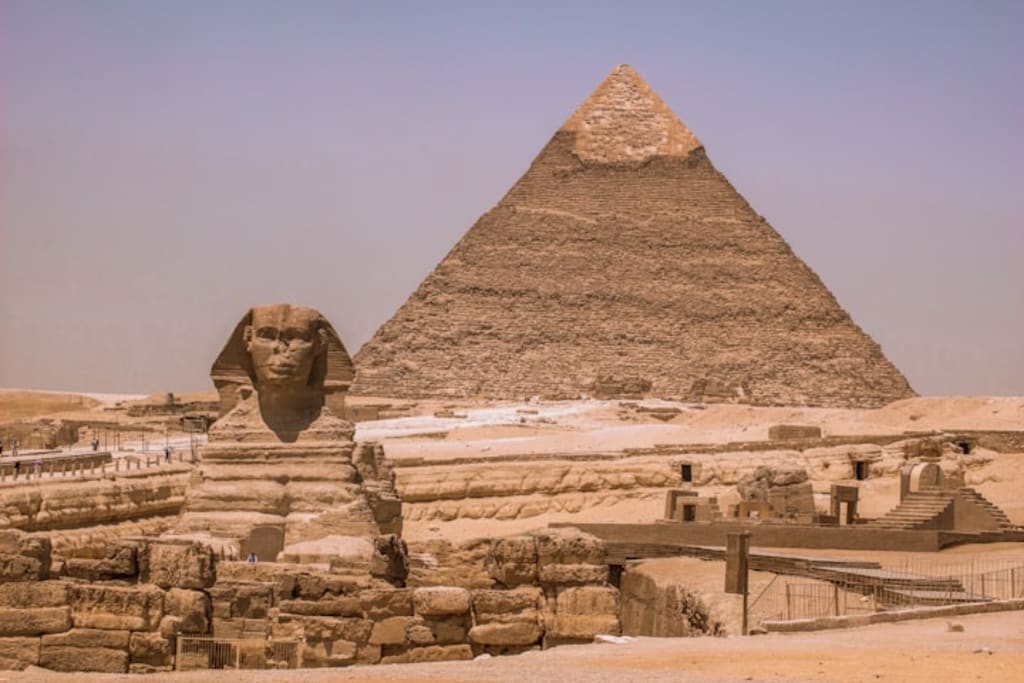
For over 4,500 years, the Great Pyramid of Giza has stood as a silent titan against the Egyptian horizon. It is the last remaining wonder of the ancient world, a geometric masterpiece of 2.3 million stone blocks that defies the simple label of "tomb." While mainstream archaeology tells us it was built for the Pharaoh Khufu, a growing chorus of engineers, historians, and explorers are looking at the precision of the stones and asking a dangerous question: What if we have the story completely wrong?
The Mathematical Impossible
To understand why the Pyramids remain a focal point of mystery, we have to look past the sand and into the math. The Great Pyramid is aligned to True North within three-sixtieths of a degree. This isn't just "close enough"; it’s a level of precision that modern architects struggle to achieve without GPS and laser-guided equipment.
Furthermore, the dimensions of the pyramid incorporate the values of \pi (Pi) and \Phi (the Golden Ratio). How did a civilization—one we are told lacked the wheel and iron tools—encode the fundamental constants of the universe into a mountain of limestone?
The Logistics of a Giant
Consider the weight of the task. Some of the granite slabs in the King’s Chamber weigh over 80 tons. These weren't pulled from a local quarry; they were transported from Aswan, over 500 miles away.
The Weight: 6 million tons in total.
The Timing: If the pyramid was built in 20 years (as usually claimed), workers would have had to set a block every two minutes, 24 hours a day, 365 days a year.
The Precision: The joints between stones are so tight that you cannot fit a razor blade between them.
Beyond the Tomb: The Power Plant Theory
One of the most popular "other" themes in the Giza discussion is the "Giza Power Plant" theory. Proponents argue that the Great Pyramid shows no signs of being a tomb—there are no hieroglyphics inside, no mummies were ever found in the original chambers, and the "sarcophagus" is a lidless granite box that looks more like a resonator than a coffin.
Chemical traces of hydrochloric acid and zinc have been found in the "air shafts," leading some to speculate that the pyramid was a massive chemical battery or an energy harvester utilizing the Earth’s natural vibrations. While controversial, this theory explains why the structure is located exactly at the center of the Earth's landmass.
The Hidden Chambers
In 2017, the "ScanPyramids" project used cosmic-ray muon radiography to look through the stone. They discovered a "Big Void"—a massive, 30-meter-long space right above the Grand Gallery.
What is inside the void?
Lost Records: Some believe it holds the "Hall of Records," a library of a pre-cataclysmic civilization.
Structural Gaps: Sceptics argue it’s just a weight-relieving space to keep the pyramid from collapsing under its own mass.
The True Pharaoh: Some still hope it contains the undisturbed burial of a king we have yet to meet.
The fact that we are still finding massive rooms in the most studied building on Earth proves that the "History Box" of Egypt is far from empty.
The "Orion Correlation" and Ancient Astronauts
We cannot talk about the Pyramids without looking up. The three pyramids of Giza align almost perfectly with the belt of the Orion constellation. To the ancient Egyptians, Orion was Sah, the manifestation of Osiris.
This celestial connection suggests that the Giza plateau wasn't just a cemetery, but a "map of the stars" brought down to Earth. Whether this was for religious ritual or, as some suggest, a beacon for travelers from above, it points to a culture that was obsessed with the relationship between the human and the divine.
Why the Mystery Persists
The reason the Great Pyramid fascinates us in 2026 as much as it did in 1926 is that it acts as a mirror. When we look at it, we see our own technological desires and our own search for meaning.
If it was just a tomb, it is the most inefficient, over-engineered tomb in human history. If it was something more—a temple of initiation, a power source, or a message in stone—then we have to admit that the "primitive" ancients knew something about the world that we have forgotten.
Final Thoughts
As we peel back the layers of the Giza plateau, the mystery only deepens. Each discovery leads to five more questions. Perhaps the Great Pyramid wasn't built to hide a body, but to preserve a truth: that humanity is capable of the impossible when we align our efforts with the stars.
Author's Note
If you enjoyed this dive into the sands of Giza, click the Heart icon below! I’ll be posting more deep dives into the world's greatest historical mysteries every week. Subscribe to stay updated on the "History Box" project!
About the Creator
Enjoyed the story? Support the Creator.
Subscribe for free to receive all their stories in your feed.
Comments
There are no comments for this story
Be the first to respond and start the conversation.