
The First Man to Press the Gas Pedal: Tung Chee-hwa and the 8 Years That Tested Hong Kong
He took office three months before the Asian financial crisis hit. He fought global speculators, tried to break the property cartel, opened the border to free travel, and left behind a pothos plant that no one remembers watering.
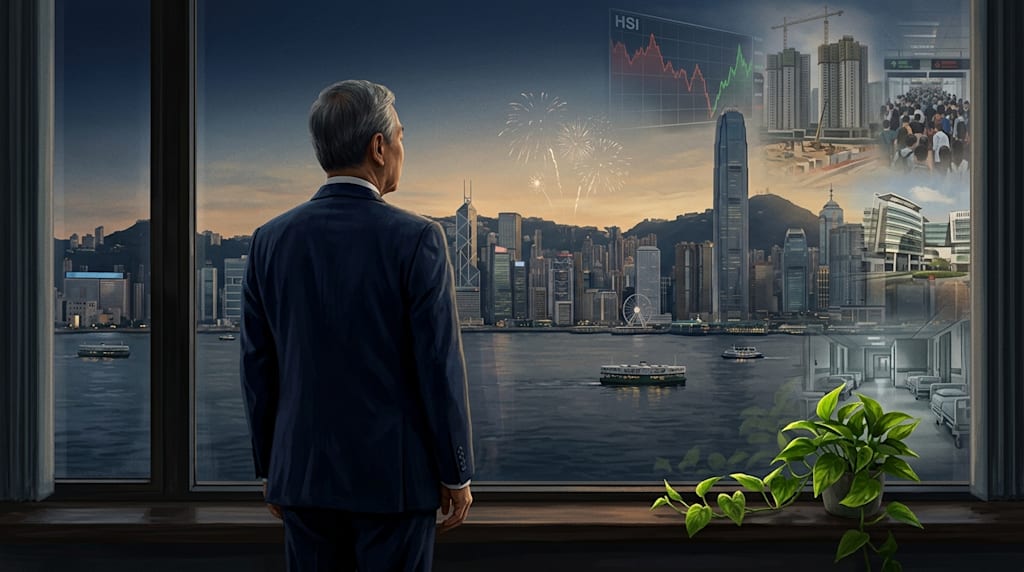
Tung Chee-hwa: The First Man to Press the Gas Pedal
On September 8, 2026, Tung Chee-hwa's office released a statement: Tung Chee-hwa, former Vice Chairman of the National Committee of the Chinese People's Political Consultative Conference and the first Chief Executive of the Hong Kong Special Administrative Region, passed away peacefully that day at the age of 89.
The office's statement included a line: "He was upright and uncompromising, held the country in his heart, and worked himself to the bone." That is the official framing. The details that follow are the ones the statement will not carry.
I
At midnight on July 1, 1997, he stood on the stage at the Convention and Exhibition Centre, his right hand raised, his left hand resting on the Basic Law. Some people in the audience cried. He did not. After the oath, he glanced out the window. Fireworks were exploding over Victoria Harbour.
Before that moment, he had spent more than a decade doing business in Hong Kong. After that moment, he became the first person to operate "One Country, Two Systems." There was no predecessor's experience to copy, no template to follow. Britain had governed Hong Kong for 156 years. What it handed back was an entire governance framework that had to be built from scratch: the SAR government, the courts, customs, the police force, and the smooth transition of more than 400 senior Hong Kong officials. The West was watching from behind, waiting to see whether this system could run at all.
He made it run.
II
Three months into office, the Asian financial crisis hit him in the face.
Soros and others shorted the Hong Kong dollar and Hong Kong stocks. The Hang Seng Index was cut in half, from over 16,000 points to 6,500. The property market collapsed. Overnight, more than a hundred thousand middle-class people became holders of negative equity. International hot money was pounding at the door. The linked exchange rate was under attack.
On August 14, 1998, he signed the last document, put down his pen, and said one sentence to Donald Tsang: "Let's begin." Then he stood up, walked to the window, and turned his back to everyone in the room. That day, the SAR government used about HK$120 billion of foreign exchange reserves to enter the market and prop it up, dragging the Hang Seng Index back from the bottom. Back then, you could not find a second government anywhere in the world willing to step into the ring and bet against international speculators.
Later, some people grumbled that this was "interfering with the free market." But the Hong Kong financial system did not collapse, and the linked exchange rate held. The life savings of more than a hundred thousand middle-class people did not go to zero.
III
He did something even more ahead of its time: he went after high property prices.
The "85,000" housing plan aimed to build 85,000 units a year, to give 70 percent of Hong Kong households their own homes within ten years, and to cut the public housing waiting time from 6.5 years to 3. More than twenty years ago, he was the first Hong Kong leader willing to touch the property developers' pie.
After the financial crisis, the property market crashed. Large numbers of homeowners took to the streets in opposition. The plan was forced onto the shelf. One afternoon in 2000, he passed by a public housing construction site. Work had stopped. He stood there for a while and asked the person next to him: "How many floors was this plot supposed to have?" The person said: "Forty." He nodded and said nothing more.
Hong Kong's housing predicament today proves exactly what he saw through back then: when real estate kidnaps a city, sooner or later there will be a problem. It was just that, in that era, reform could not go forward.
IV
In the 1990s, everyone in Hong Kong was piling into property speculation. He called for Hong Kong to become an information technology center. He pushed through Cyberport and the Science Park over strong opposition.
In his 1998 Policy Address, when he read the word "Cyberport," someone in the audience laughed. He paused, then kept reading. Twenty years later, the company of the person who laughed moved into Cyberport. Today Cyberport has incubated over a thousand tech startups and become the main incubation base for Hong Kong's internet and fintech startups.
He also pushed "biliteracy and trilingualism": Cantonese, Putonghua, and English; Chinese and English. Before the handover, Hong Kong's written language was a mix of Chinese and English, spoken Cantonese and English dominated, and Putonghua was basically marginalized. He brought Putonghua into the core education targets. During his tenure, education spending totaled more than HK$260 billion, an overall increase of 46 percent, ranking first among all policy areas. That money could have built two Chek Lap Kok airports, or 2,600 secondary schools.
V
In 2003, SARS hit Hong Kong. 1,755 people were infected. 299 died. Tourism and retail nearly came to a halt. Before the crisis had even subsided, he pushed CEPA through and, immediately after that, opened the Individual Visit Scheme for mainland residents traveling to Hong Kong.
In June 2003, after signing CEPA in Beijing, on the plane back to Hong Kong, he asked the people traveling with him: "When will the first batch of Individual Visit tourists arrive?" The person said: "At the earliest, next month." He said: "Good. Then I want to go to the border checkpoint and take a look."
In the first year after the Individual Visit Scheme started, the number of mainland visitors to Hong Kong jumped by more than ten million, pulling Hong Kong's tourism and restaurant industries back from the bottom. This step bound Hong Kong's economy to the mainland market. That arrangement still shapes Hong Kong's economy.
VI
On March 10, 2005, he walked into his office, sorted the papers on his desk, put the keys in the drawer, then stood up, looked at the map of Hong Kong on the wall, turned off the light, and walked out. Citing health reasons, he resigned early from his post as Chief Executive.
Eight years as Chief Executive. Economic transition was painful. Livelihood reforms were hard to push through. Social tensions built up. But what he carried was the storm of Hong Kong's first eight years after the handover.
After leaving office, he did not fade away. In 2014, at the founding meeting of Our Hong Kong Foundation, he said one sentence: "I am seventy-seven this year. I could do nothing at all. But I cannot let it go." He founded Our Hong Kong Foundation and spent years traveling between the mainland and overseas as a bridge for communication and stability. In 2019, he was awarded the national honorary title of "Outstanding Contributor to 'One Country, Two Systems.'"
VII
On the windowsill of his office, there was always a pothos plant. After he left, the pothos was still there. No one remembers who watered it, but it is still alive.
Farewell, Chief Executive Tung.
About the Creator
Jin
Writer of reamstories
https://reamstories.com/jin
Enjoyed the story? Support the Creator.
Subscribe for free to receive all their stories in your feed. You could also become a paid subscriber, letting them know you appreciate their work.
Comments
There are no comments for this story
Be the first to respond and start the conversation.