
The Fascinating Journey of Multilingual Voice Acting: A Deep Dive with Joe Mohan
Voice acting isn’t just about speaking different languages; it’s about capturing the essence of each language and delivering it with authenticity and emotion.

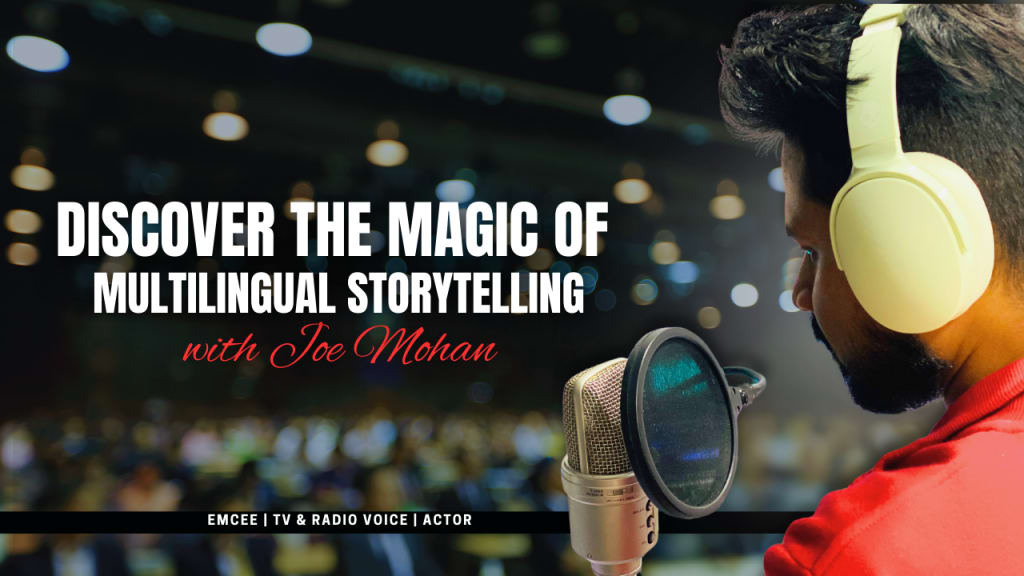
For me, multilingual voice acting and rendering voiceovers, has been a journey of connecting with people from diverse backgrounds and cultures. Every language has a soul, and it’s the job of a voice artist to honor that soul.
Throughout my career as an Emcee, Anchor, and VoiceOver Artist in the UAE and beyond, I’ve learned that true connection comes when you respect and embody the cultural nuances of each language. Voice acting isn’t just about mimicking accents, it’s about living and breathing the language, its rhythm, and its emotion.
The Power of AUTHENTICITY in Multilingual Voice Acting
When I first began my career, I quickly realized that authenticity is the key to successful multilingual voice acting. Being fluent in multiple languages, English, Hindi, Urdu & Malayalam, has also come with the responsibility of ensuring that each language is portrayed in a way that resonates with native speakers.
The power of language is immense, and as an Anchor and Emcee on stage, I’ve come to understand how tone, pace, and cultural context shape how people connect to a message. It’s not enough to simply speak; to truly engage your audience, whether you're performing a voice-over or hosting an event, you need to make them feel something.
For instance, when I perform in Hindi & Urdu, I lean into its poetic nature, allowing the words to flow naturally and with proper pronunciations while adding depth by respecting its cultural nuances. In English, I embrace its richness yet keep it simple because it is not about showing off how many difficult words you know; it is about how easily you are intelligible to English speakers from any part of the world. When I speak in Malayalam, I tap into the local flavor, warmth and intimacy the language carries. This is what makes multilingual voice delivery so powerful: every language has its own identity, and as a voice artist, it’s your job to respect and reflect that identity with authenticity.
IMMERSION: The Secret to Mastering Multilingual VoiceWork
Achieving authenticity in different languages doesn’t come from simply learning the words; it comes from immersion. For me, the process involves listening to native speakers, absorbing cultural references, and truly understanding the context in which words and phrases are used.
I remember a particularly insightful experience while working on an Arabic voiceover project. Humor, I learned, is approached differently in Arabic culture compared to English. A simple joke in English might need a more formal or poetic twist to land well with an Arabic audience. This subtlety is something that can only be understood through immersion in the culture, not just the language.
Voice acting is more than just a technical skill, it’s about respecting the cultural layers that shape a language. Whether I’m hosting a corporate event in the UAE or performing a voiceover for a global campaign, understanding these differences makes all the difference in delivering a performance that feels real and engaging.
The Role of LISTENING in Becoming a Master Multilingual Voice Artist
As an Emcee and Anchor who works across cultures, I’ve learned that the most important skill you can develop is the ability to listen. Listening doesn’t just mean hearing words; it means paying attention to the rhythm, the pauses, the intonation, and the emotion behind each sentence.
In my career, I’ve had the privilege of working with some incredibly talented people across different cultures. Whether they’re in Dubai, Muscat, Mumbai, Kerala, Delhi or elsewhere, listening to native speakers of various languages has been crucial in refining my delivery. Native speakers can teach you the subtleties that textbooks and language courses can’t.
Across these numerous interactions in Hindi / Urdu / Malayalam, I discovered that the tone of voice needed to convey seriousness or humor could be vastly different than in English. A line that may seem light-hearted in one language might require a more respectful and formal delivery in another. Paying attention to these nuances is vital to ensuring that your voice acting feels authentic and connected.
The Art of MULTILINGUALISM and Deepening Audience Connections
A memorable moment during a multilingual project occurred while I was working on a campaign in Dubai. The client asked me to dub a promotional VO script in Hindi, and after a break, I casually switched to casual Arabic when speaking with the audio-engineer about the edits. To my surprise, one of the clients overheard and was completely taken aback. “Wait, didn't you say you are from India?” they asked, astonished. Interestingly the rest of the session was very smooth, and I could feel the warmth and the vibe within the recording room was much better. This moment highlighted the versatility that a multilingual voice artist brings to the table.
When you’re able to fluidly switch between languages, it not only impresses clients but also deepens your connection with your audience. It shows that language isn’t just a tool for communication, it’s a bridge that unites people across cultures.
LESSONS Learned from Multilingual Voice Acting
Through my journey as a Voice Over Artist, Anchor, and Emcee, I’ve picked up several invaluable lessons about multilingual voice acting. These lessons can help you master the art of connecting with diverse audiences.
1. Respect Every Language
Every language has its own history, quirks, and cultural significance. Don’t just memorize words, immerse yourself in the culture behind the language to truly capture its essence.
2. Listen Before You Speak
The best voice actors are excellent listeners. Pay attention to the subtle nuances in the language and how native speakers deliver phrases.
3. Embrace Mistakes
It’s okay to make mistakes. I’ve stumbled over pronunciations, but each mistake taught me something new about the language I was speaking.
4. Authenticity Over Perfection
People connect more with an authentic delivery than with a flawless performance. If you sound genuine, your audience will feel it.
Why Multilingual Voice Acting Matters?
Multilingual voice acting is about more than just voiceover work, it’s about breaking down barriers and creating connections across cultures. As a multilingual Emcee, Anchor, and Actor, I’ve had the privilege of using my voice to bring people together, whether through hosting live events, providing live commentary, voicing characters or acting on screen, in different languages.
The beauty of multilingual voice acting is that it allows me to step into different worlds. It’s not just a job; it’s an opportunity to connect with people on a deeper level, to make them feel heard, and to share stories that resonate universally. Whether it’s a corporate event or a voiceover project or an Acting Project, I get to connect with audiences on their terms, in their language, and in a way that feels authentic and meaningful.
At the end of the day, voice acting is about more than just words. It’s about telling stories in a way that crosses cultural boundaries, bridges divides, and leaves a lasting impact on people. It’s about connecting.
About the Creator
Joe Mohan
Joe Mohan, also known as VoiceGuyJoe, wears many hats in the entertainment world. An Indian by origin, based in UAE, Joe Mohan is an award-winning anchor, versatile voiceover artist, TV presenter, and a promising actor.
Enjoyed the story? Support the Creator.
Subscribe for free to receive all their stories in your feed.
Comments
There are no comments for this story
Be the first to respond and start the conversation.