
The Factory Is Gone. The Debt Isn’t. The Court Just Sealed the Door.
What 100+ former Wahaha workers discovered after their plant shut down—and why their 2 million yuan housing fund fight is a warning for everyone.
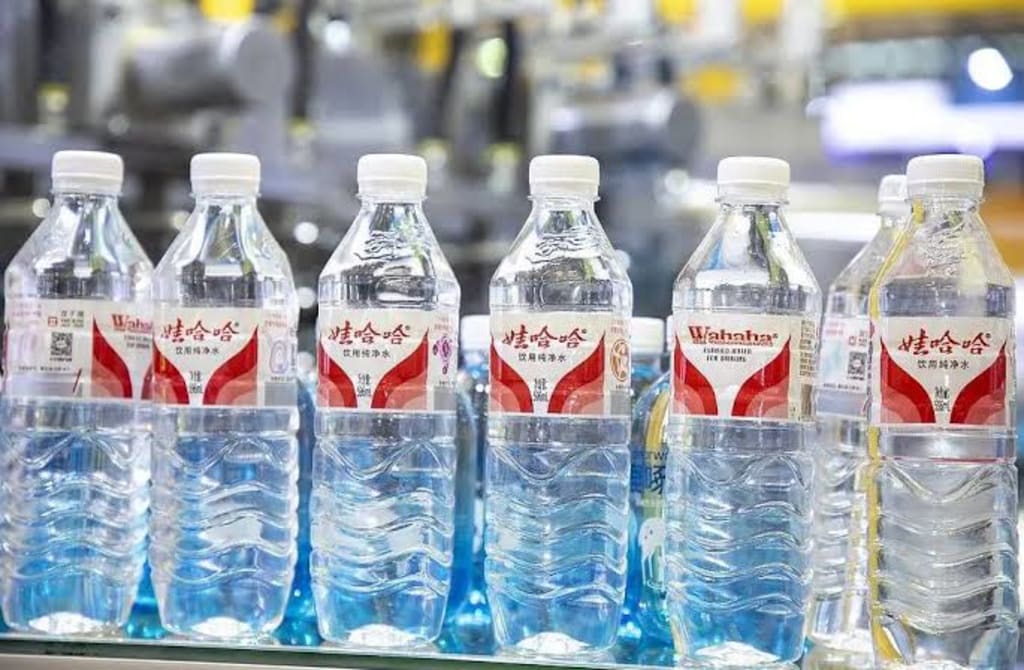
A Seal on the Door: The Hulin Wahaha Factory and the Housing Provident Fund Arrears Case
I
On August 20, 2026, a court seizure notice from the Jiguan District People’s Court of Jixi City, Heilongjiang Province, was pasted on the door of the office building of Hulin Hongsheng Beverage Co., Ltd.
The notice stated that, pursuant to civil ruling (2026) Hei 0302 Cai Bao No. 360, the court had seized a building owned by the company, located at Huanan Committee, Hongqi Street, Hulin City, with property certificate No. 2014001421 and an area of 2,889.17 square meters. The seizure period was three years, from August 20, 2026, to August 20, 2029.
A former employee who left after the factory shut down confirmed that the seizure had been applied for by the Jixi Municipal Housing Provident Fund Management Center as property preservation, and that the notice had been posted inside the office building. Staff at the Hulin Management Department of the Jixi Municipal Housing Provident Fund Management Center also confirmed this.
What was sealed was not a production workshop. It was the office building.
The company that owned the building had already completed the full process of renaming from “Wahaha” to “Hongsheng,” shutting down, and filing for liquidation. By the time the seal was applied, the company was applying for deregistration.
II
The timeline, once laid out, shows that almost every step landed on a critical point for employee rights.
On September 8, 2025, Hulin Wahaha Beverage Co., Ltd. changed its name to Hulin Hongsheng Beverage Co., Ltd. Lishui Hongbo Beverage Co., Ltd. and Ronghui Investment Co., Ltd. held 70 percent and 30 percent stakes respectively. The legal representative of Lishui Hongbo was Zong Fuli. In the same year, several former “Wahaha Changsheng” companies in Baishan, Chengdu, Guiyang, Chongqing, and other places also changed their names to “Hongsheng” or “Hengfeng.”
In March 2026, the factory shut down. Employee Mr. Chen remembered it clearly: “Production was normal until late March. Then the regional manager and the general manager suddenly arrived and began talking to employees about terminating their labor contracts.” Another employee, Mr. Liu, who had worked there for 15 years, heard the explanation as “strategic adjustment.” Before the shutdown, about 95 employees were interviewed and had their labor contracts terminated. Severance was paid at 80 percent.
After the shutdown, employees discovered that the factory had long underpaid or failed to pay housing provident fund contributions. “Some people had nothing paid at all; others had insufficient amounts paid.” They organized and complained to the local housing provident fund authorities. According to former employees, before the factory shut down, more than 100 employees were owed more than 2 million yuan in housing provident fund contributions.
On May 7, 2026, Hulin Hongsheng filed its liquidation group with the National Enterprise Credit Information Publicity System and formally entered deregistration proceedings under the name of “resolution dissolution.” The head of the liquidation group was Yan Xuefeng, a core executive of Hongsheng Beverage Group.
On May 18, 2026, the Hulin Management Department of the Jixi Municipal Housing Provident Fund Management Center issued an administrative guidance opinion. It stated that it had received petition complaints from 95 employees and, after verification, confirmed that the company had failed to pay housing provident fund contributions on time and in full, in violation of Article 38 of the State Council’s Regulations on the Management of Housing Provident Funds. The company was required to produce a supplementary payment plan and submit a written rectification report within 15 days of receiving the opinion.
The company did not rectify.
On August 20, 2026, the court sealed the office building.
Less than five months from shutdown to seizure. Less than four months from liquidation filing to seizure.
III
The legal basis for the seizure is written in Article 38 of the Regulations on the Management of Housing Provident Funds: if a unit fails to pay or underpays housing provident fund contributions after the deadline, the housing provident fund management center shall order payment within a time limit; if payment is still not made after the deadline, the center may apply to a people’s court for compulsory enforcement.
This is not a new policy. It existed when the regulations were promulgated in 1999. After two amendments, the core authorization remained unchanged. In August 2026, when the State Council published its decision to amend the regulations, the clause was renumbered from Article 38 to Article 40, effective September 20, 2026, but the core authorization for compulsory enforcement was fully retained.
A legal channel that has existed for more than two decades. Yet those who have walked through it have always been few.
For this case to trigger that channel, several conditions had to be met at the same time: 95 employees collectively complained, creating a complete petition record; the housing provident fund center’s administrative verification confirmed the arrears; and the company failed to rectify within the 15-day deadline. When the administrative process reached its end, judicial preservation became the only option.
“Property preservation is not a commonly used path in housing provident fund recovery,” one observer following the case noted. “Among recoverable cases of housing provident fund recovery during corporate liquidation or deregistration in the past five years, the mainstream approach has been to treat the arrears by analogy as unpaid wages, include them in the scope of priority repayment, and achieve payment through negotiation or direct compulsory enforcement.”
The channel has always existed. The Hulin case happened to hit every node.
IV
Housing provident fund recovery is different from social insurance. Social insurance relies on random inspections and patrol inspections. In practice, the housing provident fund is closer to a pure complaint-based system. Without an employee report, the provident fund center usually does not intervene on its own. And the force behind a single employee complaint is nowhere near that of a collective petition by 95 people.
In this case, the employees submitted complete evidentiary materials. After verification, the provident fund management center issued a formal administrative guidance opinion confirming the fact of “failure to pay on time and in full.” That opinion became the direct basis for the subsequent application for court property preservation.
There is another often-overlooked feature of housing provident fund recovery: there is no statute of limitations. Unlike labor arbitration, a former employee seeking unpaid housing provident fund contributions is not bound by the one-year arbitration limitation period. Even after many years, as long as the evidence is sufficient, one can still recover contributions owed during employment. In Shanghai, a worker recovered more than 10,000 yuan in underpaid housing provident fund from a former employer within 21 days of leaving. In Beijing, an employee recovered more than 70,000 yuan in underpaid contributions over five years.
For the Hulin factory employees, the recovery window is open. But beyond that open window lies a more fundamental constraint: the company must have assets that can be enforced against. Whether the recovery ultimately succeeds does not depend on how complete the legal provisions are. It depends on whether the entity against which enforcement is sought has money to pay.
V
Seizure does not equal recovery.
In May 2026, Hulin Hongsheng had already begun liquidation proceedings under the name of “resolution dissolution.” Under the Supreme People’s Court’s rules on hearing bankruptcy cases, if the company later enters bankruptcy acceptance, all previous property preservation measures must be lifted in accordance with law, and all assets must be included in the liquidation estate for unified distribution. As long as the auction proceeds have not yet been paid to the applicant for enforcement, other creditors who have already obtained enforcement titles also have the right to apply to participate in distribution.
The seizure preservation applied for by the provident fund center may face being “swallowed” once liquidation proceedings are fully underway.
The asset side is not easy either. Qixinbao shows that Hulin Hongsheng has land mortgages and chattel mortgage records. As of publication, no public materials confirm whether the seized 2,889-square-meter property is subject to bank mortgages or prior judicial seizures. If it is, creditors with mortgage security rank ahead of ordinary creditors in repayment, and the housing provident fund does not enjoy a “super-priority” that allows it to skip ahead of them.
The numbers on the asset disposal side are also not optimistic. In 2025, the average realization discount for industrial judicial auctions nationwide was only 78.53 percent of the appraised value. If the first auction fails and the property goes to a second auction, the starting price may drop directly to 56 percent of the appraised value. What price an industrial office building can fetch on the judicial auction market is highly uncertain.
“The amended Regulations on the Management of Housing Provident Funds of 2026 clearly state in Article 40 that if a unit fails to pay after the deadline and the provident fund center orders payment within a time limit and payment is still not made, the center may directly apply to a court for compulsory enforcement,” one analyst noted. “More importantly, when an enterprise dissolves and liquidates, unpaid housing provident fund contributions are clearly provided for in local implementation rules—they are treated by analogy as unpaid wages and given priority repayment. But ‘priority’ does not mean ‘exclusive,’ and it certainly does not mean ‘certain to be recovered.’”
There is a comparable case: in 2019, in a bankruptcy liquidation case involving 143 employees in Tianjin, the employees ultimately recovered 100 percent of the unpaid housing provident fund, totaling more than 4 million yuan. But that was the result of coordination among the provident fund center, the court, and the liquidation group over about four years. That case is encouraging, but it cannot be used to infer that “as long as there is preservation, full recovery is guaranteed.”
VI
The housing provident fund arrears at the Hulin factory are not an isolated case within the Wahaha system.
Jiemian News found multiple administrative decisions involving “Shenyang Wahaha Rongtai Food Co., Ltd.” and “Shenyang Wahaha Food Co., Ltd.” in public information from the Shenyang Municipal Housing Provident Fund Management Center. One decision made in September 2025 showed that the Shenyang center ordered Shenyang Wahaha Rongtai Food Co., Ltd. to make supplementary housing provident fund payments for 273 employees, involving more than 13.5 million yuan.
In January 2026, the Shenyang center also required Zong Fuli and her affiliated Shenyang Wahaha Rongtai Food Co., Ltd. to make a supplementary housing provident fund payment of 49,432.29 yuan for an employee surnamed Li.
Shenyang Wahaha Food Co., Ltd. had already entered deregistration proceedings in March 2026. Its number of insured employees fell from 70 in 2024 to 0 in 2025. Shenyang Wahaha Rongtai Food Co., Ltd.’s insured employees fell from 285 in 2024 to 1 in 2025.
From Hulin to Shenyang, housing provident fund arrears at multiple Wahaha-related companies have been exposed in a concentrated way during shutdowns or contractions. The arrears occurred during normal operations, were exposed during shutdown or restructuring, and recovery began only at the liquidation stage.
Wahaha insiders revealed that the company had not paid housing provident fund contributions in full for some employees. For employees with long tenures, the subsequent supplementary payments could reach tens of thousands of yuan. Some retired employees were also involved, with some amounts reaching 40,000 to 50,000 yuan.
VII
Beyond the housing provident fund arrears, Hongsheng Group is pushing forward a broader adjustment of personnel and business.
The insider told Jiemian News that since early 2026, Hongsheng Group’s energy, property management, warehousing, and laboratory divisions had successively begun outsourcing, with plans to fully implement the changes by June 30. The insider estimated that the adjustment could ultimately involve a reduction of about 30 percent of personnel.
On Hongsheng Group’s bidding announcement portal, multiple bidding announcements for warehousing outsourcing, laboratory outsourcing, and sewage station outsourcing have been published since 2026. On April 30 alone, the company published eight bidding announcements, seven of which were related to outsourcing projects.
Outsourcing brings personnel adjustments and involves employee departures and severance. The insider said that some employees’ severance payments were “discounted” when they left. Jiemian News was unable to obtain a response from Hongsheng Group on this point.
From housing provident fund arrears to discounted severance, from collective complaints to court seizure, what more than 100 employees at the Hulin factory experienced was not just the shutdown of a factory.
VIII
Back to the sealed office building.
A seal can prevent assets from being transferred, but it does not determine how assets are distributed. Whether the more than 2 million yuan in housing provident fund arrears can reach the employees depends on four conditions that have not yet been confirmed by public information: whether the property is subject to large-scale bank mortgages or other priority rights; whether the company’s other priority debts will consume most of the disposal proceeds; whether the industrial plant can be sold at a price close to its appraised value; and whether the liquidation group will reserve housing provident fund payments with priority by analogy to employee wages in the distribution plan.
The current seizure gives employees far better protection than “doing nothing.” But it is still separated from “certain full recovery” by a whole set of unknowns in the liquidation process.
For the more than 170 million people in China who contribute to housing provident funds, the significance of the Hulin case goes beyond the 2 million yuan itself. It demonstrates the feasibility of a path: when a company fails to pay housing provident fund contributions, collective employee evidence, administrative verification by the provident fund center, and judicial preservation by a court can form a complete recovery chain. But it also exposes the fragility of that path: when a company has already entered liquidation or bankruptcy proceedings, the procedural connection between administrative recovery and judicial liquidation still contains many uncertain areas.
The moment the seal was applied, employee rights protection moved from the “complaint” stage to the “distribution” stage.
And distribution is precisely where institutional design is most tested.
About the Creator
Jin
Writer of reamstories
https://reamstories.com/jin
Enjoyed the story? Support the Creator.
Subscribe for free to receive all their stories in your feed. You could also become a paid subscriber, letting them know you appreciate their work.
Comments
There are no comments for this story
Be the first to respond and start the conversation.