
THE DEVIL IN THE DRIFT:
Pecan Coffee, Poisonous Plumes & Toledo's Chemical Wake

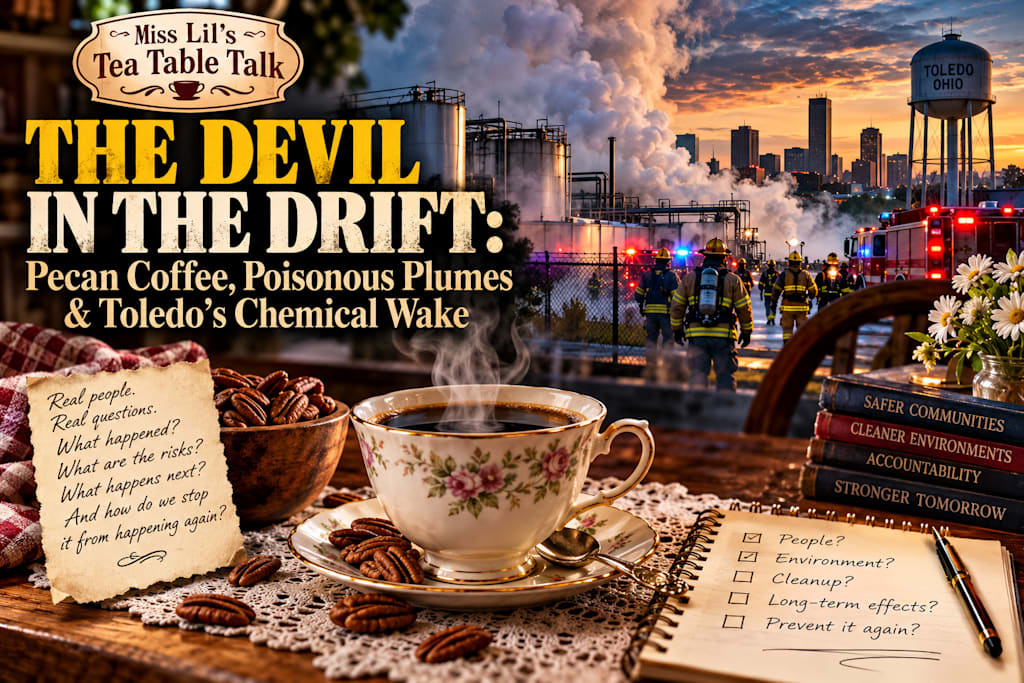
THE DEVIL IN THE DRIFT: Pecan Coffee, Poisonous Plumes & Toledo's Chemical Wake
Miss Lil's Tea Table Talk
Pull up a chair, sugar. Miss Lil has questions, and this pot of coffee isn't going to drink itself.
There are mornings when a lady wants nothing more than a warm cup of southern pecan coffee, a quiet moment, and a little peace before the world starts hollering.
Then there are mornings when the news hands her a chemical leak, a frightened community, and enough unanswered questions to keep the entire tea table talking until supper.
On Tuesday, October 20, 2026, a hazardous chemical release at MC Tank Transport in North Toledo, Ohio, triggered an emergency response that continued into Wednesday. Residents were evacuated, thousands were instructed to shelter indoors, and officials faced difficult decisions about how to handle a damaged chemical tank without putting more lives at risk.
Now, my dears, let's get one thing straight. This isn't a tale about an imaginary haunted factory. This is a real industrial incident involving real people, real uncertainty, and a chemical whose effects deserve a closer look.
So let us pour the coffee, set the biscuits within reach, and get to the bottom of it.
FIRST, WHAT IN THE WORLD HAPPENED IN TOLEDO?
According to the U.S. Environmental Protection Agency, the substance released was glycidyl methacrylate, commonly abbreviated GMA. This industrial chemical is used in manufacturing certain plastics, paints, and protective coatings.
The release came from a tank holding approximately 5,500 gallons. Officials attributed the incident to an error during the transfer of the material.
A tank of that size is no little garden-variety problem.
The leak produced a visible vapor plume and raised concerns about chemical exposure and the possibility of an explosion. Emergency responders initially established an evacuation zone extending one mile from the facility. A broader, three-mile shelter-in-place order followed early Wednesday morning.
Nearly 1,000 residents were ordered to leave the immediate area. Schools closed, nearby operations were disrupted, and emergency shelters were made available.
Imagine being awakened in the middle of the night and told to leave your home, perhaps without knowing whether you would be back in a few hours or several days. Imagine worrying about the children, the pets, the garden, or the elderly neighbor down the road.
That is the human side of an industrial accident, and it deserves more than a passing mention beneath a headline.
WHAT CHEMICAL ARE WE DEALING WITH?
Glycidyl methacrylate is a reactive industrial chemical. It is useful in manufacturing, but that usefulness comes with handling hazards that must be managed carefully.
Exposure can irritate the eyes, nose, mouth, respiratory tract, and skin. Excessive exposure may also cause headaches, dizziness, fatigue, nausea, and vomiting.
And here's where Miss Lil puts down her coffee for a moment.
A chemical's usefulness in a factory does not automatically make it safe to breathe when it escapes into the neighborhood.
Industrial chemicals are meant to be handled under controlled conditions, not released into the air where families live.
The important questions are how much was released, how the chemical moved through the air, how much people actually inhaled, and whether any material settled onto soil, plants, buildings, or water.
Smell alone cannot answer those questions. A strong odor does not tell us precisely how dangerous an exposure is, and the absence of an odor does not prove that the air is safe.
That is why environmental sampling and sound public-health guidance matter so much.
WHAT IS BEING DONE ABOUT THE LEAK?
Now, this is where we separate the frightening headlines from what officials are actually doing.
As of Thursday, October 22, the response has included several important measures.
1. Evacuations and Public Safety
The shelter-in-place order was lifted Wednesday evening, and the evacuation zone was reduced from one mile to a half-mile radius. Residents still need to follow current official instructions about whether they can safely return home.
2. Air Monitoring
The EPA has been helping Toledo Fire & Rescue monitor air around the site, measuring volatile organic compounds and other airborne pollutants. Additional sampling inside the evacuation zone and deployment of a mobile laboratory have also been part of the response.
3. Managing the Damaged Tank
Fire officials attempted to contain the release, but those efforts were unsuccessful. Because the compromised tank presented a potential explosion hazard, officials determined that allowing the chemical reaction to finish was safer than attempting a more dangerous intervention.
Drone observations showed the tank cooling and the plume diminishing.
4. Medical Assessment and Health Guidance
Local health officials have advised people experiencing symptoms to seek medical guidance. More than two dozen people reportedly sought medical evaluation, with many treated and released. Officials continue to assess the incident's health implications.
Here's the part that deserves emphasis: the immediate danger easing does not automatically mean the investigation is complete or every environmental question has been answered.
Air monitoring is an important step. But the public also needs accessible results, clear explanations of what those results mean, and information about any additional cleanup or testing that may be necessary.
Residents can follow the City of Toledo's official incident updates and the EPA's response page:
City of Toledo: https://toledo.oh.gov/news/2026/10/21/hazmat-evacuation-in-north-toledo
U.S. EPA: https://response.epa.gov/site/site_profile.aspx?site_id=17475
THE LONG-TERM QUESTION: WHAT COULD THIS MEAN FOR HUMAN HEALTH?
Now, my dear readers, this is the question I would be asking over my second cup.
Glycidyl methacrylate is not merely an eye-watering nuisance. The International Agency for Research on Cancer has classified it as probably carcinogenic to humans, Group 2A, based on sufficient evidence from animal studies and strong mechanistic evidence. Evidence directly establishing cancer risk in humans is inadequate.
That distinction matters. We must take the hazard seriously without pretending we already know what this particular release will mean for every person who may have been exposed.
Short-Term Effects
Depending on the amount inhaled or the extent of contact, exposure can cause:
Burning or irritation of the eyes, nose, throat, and skin.
Coughing or breathing discomfort.
Headaches, dizziness, fatigue, nausea, or vomiting.
People experiencing symptoms should contact a medical professional and explain the possible chemical exposure. Anyone experiencing severe breathing difficulty or another medical emergency should call 911.
Long-Term Health Effects
There are legitimate reasons to investigate possible long-term effects, including cancer risk and damage associated with significant or repeated exposure.
But here's the crucial distinction: a chemical's ability to cause cancer under certain exposure conditions does not establish that a brief exposure during this incident will cause cancer.
To assess the risk, investigators would need information about airborne concentrations, how long people were exposed, their distance from the release, and other relevant factors.
Those data are essential before anyone can responsibly estimate the long-term risk to Toledo residents.
What should happen next?
Residents who were inside the affected area should be able to access clear information about the exposure, medical advice, and any recommended follow-up.
If symptoms develop or persist, they should not dismiss them simply because an evacuation order has been lifted.
I would also like to see health officials explain how residents can report exposure concerns and whether additional monitoring or longer-term health follow-up is warranted.
People deserve answers, not guesses dressed up as reassurance.
WHAT ABOUT THE ENVIRONMENT?
A chemical release doesn't stop being an environmental issue just because the visible plume disappears.
There are several pathways investigators should consider.
The Air
Monitoring can help establish where airborne chemicals traveled and whether concentrations reached levels of concern. Results collected at different times and locations are especially valuable because conditions change as a release develops and dissipates.
The Soil and Gardens
If liquid or contaminated droplets reached the ground, investigators may need to sample affected surfaces and soil.
Residents have raised concerns about rain and possible deposits on cars, homes, and gardens. Those concerns need to be assessed with evidence, not dismissed or automatically treated as proof of contamination.
Storm Drains and Waterways
Glycidyl methacrylate has environmental hazards of its own. Laboratory data indicate toxicity to aquatic organisms, and environmental guidance emphasizes protecting water intakes during a release.
Investigators should determine whether any material entered stormwater systems or nearby waterways.
Wildlife and Aquatic Life
If the chemical reached a waterway at a harmful concentration, aquatic organisms could be affected. The actual impact would depend on the quantity released, the concentration in the water, and the duration of exposure.
There is one encouraging detail worth mentioning: published assessments report that glycidyl methacrylate can biodegrade under certain environmental conditions and is not expected to bioaccumulate substantially.
That is good news, but it is not a magic eraser.
A substance's potential to break down over time does not mean a concentrated release is harmless. It does not tell us whether an individual garden, drain, or stretch of water was contaminated during this particular incident.
We need incident-specific sampling to answer those questions.
HOW DO WE STOP THIS FROM HAPPENING AGAIN?
Now we're getting to the meat and potatoes of this conversation.
Officials have said the release resulted from an error during the chemical transfer. The precise sequence of events and underlying causes still need to be established.
If a transfer error can release a hazardous chemical into a neighborhood, prevention must go beyond telling workers to be more careful.
Here are the changes I would want to see investigated.
1. Automatic Shutoff Systems
Transfer systems should use appropriate safeguards to detect abnormal pressure, leaks, overfilling, or incorrect connections and stop the flow when a dangerous condition develops.
2. Better Transfer Procedures and Training
Facilities should verify the correct tank, chemical, hose connections, valve positions, and transfer conditions before work begins. Training must be practical, repeated, and backed by documented checks.
3. Stronger Containment and Emergency Planning
Secondary containment, compatible equipment, leak detection, and emergency plans should be appropriate to the chemical's hazards. Plans must address dangerous reactions as well as ordinary spills.
4. Independent Investigation and Accountability
Regulators should establish what failed, review maintenance and operating records, and require corrective measures where warranted. The findings should be made public, along with any enforcement actions.
5. Faster Public Warnings and Transparent Monitoring
Communities near hazardous-material facilities need reliable alerts, clear evacuation instructions, accessible air-monitoring data, and explanations of when it is safe to return.
And let's not forget the people who live beside these facilities.
Residents should have access to information about the chemicals stored nearby, the risks associated with those chemicals, and the emergency plans in place should something go wrong.
Industrial operations bring jobs and provide materials we use every day. But the people living nearby should not have to discover the risks only when emergency sirens begin to sound.
MISS LIL HAS A FEW QUESTIONS FOR THE POWERS THAT BE
Miss Lil sets down her coffee cup and reaches for her notebook. The questions are piling up faster than the biscuits are disappearing.
If I were sitting across the table from the facility's management, environmental regulators, and local officials, I'd want answers to these questions:
1. What exactly failed during the chemical transfer?
Was it a faulty component, a procedural error, an equipment failure, or a combination of problems?
2. What do the air-monitoring results show?
Where were samples collected, what was detected, and how did the readings change over time?
3. Will soil, stormwater, and nearby waterways be tested?
If testing is necessary, who will conduct it, and when will the results be released?
4. What happens to residents who were exposed?
Will they receive clear guidance about symptoms, medical evaluation, and any recommended follow-up?
5. Who pays for cleanup and damage?
Residents deserve clarity about the process for reporting property damage, contamination concerns, and other incident-related losses.
6. What safeguards will be added before normal operations resume?
An investigation that identifies the mistake but fails to prevent a repeat is an unfinished investigation.
These aren't unreasonable demands. They're the sort of questions a community should be able to ask when an industrial accident sends people running from their homes.
THE VERDICT OVER SOUTHERN PECAN COFFEE
Here's where I land this morning, sugar.
Toledo's emergency response has involved difficult decisions, evacuations, air monitoring, and cooperation between local responders and the EPA. The reduction in the evacuation zone and the lifting of the broader shelter-in-place order are encouraging developments.
But they do not, by themselves, establish the full environmental or long-term health consequences of the release.
We must avoid two extremes: declaring that everyone exposed will suffer lasting harm, or declaring that everything is perfectly fine before the evidence is in.
Neither panic nor blind reassurance will serve this community.
What will serve it is transparent testing, honest communication, a thorough investigation, appropriate medical guidance, and enforceable measures to prevent another release.
And if a preventable mistake caused this incident, then the lesson must be bigger than a press conference and a promise to do better.
A community's safety should never depend on whether an industrial transfer goes perfectly. It should depend on safeguards strong enough to prevent one mistake from becoming everybody's emergency.
So, my dears, finish your coffee while it's hot. Keep asking questions. Read the official updates. And don't let the conversation disappear just because the plume does.
Because the people of Toledo deserve to know not only what happened on Tuesday night, but what is being done to make sure it doesn't happen again.
Until next time, keep your teacup full, your eyes open, and your questions sharper than your grandmother's best kitchen knife.
With curiosity and a pinch of southern sass,
Miss Lil ☕🌰
SOURCES FOR FURTHER READING
U.S. EPA: Toledo Glycidyl Methacrylate Release
https://response.epa.gov/site/site_profile.aspx?site_id=17475
City of Toledo: Official Hazardous-Material Incident Updates
https://toledo.oh.gov/news/2026/10/21/hazmat-evacuation-in-north-toledo
Toledo-Lucas County Health Department: Public Health Update
https://lucascountyhealth.com/public-health-update-glycidyl-methacrylate-gma-chemical-leak/
International Agency for Research on Cancer: Glycidyl Methacrylate Evaluation
https://www.ncbi.nlm.nih.gov/books/NBK568273/
About the Creator
Lilithea Adasia
I dig where others look away. 🖤 True crime, paranormal mysteries, uncomfortable truths, and the beautifully broken human experience. I chase the stories others bury and ask the questions others avoid. Come curious. Leave questioning.
Enjoyed the story? Support the Creator.
Subscribe for free to receive all their stories in your feed.
Comments