
The Chess Photo That Looks Like Disrespect Until You Know the Game
Magnus Carlsen and Viswanathan Anand glanced at each other’s boards while their opponents thought. In classical chess, that moment is ordinary.
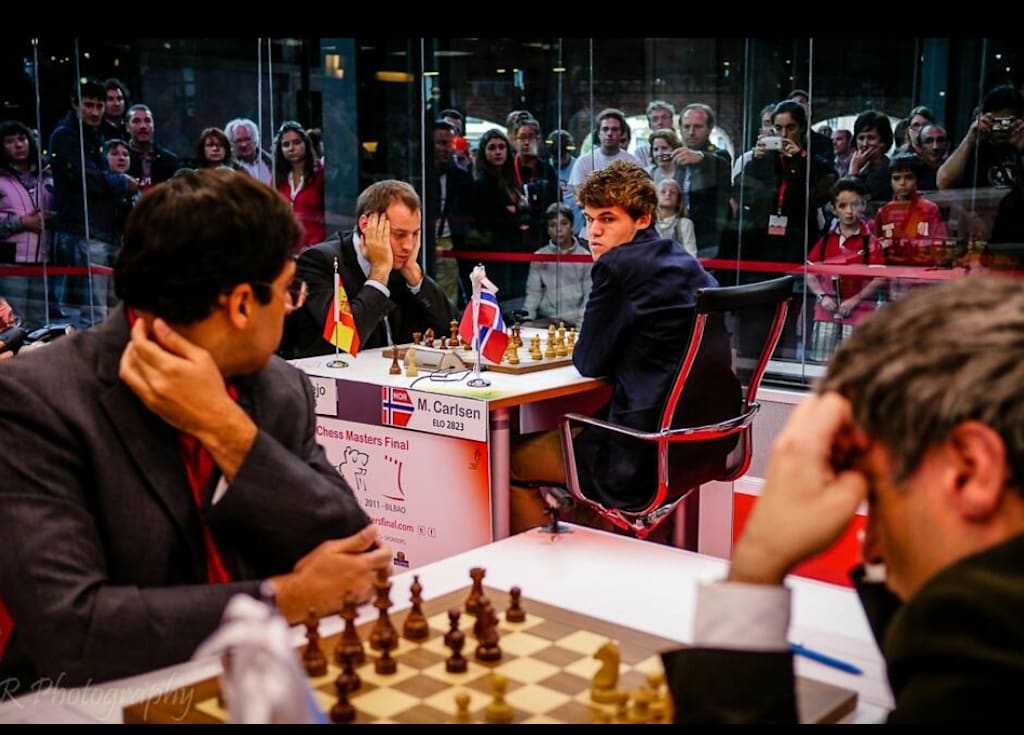
When Magnus Carlsen turned sideways, the legs of his chair scraped against the floor. He did not stand. He shifted his weight left, right hand still on the edge of his table. Two tables away, Viswanathan Anand turned too. Their eyes landed on each other’s board almost at once. Their opponents looked down, chins in hands, eyebrows pressed together. Francisco Vallejo Pons studied the pawn structure of the Queen’s Indian Defense. Vasyl Ivanchuk watched the knight that had just jumped to h4 in the Slav Defense. The pieces were still near their starting squares. The board had open space, like a plaza in the early morning.
People moved through the hall. An arbiter in a dark suit passed between tables, scoresheets under his arm. Light fell from the ceiling onto wooden boards and made the black and white squares shine. Clocks ticked beside each table, not loudly, but all together, like rain on a tin roof. Carlsen put his left hand in his pocket, took it out, and tapped the table edge twice. Anand picked up his pen, wrote symbols on his scoresheet, and held the cap in his mouth. The cap was blue, with a ring of teeth marks.
Classical chess is not a sprint. A game can last six hours. A player cannot sit still the whole time. While your opponent thinks, you can stand, walk the corridor, visit the bathroom, or stop by another board. No one calls that rude. In this game, time is cut apart. Your time, my time, the numbers on the clock. Whoever’s turn it is returns to the seat. Everyone else can leave for a while. That is the rule. It is also an understanding.
That glance reads like two long-distance drivers at a rest stop checking each other’s trucks. Which route are you taking? What fuel did you put in? Are your tires holding? Both men know that many opening moves were prepared before the game. Anand plays the Queen’s Indian Defense, a weapon he uses often. Carlsen’s board shows the Slav Defense, Modern Line. Nh4 attacks the bishop on f5. Black must decide where the bishop goes. These variations have appeared in chess literature countless times and have run through engines countless times. The thinking here is retrieval. It is looking for one compartment in the drawer of memory.
Anand learned opening preparation another way. He learned the rules from his mother at six. India then did not have so many chess academies, so many grandmasters, or engines available at any hour. His mother was not a chess player. She saw that her son loved the game, so she copied games and weekly puzzles from a television program. When Anand came home from school, they sat at a table and set the symbols on a board. When they solved the puzzle, they mailed the answer. If they won, the prize was a chess book. Later he won every week. The program wrote to ask him to stop entering. If he needed a book, he should just say so.
He had no coach until he became a grandmaster. People called him the “Lightning Kid” because he played fast. Others were still thinking. He had already moved. In 1988, he became India’s first chess grandmaster. He was nineteen. Later he became world champion five times: 2000, 2007, 2008, 2010, 2012. He kept playing after thirty, after forty, and after fifty he remained among the world’s best. Most players peak around thirty and then decline. Anand stretched that line out.
There is an old photograph. In 1989, Anand and Mikhail Tal sat across a board. Tal was a former world champion. That year he was fifty-two. Anand was young, his face round, his eyes bright. Tal smoked. The smoke rose and scattered in the light. Anand won that game. Tal died in 1992. Now Anand is the veteran. He sits at the board, watching other players’ openings, as if watching generation after generation walk into the same room.
Carlsen is another story. He was born in 1990 in Norway. As a boy, people called him a genius. In 2013, he became world champion. He defended the title five times. His chess is like water, flowing into the cracks of a position. He can replay games from years earlier. He also arrives late, twists in his chair, and gets up to look at other boards. He does not care about those forms. He cares about what is on the board.
The two opponents in the photo are also working. Vallejo Pons is a Spanish grandmaster. Ivanchuk is a Ukrainian grandmaster. Both are calculating. Head-scratching is part of calculation. When chess players think, the body looks for an outlet. Some twirl a pen. Some drink water. Some stare at the ceiling. Some pick up a piece and put it down again. Outsiders see head-scratching. Insiders see a storm. In their own time, they are trying to find the only path.
Anand once took a train. The person next to him asked what he did for work. He said, chess. The man said, unless you are Viswanathan Anand, don’t do it. Anand said, I am. The man did not recognize him. The story has been told many times since, like a joke. Beneath the joke is something else. A man can become his country’s synonym for chess and still not be recognized in public. On the board his name is large. In life his name is small.
Carlsen has had similar experiences. A rental car company would not rent him a car because he had not held a license long enough. They did not know that this young man had already sat on the world champion’s throne for years. The time on the board and the time in life use two different scales.
The photo again. Carlsen and Anand looked at each other’s games for a few seconds. Then they returned to their seats. Anand took the pen cap from his mouth and wrote another line on his scoresheet. Carlsen put his hand back on the table, fingertips touching the pawn in front of his king. The arbiter passed without stopping. The clocks kept running. Ivanchuk reached out and moved the bishop to g6. Vallejo Pons picked up a knight, held it in midair, and put it back.
Someone in the hall coughed. A plastic bottle cap was unscrewed and screwed back on. A scoresheet page turned with a light sound. Anand glanced toward Carlsen. Carlsen happened to look up at the same moment. Neither smiled nor nodded. They only looked. Then each returned to his board. The pieces were still there. The board was still sixty-four squares. The next move was already waiting.
About the Creator
Jin
Writer of reamstories
https://reamstories.com/jin
Enjoyed the story? Support the Creator.
Subscribe for free to receive all their stories in your feed. You could also become a paid subscriber, letting them know you appreciate their work.
Comments
There are no comments for this story
Be the first to respond and start the conversation.