
The Calm You See in Senior Leaders Is Often Just Front-Stage
Distance, power, and a closed office door explain more than personality does.
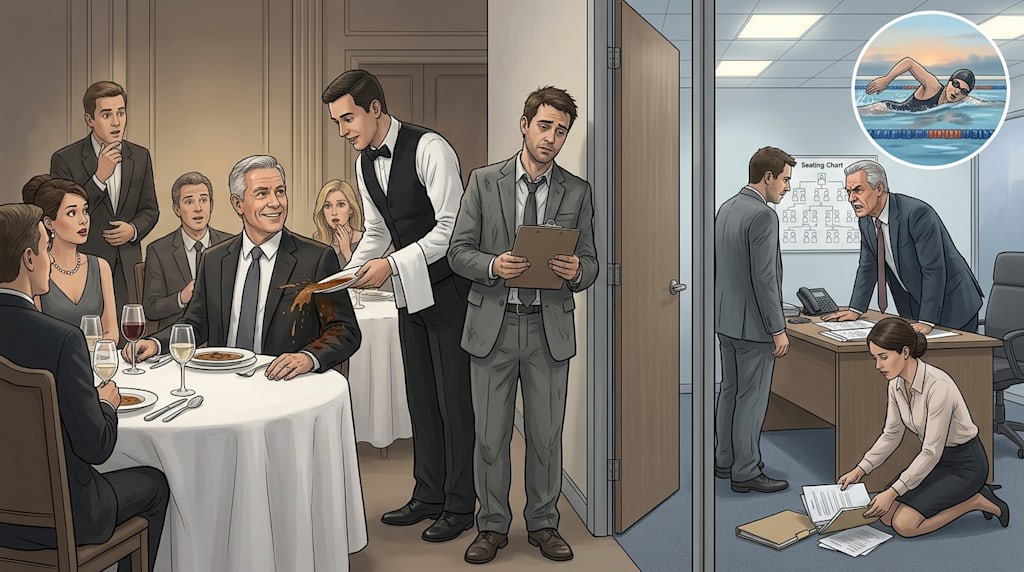
I once watched a senior leader get soup spilled on him at dinner. He smiled, said it was fine, and went back to work talk. Everyone at the table read it as proof of top-level emotional stability.
That dinner did not prove much. The waiter did not matter to him. The dinner did not matter much either. A spilled bowl did not touch his core pressure. Not getting angry at a waiter costs little, and there was no need.
Senior leaders are not all emotionally stable. But working contacts often see them that way, and there are structural reasons. What you see is front-stage behavior under a particular distance, setting, and power relationship. It is not their full emotional life.
1. He may not yell at you because you are not important enough
A senior leader being mild to you does not mean he is mild to everyone. You are often not at the center of his pressure chain. Your mistakes, small troubles, and annoyances may never reach his pressure sources. Toward the grassroots, outsiders, strangers, and people who do not matter to him, he has no reason to get angry.
This sounds harsh. It is also common in power structures. A leader’s emotional release is selective. He is cautious with superiors, calculating with peers, direct with the core team, and polite to the grassroots and outsiders. You see the side he lets you see. The people who take his impatience, harshness, forcefulness, or cutting remarks are often middle managers, core staff, and trusted subordinates. They sit closer to the pressure. They also absorb emotion and buffer it for the organization.
Distance creates a filter. From far away you see a managed expression. From close up you see where the emotion goes.
2. Front-stage stability is not backstage stability
The higher the position, the higher the cost of showing emotion. An outburst reads as loss of control. A complaint reads as taking sides. Anxiety reads as organizational risk. A bad expression can become a handle for others. Senior leaders learn emotional labor: control the face, control the wording, choose the occasion for release.
Composure does not mean no emotion. It means emotion is delayed, packaged, or moved. The more stable someone looks in public, the more impatient he may be in private. The kinder he is to strangers, the harsher he may be to his core team. This does not make every senior leader a hypocrite. The position trains people to perform stability. Stability is an occupational skill and a form of impression management. It can come from cultivation or strategy. It can be self-regulation, or it can mean the outlet moved somewhere you cannot see.
I know a division chief who always spoke slowly in meetings. When a subordinate made a mistake in a report, he said, “Revise it again.” Once his office door closed, he often told the deputy director, “How many times have I said this?” and “Go think it through yourself.” The deputy worked with him for six years, took the most scolding, and got promoted fastest. Inside the door and outside the door, two sets of expressions.
3. Pressure finds an outlet
Senior pressure comes from higher-level assessments, policy changes, performance targets, complex interpersonal games, and risks that can blow up at any time. That load is heavy. No one can carry it indefinitely. Pressure does not vanish. It seeks an outlet.
One common outlet is downward release, layer by layer. Senior leaders are harsh with middle managers. Middle managers are impatient with the grassroots. The grassroots take it home. This is how an organization builds a buffer. Middle managers absorb the emotions, pressure, and responsibility of senior leaders, then break them down for people below. Many leaders pay higher salaries and offer more benefits. In part they are buying emotional value from their core teams, buying tolerance for direct pressure. This is unpleasant to hear, but it describes how many organizations work.
Not every senior leader behaves this way. Some organizations use systems, processes, and staff teams to buffer. Some leaders regulate and digest pressure themselves. Some look stable outside and are repressed inside. Downward transfer remains a common mechanism. The calm you see may mean he has already released his pressure. The stability you see may mean you are not among the people he releases it on.
4. What screening do people at the top pass?
People who reach senior positions usually have survived high-pressure environments. They often have stronger emotional control, delayed expression, interest calculation, and risk avoidance. Long-term survivors of complex games know when to lose their temper and when not to. They know whom they can lose it on and whom they must restrain around.
This does not equal psychological health. It does not equal a good temper. It means they choose their outlet and occasion well. Stability can be ability or repression. It can be cultivation or strategy. It can be long training, or it can be the relaxation that comes from power security.
A person who slams the table at the grassroots may become mild at a senior level. He did not change. He no longer needs to slam the table. His position speaks for him.
5. Exercise helps, but it is not the only exception
One condition does make senior leaders more emotionally stable: regular, fairly frequent exercise over the long term. High-intensity exercise works as a healthy release valve. Anxiety and irritability burn off through physical exertion. Leaders with this habit tend to stay stable over time. The gap between how they treat insiders and outsiders is smaller, and they are easier to deal with.
I know a vice president who swims at six every morning for forty minutes, without fail. He is impatient in meetings and criticizes people. Once the criticism is over, it is over. He does not bring up old scores, displace anger, or carry emotion into the next meeting. His subordinates say working for him is tiring but not suffocating. Another leader had no exercise habit. When pressure built up, he threw folders in his office, then called his secretary in to pick them up. The secretary lasted eight months and asked for a transfer.
Exercise is not the only variable. Sleep, family relationships, professional staff, institutional buffers, cognitive desensitization, experience, and power security all affect emotional state. Saying “unless he exercises every week” is too absolute. Senior leaders with healthy release channels are more likely to have front-stage stability that matches backstage stability. Those without healthy outlets may look more stable in public and need an outlet even more in private.
6. How to tell whether a leader is stable
Do not judge only by how he treats the grassroots, outsiders, or strangers. That is the front stage. Watch how he treats his core team and middle managers, how he acts under pressure, and how he behaves in long-term cooperation.
Watch whether he shifts blame when responsibility is at stake. Watch whether he loses control when he hears bad news. Watch whether he keeps basic respect for people who have no use value to him. Watch whether he allows mistakes. Watch whether he uses emotion as a management tool.
Emotional stability is not never getting angry. It is anger with boundaries, purpose, and proportion. It is not having no pressure. It is not dumping pressure on people weaker than you. It is not being mild in public while hurting the people around you in private.
A simple test: look at the person who has stayed by his side longest. If someone who worked with him for five years still talks to him and still jokes at dinner, his stability may run deeper than the front stage. If the people around him keep changing and all go silent, his mildness is only for you.
Conclusion
Senior leaders are not all emotionally stable. The stability you observe is often front-stage stability. Distance creates a filter. Power asymmetry creates restraint. Professional impression management creates a calm face. Transferred pressure creates relaxation. High-pressure environments create adaptive capacity. Together they shape the impression.
You see him laugh after soup spills on him at dinner. That happened. You do not see him in the car after dinner, berating the office director for ten minutes because the seating order was wrong. The office director comes in the next day, redoes the seating chart, sends it to the work group, and adds a smiling emoji.
Front-stage stability is easy. Backstage stability is the hard part.
About the Creator
Jin
Writer of reamstories
https://reamstories.com/jin
Enjoyed the story? Support the Creator.
Subscribe for free to receive all their stories in your feed. You could also become a paid subscriber, letting them know you appreciate their work.
Comments
There are no comments for this story
Be the first to respond and start the conversation.