
The Calm Leader You Admire Is Probably Just Standing Far Away
What distance hides about emotional stability, and why middle managers get the sharp edge.
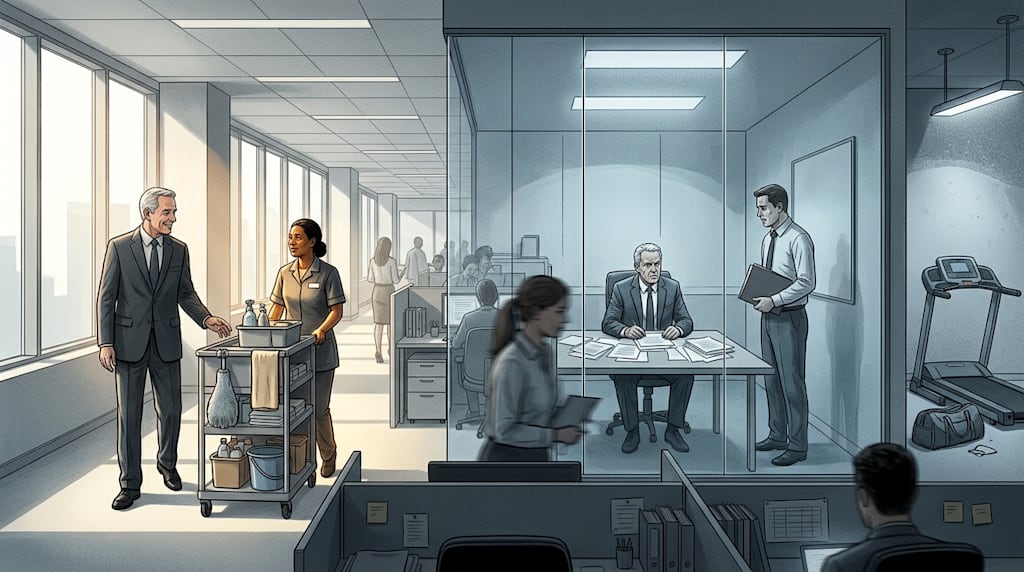
A meeting ends. The leader steps down from the stage, passes the cleaning lady, turns slightly to let her by, and says, “Thanks for your hard work.” In the elevator, a phone rings. He waves his hand and smiles. “It’s fine, take it.” Grassroots staff come to report. He listens, nods, and says, “Good thinking. Go back and refine it.”
Put those scenes together and the conclusion writes itself: this man is calm.
Then you move into the office and become a middle manager who reports to him directly. In your first month, he sends your material back three times. The first note says “Rewrite.” The second says “Did you even try?” The third time, he throws the printed draft onto the table. Pages slide across the floor. He stares at you for five seconds and says, “Do you think I have nothing better to do?”
Same person. The man who smiled at the cleaning lady and the man who threw your draft are the same man. He has not changed into a second person. He has stopped performing the public version for you.
The gentleness you see is the cheapest version
Facing grassroots staff, strangers, or people who do not matter to him, a leader has no reason to get angry. Your work mistakes do not touch his assessment line. Your small worries do not become his risk. Your daily troubles do not reach his superiors. Being polite costs him nothing and earns him a reputation as a decent boss. That math is easy.
Once you become his direct middle manager, the math changes. You answer for targets. You cover for accidents. You take bullets for him in front of his superiors. What you submit is what he submits upward. If you fail, he cleans up the mess. His anger at you does not mean you are unimportant. It means you have entered his pressure chain.
So “he does not get angry at you because you are not important” is only half true. He does not get angry at you because you are not yet in the chain. Once you are in it, the anger will find you.
Emotions move toward safe targets
People say a leader’s emotions roll downward, layer by layer. That sounds right, but it misses the choice inside the release. Emotions move toward safe targets.
Getting angry at grassroots staff can trigger complaints, public attention, or consequences he cannot control. Getting angry at strangers brings no benefit. Getting angry at people who do not matter is waste. Direct middle managers, core staff, and trusted subordinates are different. They cannot easily leave the platform. They can absorb the hit. They can digest it. In some organizations, absorbing a superior’s mood is treated as part of the job.
That produces the familiar split. A leader is warm to grassroots staff and harsh to middle managers. He is not suddenly another man. The cost of losing his temper is different in each setting. Public settings have an audience. Pressure scenes have only his own people.
Middle managers often serve as the receiving layer for a senior leader’s mood, pressure, and responsibility. A thousand threads come down from above. One needle has to carry them below. High pay, authority, platform access, and resources compensate for some of that load. People joke about “grievance pay.” The joke has a transactional logic, but it is incomplete. Middle managers stay for the platform, the power, the growth, the identity, and the path they have already built. Emotional absorption is part of the price, not the whole story.
Exercise is one outlet, not the only one
Some leaders stay steadier over time because they exercise often and hard. Anxiety, irritation, and aggression burn off through physical effort. The gym becomes a release valve. Pressure does not crowd entirely into the people around him. Leaders with that habit usually show less contrast between how they treat people in public and how they treat people at close range.
Exercise is not the only outlet. Family support, management training, counseling, hobbies, the ability to delegate, a reliable team, and formal review and appeal systems all reduce the amount of pressure that gets pushed downward. A leader who turns pressure into tasks, hands tasks to systems, and leaves emotion in the gym rather than the meeting room has a stability that holds under pressure. It is not just a filter created by distance.
Now picture the opposite. A leader works under long-term pressure. He has no release valve. His organization treats downward anger as normal. His kindness to grassroots staff today may mean only that he has not walked up to you yet. When you become his direct middle manager, when you answer for targets, incidents, personnel, and budgets, you may meet a different face.
Do not judge him by how he treats grassroots staff
Look at six things instead.
First, look at how he treats people who cannot push back. Respect for superiors is instinct. Respect for subordinates is training. Watch how he talks to cleaners, security guards, drivers, frontline staff, and new hires. That tells you more than any speech about unity.
Second, watch the first ten minutes after bad news. Does he solve the problem or hunt for someone to blame? Does he ask “What do we do now?” or “Who did this?” The first ten minutes are close to instinct. There is no time to polish the reaction.
Third, watch how he handles a direct subordinate’s mistake. Does he fix the issue or humiliate the person? Harshness is not cruelty. He can criticize and hold people accountable. He cannot grind a person’s dignity into the floor. The difference is simple. One leader says, “This data is wrong. Run it again and get it to me by three.” The other says, “Is there something wrong with your brain?”
Fourth, watch him outside meetings, in corridors, and at dinners. On stage, he plays a role. Off stage, habit shows. His attitude toward waiters, his face when someone is late, his patience with quiet people. A man can spend three hours on stage praising teamwork, then curse a waiter until the waiter cries because the food came slowly.
Fifth, watch whether he repairs the relationship after losing his temper. A leader who never gets angry is not automatically stable. A leader who can repair after anger may be mature. Apology is not weakness. It confirms the boundary between pressure and abuse. If he acts after every outburst as if nothing happened, his stability exists only when he does not need you.
Sixth, watch middle-manager turnover, sick leave, and silence. If middle managers keep leaving, if no one speaks in meetings, if bad news cannot travel upward, then his calm face exists only in the eyes of people far away. A steady team passes bad news quickly because no one fears punishment for carrying it.
Power amplifies a person. It does not replace one.
It is unfair to say every senior leader is unfriendly once you get close. High-pressure positions do make harshness, impatience, and dominance more common. Whether that turns into cruelty depends on personality, training, accountability, support, and outlets. Power amplifies what is already there. It also selects and trains emotional expression. Some people harden. Others develop better boundaries.
A rough model helps:
Downward emotional transfer equals pressure source times safe target times personality and training times culture, divided by outlets and institutional constraints.
Pressure is not a license to yell. High rank is not an excuse for cruelty. If an organization treats downward anger as normal, every layer will find a buffer. If an organization has clear accountability, review, appeal, and repair systems, pressure gets broken into problems instead of faces.
So do not worship a leader’s calm too quickly. The calm you see may come from distance. The kindness you feel may mean you have not reached his pressure core. A steady leader is not a man who never gets angry. He is a man who does not need to get angry downward to stay steady. He has pressure, outlets, boundaries, the ability to repair, and respect for people who cannot fight back.
When he walks up to you, watch whether he still treats you as a person.
About the Creator
Jin
Writer of reamstories
https://reamstories.com/jin
Enjoyed the story? Support the Creator.
Subscribe for free to receive all their stories in your feed. You could also become a paid subscriber, letting them know you appreciate their work.
Comments
There are no comments for this story
Be the first to respond and start the conversation.