
The Art of Not Finishing Early
Why waiting until the last responsible moment produces better work and preserves your sanity
I learned this lesson the hard way, in a conference room that smelled like stale coffee and someone else's anxiety.
Three weeks of overtime. Nights spent hunched over my laptop while my roommate watched entire seasons of shows I'd never see. I had built the perfect proposal—forty-seven slides, custom graphics, a narrative arc that would make a McKinsey partner weep with envy. I submitted it four days before the deadline, expecting a gold star and maybe a promotion.
Two hours later, my boss forwarded an email. The client had pivoted. New scope. Different audience. "Great work," she wrote. "Can you redo it by Friday?"
The Friday that was now two days away.
Everything I had built in those three weeks became irrelevant. Not because I had done a bad job. Because I had done the job before the job actually existed.
The Productivity Trap
I used to believe that finishing early was the purest expression of competence. A real professional anticipates, executes, delivers. Waiting until the deadline felt like procrastination dressed up as strategy.
Then I started paying attention to the people around me who seemed to survive the job without burning out. They weren't lazy. They weren't disorganized. They just had a different relationship with time.
My colleague Dave—a man who once responded to a "quick question" with "let me get back to you next Thursday"—finished fewer projects than I did. But every single one of them landed. No rework. No emergency pivots. No 11 PM Slack messages asking if anyone had the latest version of the deck.
I asked him how he did it. He said something I still think about: "Information has a shelf life. If you start cooking before you know the ingredients, you're just making waste."
What I Got Wrong About Efficiency
Here's what I've learned since that conference room humiliation:
Moving early on incomplete information isn't efficiency—it's gambling. You're betting that the project scope won't change, the client won't pivot, and your assumptions will hold. In my experience, that bet loses at least half the time. The hours spent on speculative work don't come back. The energy doesn't recharge. You just do the work twice.
When you finish early, you don't finish—you get assigned more. There's a perverse incentive in most organizations: visible speed signals capacity, which attracts additional work. The reward for finishing your tasks is usually someone else's tasks. Help a colleague analyze data once, and suddenly you're the unofficial data person for the entire team. Be careful what you're good at.
Most creative work doesn't scale linearly with time. If you start writing three days early, you don't get three days of productivity. You get one day of actual work and two days of anxiety, second-guessing, and compulsive revision. The best writing happens under constraint. Too much time is just as dangerous as too little.
Your energy is finite and strategic. The people who last in high-pressure jobs aren't the ones who sprint constantly. They're the ones who know when to conserve and when to go all-in. Finishing early burns fuel you'll need later.
The Last Responsible Moment
This is the concept I wish I'd understood ten years ago. It comes from lean manufacturing, but it applies to knowledge work just as well: delay decisions and execution until the cost of waiting exceeds the cost of being wrong.
That's not procrastination. Procrastination is waiting because you don't want to start. The last responsible moment is waiting because starting too early means starting with incomplete information.
The trick is knowing the difference.
For a report that depends on quarterly numbers you won't have until Tuesday, starting Monday is a waste. For a proposal where the client hasn't confirmed the budget, building the full deck is guessing. For a creative project where the brief might change, waiting for the brief to settle isn't lazy—it's strategic.
The Discipline of Patience
None of this means you should scramble at the last minute. There's a middle ground between the anxious overachiever and the chaotic procrastinator.
What it looks like:
Gather information first. Ask the clarifying questions. Confirm the scope. Understand what "done" actually means before you start building.
Map the dependencies. What do you need to know? Who needs to approve what? What could change?
Work in tight bursts. When you do start, work with focus and intensity. Constraint produces quality.
Protect your buffer. If the deadline is Friday, aim to finish Wednesday. But finish Wednesday of the actual final week, not two weeks early.
The Chess Player's Mindset
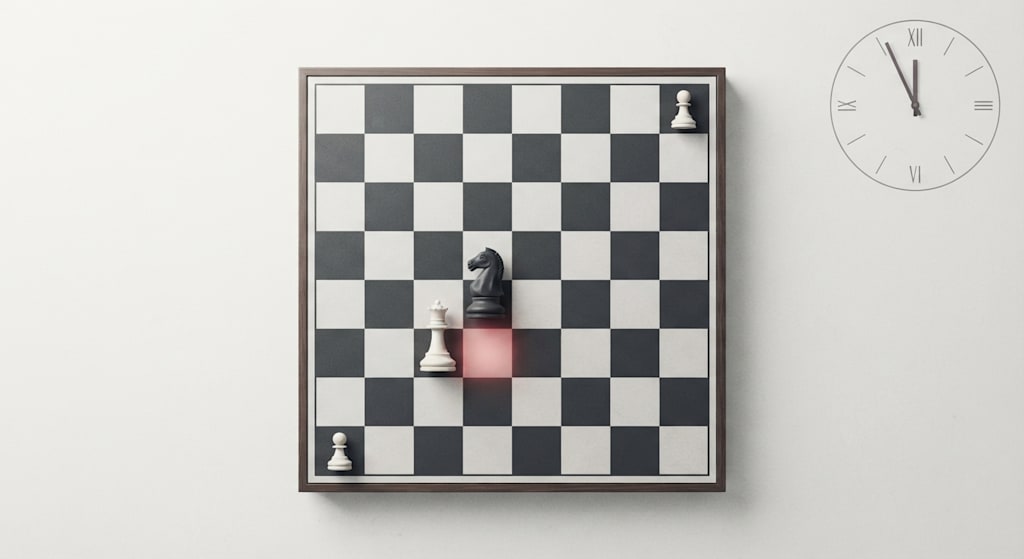
The best strategic thinkers I've worked with treat their work like a chess game, not a sprint. They're not always moving. Sometimes they're watching, waiting for the board to settle, letting their opponent reveal their strategy.
They know that speed without direction is just noise.
After that conference room disaster, I stopped finishing early. Not because I wanted to do less, but because I wanted to do better. I started asking more questions upfront. I began waiting for the variables to settle before committing to execution. I learned to sit with uncertainty instead of trying to eliminate it with premature action.
The result wasn't that I worked less. It was that the work I did actually mattered. The rework disappeared. The redo requests stopped. And I stopped feeling like I was constantly running in place.
You can finish early if you want. But don't confuse motion with progress.
Sometimes the most productive thing you can do is wait until you actually know what you're doing.
About the Creator
Jin
Writer of reamstories
https://reamstories.com/jin
Enjoyed the story? Support the Creator.
Subscribe for free to receive all their stories in your feed. You could also become a paid subscriber, letting them know you appreciate their work.
Comments
There are no comments for this story
Be the first to respond and start the conversation.