
The AI Tool Saved Me Six Hours. My Job Took Them Back.
My office called it efficiency. I called it a second shift.
Zhou Min first heard “AI empowerment” at the Monday meeting.
The director stood in front of the whiteboard and drew an upward arrow with a marker. He said the company had bought new AI tools, and that from then on, writing copy, making reports, and organizing meeting minutes could all be “efficiency-boosted.” He said “efficiency boost” three times. Each time he drew a circle in the air, as if the phrase were a ball he could hold.
Zhou Min sat in the third row, twirling a pen. The clip on the cap was loose, so it wobbled as it turned. She thought: finally, I won’t have to revise a hundred-character Weibo post six times.
Her department handled brand content: six people, three product lines. Zhou Min covered two of them. For the past six months, her routine had been: write a draft in the morning, revise it in the afternoon, send the final version at night. A Weibo post went through four rounds of revision. The director revised it once, the product manager once, legal once, and finally she smoothed it out herself. Sometimes the job felt less like writing copy than playing Guess What the Boss Likes Today.
On Tuesday morning, she opened the tool for the first time. The input box was huge, like a form waiting to be filled out. The cursor blinked in the upper left corner. She typed: “Write a promotional post for a new autumn coffee, target audience women aged 25–35, warm style but not overly sweet.”
Enter. Three seconds. Five versions appeared.
The first was too literary, the second too blunt, the third had something, the fourth sounded like an ad, the fifth like an essay. She picked the third, changed four words, and sent it to the director. He replied with a thumbs-up.
By two that afternoon, she had finished work that used to take until six. She stared at the screen for a while. Then she opened a shopping site and bought a keyboard cover she had wanted for a long time but never bought. Transparent. Thirty-nine yuan. Her old cover had been used for two years, and its edges had turned yellow, but she had never replaced it. Today she did.
She sent Chen Jie a WeChat message: “That AI tool is actually pretty good.”
Chen Jie replied: “Really? I’ll try it.”
The second week, the director posted in the group chat: “From now on, everyone use AI for first drafts. Let’s get efficiency up.”
Zhou Min did as told. In one day she produced twelve proposal versions, covering three product lines. At the weekly meeting, the director praised her by name, saying “Zhou Min’s output efficiency has tripled.” She smiled and drew a circle in her notebook. The circle wasn’t round, so she added another one beside it.
After the meeting, Chen Jie leaned over from the next desk and asked, “How did you do it? Teach me.” Zhou Min spent twenty minutes teaching her how to write prompts. Chen Jie tried three times and said, “This is such a hassle.” Zhou Min said, “Practice makes perfect.” Chen Jie said, “I’d rather write it myself.” Zhou Min didn’t answer. She thought: writing it myself takes a day. AI takes two hours. If practice makes perfect, why not do it?
That evening, she left work at eight. On the subway, she did the math. Before, she wrote one piece a day. Now she wrote four. Her salary hadn’t changed, so her hourly wage had gone down. But at least she wasn’t working overtime. She checked the shipping update for the keyboard cover. It would arrive tomorrow.
The third week, the director said at the meeting: “Since everyone’s efficiency is up, let’s change the weekly report to a daily report. Send it before you leave work every day.”
The room went quiet for two seconds. Zhou Min saw the corner of Chen Jie’s mouth twitch, but no one spoke. The director added, “This is also to keep progress synced. Everyone, please cooperate.”
After the daily report started, Zhou Min spent an extra forty minutes a day writing it. The template had three parts: today’s output, tomorrow’s plan, risks and requests for help. She filled in three lines every day. Before filling them in, she had to recall what she had done. After filling them in, she checked for omissions. Forty minutes was the time she used to spend revising one version of copy. She checked the template twice before filling it in. She told herself: it’s only forty minutes. The time AI saves is enough.
The fourth week, she got a request: make an annual content plan for a new client. She spent two days. AI generated one hundred and twenty topic ideas. She filtered out forty and made a table: topic, angle, target audience, expected effect. She sent the table to the director. He looked at it and said, “Not bad. Can you produce two more versions in different directions?”
She spent another day producing two versions. One conservative, one aggressive. The director said, “All three are good. Merge them.”
She spent half a day merging them. She put the topics together, removed duplicates, sorted them, and adjusted the structure. The director looked and said, “The third version has better tone, but the second version has more solid topics. Take the third version’s tone and apply it to the second version’s topics.”
She spent half a day redoing it. She rewrote the second version’s topics one by one in the third version’s tone. The director looked and said, “The first version still looks best. Use the first version, but add the two highlights from the third.”
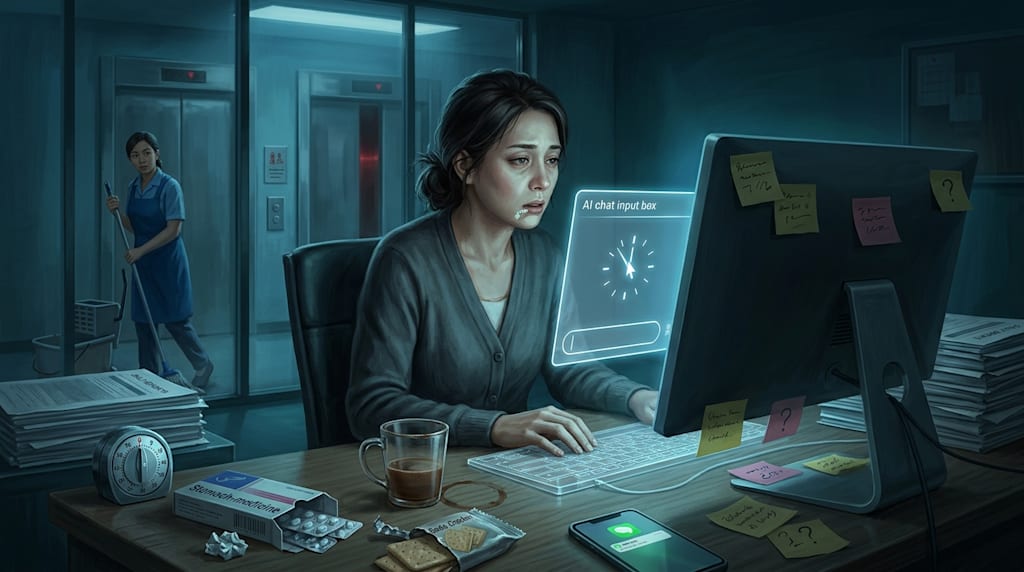
She stared at the screen. Her coffee had gone cold. A brown ring stained the side of the cup. She drank the cold coffee and made another instant coffee. Her stomach felt bloated. She opened the drawer for stomach medicine and found the last box empty. She crushed the empty box, threw it in the trash, and didn’t buy more.
The fifth week, things got concrete.
The data AI generated was wrong. In an industry report, AI cited a statistic that did not exist. The number looked reasonable: online penetration rate for a certain category, 47.3%. Zhou Min didn’t catch it during review. The report went to the client. An analyst on the client side called. The tone was polite, but the point was clear: the number could not be traced to any source.
The director called Zhou Min into his office and closed the door. “From now on, verify every piece of content AI generates, one by one.”
Zhou Min said, “If I verify every item one by one, it’s slower than writing it myself.”
The director said, “Then think about how to optimize the process.”
Zhou Min went back to her desk, opened the document, and started checking. Of the one hundred and twenty topics, thirty-seven cited data. She checked until nine that night. Six were wrong. She marked them in red and sent them back. The director said, “Don’t use AI for the data sections. Fill them in manually.”
She closed the document and opened a job site. She saw a content operations job. The description said “proficient in AI tools preferred.” She closed the page.
Thursday of the sixth week was a day Zhou Min remembered clearly.
At nine in the morning, the director @-mentioned her in the group chat: “The client suddenly wants to change direction. Produce a new proposal before end of day. Be quick.”
Zhou Min opened the AI tool and entered the request. In ten minutes, a framework appeared. She filled in content, adjusted the structure, made the PPT, and by three in the afternoon had finished one version. She sent it to the director. He said, “The direction is right, but the details aren’t deep enough. Go deeper.”
She revised until five. The director said, “The tone is wrong. Too hard. Soften it.”
She revised until seven. The director said, “The first version was better. Combine the first version’s framework with the second version’s content.”
She revised until nine. The director said, “The client changed their mind again. Add a competitor analysis module.”
She revised until eleven. When the competitor analysis was done, the director said, “Is this data source reliable?”
She said, “I verified it.”
The director said, “Verify it again.”
She verified until midnight. The director said, “All right, send it to me.”
After she sent it, she leaned back in her chair. She and the cleaning lady were the only ones left. The lady pushed her mop past and glanced at her. “Girl, you’re working late again.”
Zhou Min smiled. “Almost done.”
She opened the food delivery app. The congee shop she usually ordered from had closed. She closed the app. She felt around in her drawer for soda crackers and ate three. They were stale. The stomach medicine was gone, and she had forgotten to buy more. She opened the shopping app, added stomach medicine to her cart, and closed it. Tomorrow.
She opened the notes app and scrolled to an entry from a week ago: “Finished a day’s work in two hours today.” She stared at it. Then she added a line: “Then revised it seven times.”
The seventh week, things did not get better.
Zhou Min began tracking her time. She used the notes app and recorded every task as soon as she finished it. After a week, she found: AI generation took 12% of her time. Review and rework took 48%. Communication and alignment took 30%. Writing and thinking herself took less than 10%.
She showed the table to Chen Jie. Chen Jie said, “Why are you recording this?”
Zhou Min said, “I want to know where the time went.”
Chen Jie said, “The time went to feeding AI.”
Zhou Min said nothing. She opened the AI tool and looked at the input box. The cursor blinked. The box was a new workstation. Every day she sat there, translating requests into prompts, then translating AI output into something the director could understand. She had become AI’s translator and its quality inspector. When the output failed, she was also the one who had to explain it.
That night, she worked until ten. As she was leaving, she glanced at Chen Jie’s desk. The computer was still on, showing a document titled “Daily Report_Week 18.” Chen Jie wasn’t there, probably in the pantry. Zhou Min waited. Chen Jie didn’t come back. Zhou Min turned off the monitor and left a sticky note: “Turned it off for you. Leave early.”
On Monday of the eighth week, Zhou Min did something.
She did not resign. She opened a blank document and wrote a “Content Production Process Optimization Proposal.” It had three points. First, AI-generated first drafts need acceptance criteria from the requester to avoid endless revisions. Second, for data sections, the requester provides the source; AI only organizes. Third, change the daily report back to a weekly report; daily output is documented in files.
She sent it to the director and CC’d the department group.
The director did not reply. In the afternoon, he called her into his office. “Your proposal, the idea is good, but the timing isn’t right. The client side is busy.”
Zhou Min said, “I’ll put it aside for now.”
She walked back to her desk. Chen Jie sent her a WeChat message: “Are you crazy?”
Zhou Min replied: “Not crazy. I just don’t want to revise a seventh version.”
Chen Jie replied with a facepalm emoji.
Zhou Min saved the proposal in a folder called “Useful Later.” Then she opened the AI tool and entered the day’s request. The cursor blinked. She started typing.
Before leaving work, she opened the shopping app and bought two boxes of stomach medicine. She added one more thing: a timer. Mechanical. Twist it once, it runs for an hour, then rings.
She decided that starting tomorrow, it would ring every hour. When it rang, she would stop and ask herself: In this past hour, was I doing something only I can do, or was I patching things up for AI?
She didn’t have an answer yet. She kept the timer in the cart anyway.
She clicked checkout. A notification popped up: “Estimated delivery tomorrow.”
She turned off the computer and stood up. Three other people were still working overtime. At the door, she looked back at her desk. The keyboard cover had arrived and was stuck to the keyboard, transparent, reflecting the light. She had forgotten when she put it on.
She stepped into the elevator and pressed the button for the first floor. As the doors closed, her phone buzzed. It was DingTalk. She didn’t look.
About the Creator
Jin
Writer of reamstories
https://reamstories.com/jin
Enjoyed the story? Support the Creator.
Subscribe for free to receive all their stories in your feed. You could also become a paid subscriber, letting them know you appreciate their work.
Comments
There are no comments for this story
Be the first to respond and start the conversation.