
The 30-Second Report That Makes Your Boss Trust You
Stop saying "pretty much." Use numbers, name the risk, and hand your manager a choice.
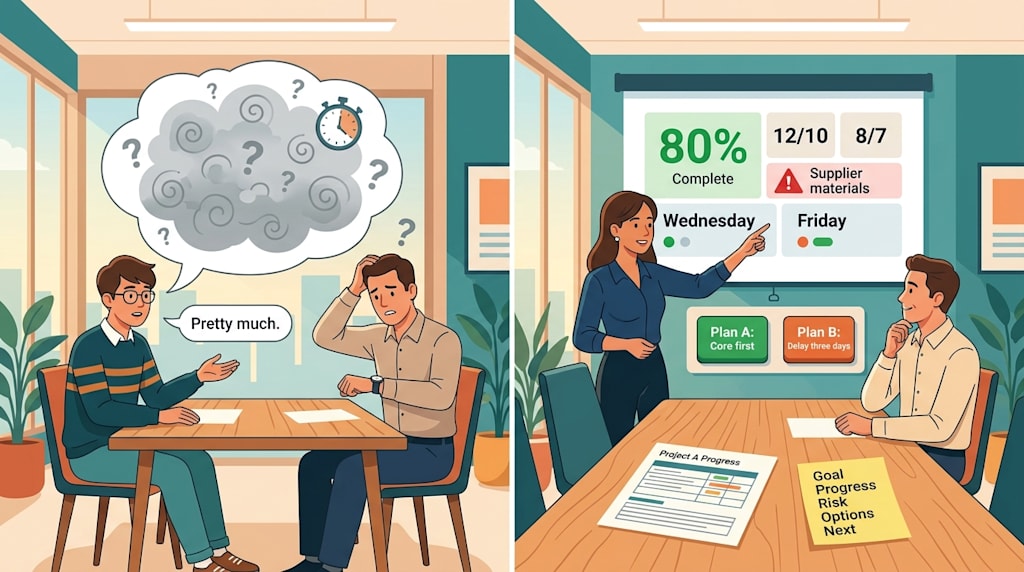
Monday morning, 9:40. Meeting room.
The manager flips through the weekly report. "How's Project A going?"
Xiao Zhang says, "Pretty much. Almost done."
The manager pauses. "How long is 'almost'?"
"Probably this week."
The manager says nothing and turns to Xiao Li.
"Project A launches Friday," Xiao Li says. "We're at 80%. Backend APIs: 12 total, 10 done. Frontend pages: 8 total, 7 done. The last API and page should be finished Wednesday afternoon. The risk is supplier materials. They were due at 18:00 today. If they don't arrive, integration testing slips two days. I suggest launching the core features first and moving non-core features to next Monday. I need you to get the supplier to deliver before 18:00. Then I'll finish development Wednesday, test Thursday, and release Friday."
The manager nods. "Do it."
After the meeting, Xiao Zhang asks, "How do you remember all that?"
"I don't," Xiao Li says. "I fill in a template before I walk in."
Vague reports make your manager do your job
"Pretty much" is not a status. "Progress is okay" is not a status. "Client feedback is okay" is not a status. "I'm following up" is not a status.
When you say those things, your manager has to ask:
Where exactly is it?
When will it be done?
What could go wrong?
What do you need from me?
Once or twice, fine. Every week, he starts to think you don't know your own work.
Xiao Li's report has no "pretty much." It has 80%, 12, 10, 8, 7, Wednesday afternoon, two days, 18:00, Friday. The numbers do the work.
Numbers turn a feeling into a fact
Compare these two:
"This feature is almost done. We should be able to test next week."
"This feature is 80% done. Development finishes Tuesday. Testing starts Wednesday. The first version goes out before end of day Wednesday."
The second isn't longer. It just answers the questions your manager is already asking.
Even kids do this. "I finished 3 of 6 homework assignments. I'll finish the rest tomorrow." Or: "I'm 80% done. I have 20% left. Two hours."
"Almost done" means nothing. "Two hours left" means something.
Put the report in four boxes
A routine update can fit into four boxes.
Completed: 3 items. Two on schedule, one a day early.
Unfinished: 1 item. About 70% done. Expected tomorrow afternoon.
Risk: Project B is waiting on supplier materials. They were due today. If they don't arrive, two days of development slip. I need you to call the supplier before 18:00.
Next: Tomorrow I'll push Project A to 90%. If the materials arrive today, integration testing starts Wednesday, testing Thursday, release Friday.
That's it. The manager reads it in 30 seconds. He knows where things stand and what he has to do next.
Use comparison to show you're not just busy
Numbers alone don't prove much. Comparison does.
A salesperson says: "I cultivated 30 potential clients. I think a third will buy next quarter."
Next quarter: "Of the 30 from last quarter, 40% bought. That beat my one-third estimate. This quarter I added 20 new clients. The total is lower, but I tightened my screening. I expect half to buy within six months."
Now the manager sees something. The salesperson made a prediction, checked it, and changed his method. That's not activity. That's judgment.
Bad news: say it early and bring a fix
People hide bad news because they think it makes them look incompetent. The opposite is true. Bad news that arrives late makes you look incompetent. Bad news that arrives early, with a plan, makes you look reliable.
So when the supplier misses the deadline, don't say, "We have a problem." Say:
"The supplier materials were due at 18:00. They're not here. That puts two days of Project B at risk. If we don't get them tonight, I suggest launching Feature A first and moving Feature B to Monday. Or you can call the supplier and push for tonight. We'll work late and try to keep Friday."
You've named the problem and offered two ways out. Your manager can decide in ten seconds.
Give your manager a choice, not a quiz
"What should we do?" is a quiz. Managers hate quizzes.
Try: "Two options. A: launch core features Friday, delay non-core by a week. B: delay everything three days and ship complete. I lean toward A because core features validate the market and non-core can wait. Which do you want?"
Now he just picks. The more decisions you make easy, the more he trusts you with bigger ones.
Mistakes that make you sound junior
Reporting effort instead of results. He doesn't care how busy you were. He cares what moved.
Reporting problems without options. Bring A and B.
Reporting only good news. The later the bad news, the worse it gets.
Dumping numbers without a conclusion. Numbers should point somewhere.
Using vague words. Pretty much, okay, as soon as possible, should, probably. They all weaken you.
Saying whatever pops into your head. He can't follow you, so he stops trying.
Telling him what he wants to hear. You can be diplomatic. You can't lie.
Talking about things that don't matter. His time is not your time.
The template
Goal X. Currently Y% done. Ahead or behind by Z.
Risk: A. Impact: B.
I suggest C. I need D.
Next I will E. Expected completion: F.
Example:
This week's goal is 6 tasks. I've finished 4. That's 67%, one behind.
Risk: supplier materials missing. Impact: two days of Project B.
I suggest launching Feature A first and moving Feature B to Monday. I need you to get the materials by 18:00.
Next I'll push Project A to 90%. Release Friday.
At 5:30, Xiao Li sends the weekly report.
Subject: Project A Progress_2026-10-11.
First line: Goal Friday. 80% done. Risk: supplier materials. Suggestion: core features first. Need: supplier by 18:00. Next: development Wednesday, testing Thursday, release Friday.
Then he saves the template as a sticky note, sticks it next to his monitor, and shuts the laptop.
About the Creator
Jin
Writer of reamstories
https://reamstories.com/jin
Enjoyed the story? Support the Creator.
Subscribe for free to receive all their stories in your feed. You could also become a paid subscriber, letting them know you appreciate their work.
Comments
There are no comments for this story
Be the first to respond and start the conversation.