politics
Political figures, histories, and current events in the whole scope of modern and past politics. Work place politics.
Why Sole Traders Must Priorities Self Assessment Tax Returns
In the realm of small business and entrepreneurship, sole traders form the backbone of the UK economy. Whether operating as a freelance graphic designer, a local tradesperson, or a digital content creator, being a sole trader brings both independence and responsibility. Chief among these responsibilities is the legal obligation to submit a Self Assessment Tax Return annually.
By Self Assessment Tax Returnabout a year ago in Journal
Mossad Exposed: The Greatest Successes and Failures of Israel’s Elite Spy Agency
Since the beginning of Israeli attacks on Iran, Israeli aircraft have targeted Iranian nuclear facilities, military installations, and private residences, most of which are located in the western part of the country and around the capital, Tehran. Although these attacks were carried out from the air, it is suspected that Israel’s intelligence agency Mossad played a significant role in identifying these targets and assisting in ground operations. It is believed that Mossad agents used drones smuggled into the country to target Iran's remaining air defense systems. Iranian officials have previously admitted that they suspect the presence of Israeli intelligence collaborators within their security forces. Since the start of Israeli strikes on June 13, a large number of key Iranian military officials and nuclear scientists have been successfully targeted, indicating that Israel had precise intelligence on their whereabouts. Notable Successful and Failed Operations by Mossad Assassination of Hamas Leader Ismail Haniyeh Ismail Haniyeh, the political head of Hamas, was killed on July 31, 2024, while staying at a guesthouse in Tehran. Israel initially did not take responsibility for the killing, but months later, Israeli Defense Minister Yoav Gallant admitted that Israel was behind the assassination. However, the exact circumstances of Haniyeh’s death remain unclear. A senior Hamas official, Khalil al-Hayya, in a press conference, cited eyewitnesses claiming that Haniyeh was directly targeted by a missile. However, a report in the New York Times, citing seven officials, claimed that Haniyeh was killed by a bomb planted two months earlier in the building where he was staying. Haniyeh was one of the senior Hamas leaders killed by Israel after the group’s October 7, 2023, attack on southern Israel. Other Hamas leaders targeted include Yahya Sinwar, his brother Mohammad, military wing chief Mohammad Deif, and his deputy Marwan Issa. ‘Pager’ Attacks on Hezbollah Operatives On September 17, 2024, thousands of pagers exploded simultaneously across Lebanon, especially in areas with strong Hezbollah influence. These blasts injured and killed not only the users but also those nearby, causing widespread panic. The next day, walkie-talkies also exploded, causing hundreds more injuries and deaths. At the time, clashes were ongoing between Israel and Hezbollah, which had intensified after Hezbollah launched rockets at Israeli positions a day after Hamas’s October 7 attacks. Two months later, the Israeli Prime Minister admitted Mossad had embedded explosive devices in walkie-talkie batteries. These devices were deadly because walkie-talkies are usually kept close to the heart in the chest pockets of protective vests. These explosions triggered a wave of fear across Lebanon as many occurred in public places like markets. Hospitals were overwhelmed with injured people, many of whom were left disabled. Volker Türk, head of the UN Human Rights Office, condemned the attack as a war crime. Assassination of Mohsen Fakhrizadeh In November 2020, Iran’s top nuclear scientist Mohsen Fakhrizadeh was assassinated east of Tehran. He was killed using a remote-controlled machine gun assisted by artificial intelligence. In April 2018, Israeli PM Netanyahu had presented folders of documents allegedly stolen by Mossad during a raid on a storage facility just 30 kilometers from Tehran. These documents supposedly revealed Iran’s covert nuclear weapons program and highlighted Fakhrizadeh’s central role. Iran had earlier accused Israel of killing four other nuclear scientists between 2010 and 2012. Assassination of Mahmoud al-Mabhouh in a Dubai Hotel In 2010, senior Hamas military figure Mahmoud al-Mabhouh was killed in a Dubai hotel. Initially believed to be a natural death, Dubai police later used CCTV footage to identify the hit squad. It was revealed he had been electrocuted and then strangled. Though Mossad was suspected, Israel neither confirmed nor denied involvement, maintaining its policy of “strategic ambiguity.” Yahya Ayyash and the Exploding Phone In 1996, Mossad assassinated Yahya Abdul-Latif Ayyash, a key Hamas bombmaker, using a Motorola Alpha mobile phone rigged with 50 grams of explosives. Ayyash was known for his bomb-making skills and planning complex attacks. He was high on Israel’s most-wanted list. In 2019, Israel declassified details of the operation, and a TV station aired his final conversation with his father before the explosion. This highlighted Mossad’s use of advanced technology in targeted killings. Operation Brothers In the early 1980s, under orders from the Israeli Prime Minister, Mossad launched a deceptive operation to smuggle 7,000 Ethiopian Jews into Israel via Sudan. A fake diving resort was set up on the Sudanese coast—Sudan being a member of the Arab League and hostile to Israel. By day, Mossad agents posed as resort staff. By night, they smuggled Ethiopian Jews who had walked across the border. They were then flown or shipped to Israel. The operation lasted five years and was completed before Sudan discovered it. The 'Holocaust': Capture of Nazi Officer In 1960, Mossad abducted former Nazi officer Adolf Eichmann from Argentina in one of its most historic intelligence operations. Eichmann was responsible for orchestrating the Holocaust, in which six million Jews were killed during WWII. After escaping post-war justice, Eichmann hid in Argentina. In 1957, Fritz Bauer, Chief Prosecutor of West Germany’s Hesse state, informed Mossad of Eichmann’s whereabouts. A 14-agent Mossad team located, kidnapped, and transported him to Israel, where he was tried and executed. Operation Entebbe Israel’s Entebbe operation in Uganda is considered one of its most successful military missions, based on Mossad intelligence. A passenger plane from Tel Aviv to Paris via Athens was hijacked by members of the Popular Front for the Liberation of Palestine and two Germans. The plane was diverted to Uganda, where 103 Israeli citizens were among 250 hostages. Israeli commandos stormed the airport and rescued the hostages. Three hostages and Yonatan Netanyahu—brother of current PM Benjamin Netanyahu—were killed in the mission. Several Ugandan soldiers were also killed. Revenge for the Munich Olympics In 1972, the Palestinian group Black September attacked the Israeli Olympic team in Munich, killing two and taking nine hostages—all of whom later died during a failed rescue. In response, Mossad launched a revenge campaign targeting several PLO members, including Mahmoud Hamshari, who was injured by a bomb hidden in his phone in Paris and later died from his injuries. Mossad's Failures October 7 Hamas Attack On October 7, 2023, Hamas launched a surprise attack near Gaza, shocking the world. Analysts regard Mossad’s failure to foresee the attack as a major intelligence lapse. According to Israeli officials, the attack resulted in around 1,200 deaths and 251 hostages taken to Gaza. In retaliation, Israel has focused its military efforts on Gaza’s civilian population rather than just Hamas, resulting in over 57,000 civilian deaths—mostly women and children. Yom Kippur War Nearly 50 years before the Hamas attack, Israel faced another surprise assault it was unprepared for. On October 6, 1973, Egypt and Syria launched a coordinated attack on Israel during Yom Kippur, the Jewish Day of Atonement. Egyptian forces crossed the Suez Canal with little resistance, and Syrian forces advanced on the Golan Heights. The Soviet Union supported Egypt and Syria, while the US rushed aid to Israel. Though Israel eventually repelled the forces, the war ended on October 25 after a UN ceasefire resolution was passed. When Israel Had to Save a Hamas Leader’s Life In 1997, Mossad attempted to assassinate Hamas political leader Khaled Meshaal in Jordan using a poison injection, but the operation failed when an agent was caught. Israel was forced to provide the antidote to save Meshaal’s life. Mossad chief Danny Yatom flew to Jordan to administer the antidote. The incident seriously damaged Israel-Jordan relations. Failed Assassination Attempt on Mahmoud al-Zahar In 2003, Israel carried out an airstrike on Hamas leader Mahmoud al-Zahar’s home in Gaza City. Though al-Zahar survived, his wife, son Khaled, and several others were killed. The complete destruction of his home highlighted the risks of military operations in densely populated areas. Lavon Affair In 1954, Egyptian authorities foiled a secret Israeli operation codenamed "Susannah." The plan was to plant bombs in American and British installations in Egypt, to convince the UK to maintain its military presence in the Suez Canal region. The failed operation caused a diplomatic crisis, leading to what became known as the "Lavon Affair," named after Israeli Defense Minister Pinhas Lavon, who was believed to be involved in planning the operation.
By Real contentabout a year ago in Journal
The Middle East Drama. Content Warning.
In a region riddled with military tension and geopolitical noise, recent events appear more like a carefully staged drama than an actual war. One of the latest acts in this political theatre was Iran’s strike on the U.S. Al-Udeid Airbase in Qatar—an incident that surprisingly failed to rattle global markets. This raises a critical question: Are we truly on the brink of war, or are we merely watching a well-rehearsed performance crafted behind closed doors?
By ayoube elbogaabout a year ago in Journal
Why Coworking Etiquette Matters: A Quick Guide
In the ever-evolving landscape of professional workspaces, coworking has emerged as a popular choice for freelancers, entrepreneurs, and remote workers alike. Coworking spaces offer a vibrant atmosphere, networking opportunities, and a collaborative environment conducive to productivity. However, amidst the flexibility and creativity fostered by these shared workspaces, one crucial aspect often overlooked is coworking etiquette.
By Munnazir Zarinabout a year ago in Journal
Trump’s “Big, Beautiful Bill” Enters Senate Debate: A Defining Moment for GOP Agenda
Washington, D.C. — June 30, 2025 — In a charged and historic moment, the U.S. Senate has officially begun debate on what former President Donald Trump calls his “Big, Beautiful Bill” — a sweeping legislative package that combines border security, economic restructuring, and cultural policy reform into one sprawling proposal. Though Trump is no longer in office, the bill bears his imprint and influence at every level and has become the centerpiece of the Republican legislative agenda in the lead-up to the 2026 midterms. Introduced by Senate Republicans earlier this month, the bill is formally titled the “American Freedom and Security Act of 2025”, though Trump continues to refer to it by his signature phrase, evoking the same branding style that made “Build the Wall” and “Make America Great Again” rallying cries for his movement. With the Senate now in open debate, the bill has triggered intense partisan division, drawn the eyes of the nation, and sparked protests and celebrations across the country. Whether the legislation ultimately passes or fails, its significance is undeniable: it represents the most comprehensive attempt to reshape federal policy along Trump-aligned populist lines since his administration ended in 2021. What Is in the “Big, Beautiful Bill”? The bill is a multi-pronged legislative package encompassing the following key pillars: 1. Border Security and Immigration Overhaul Immediate funding for the completion of the U.S.-Mexico border wall. Expansion of ICE authority and reinstatement of Trump-era deportation protocols. New “Merit-Based” immigration system replacing the current family-preference model. Nationwide E-Verify mandates for employers. 2. Economic Nationalism and Trade Policy Implementation of new tariffs on Chinese, Mexican, and Vietnamese goods. Tax incentives for manufacturers who relocate operations to U.S. soil. “Patriot Pay” tax relief for workers in industries deemed “strategic to national sovereignty.” 3. Cultural and Educational Reform Bans on federal funding for schools that teach critical race theory (CRT) or “gender ideology.” Mandates for U.S. history education emphasizing “patriotic values.” Protection of religious expression in public schools and government institutions. 4. Law and Order Measures Expanded federal support for police departments and military surplus equipment. Reclassification of certain protest groups as domestic terror threats. Federal penalties for property damage during protests. 5. Media and Tech Oversight Introduction of a federal “Fairness in Platforms” clause aimed at curbing what Republicans call social media censorship. Tax penalties for Big Tech companies found to “manipulate political discourse.” Though controversial, the bill has galvanized Trump supporters who view it as a long-overdue consolidation of America-first policies. At the same time, it has ignited fierce opposition from Democrats, civil liberties groups, labor unions, and progressive activists who argue the bill is authoritarian, discriminatory, and economically reckless. The Senate Begins Debate: Sparks Fly Early As Senate Majority Leader Steve Daines (R-MT) opened debate on the floor, he declared the bill “the most important legislation of our time.” > “We’re here today to defend the soul of our country — our borders, our jobs, and our values,” Daines said. “This bill secures America, strengthens our economy, and puts Washington back on the side of the American worker.” Senate Minority Leader Chuck Schumer (D-NY), however, issued a blistering response. > “This is not a ‘beautiful’ bill — it’s a dangerous one,” Schumer argued. “It weaponizes government against vulnerable communities, undermines our constitutional freedoms, and seeks to turn the Senate into a tool for one man’s revenge agenda.” Behind the scenes, Democrats are preparing a series of amendments to slow the bill’s momentum. Senate procedures allow for extensive debate, meaning that while Republicans have the majority, they may still face delays and require 60 votes to overcome potential filibusters unless they invoke the budget reconciliation process — which could strip certain parts of the bill. Trump's Shadow in the Chamber Although Trump is not physically present in the Capitol, his presence looms large. The bill has become a litmus test for Republican loyalty, and Trump has been actively calling senators and holding rallies in swing states to push for its passage. In his latest rally in Pennsylvania, he referred to the bill as “the biggest win since Reagan — and maybe bigger.” > “They said I was gone,” Trump shouted to a crowd of thousands. “But look — my ideas are running the show!” Republican senators in vulnerable seats are walking a tightrope. Some, like J.D. Vance (R-OH) and Josh Hawley (R-MO), are vocal supporters of the bill. Others, such as Susan Collins (R-ME) and Lisa Murkowski (R-AK), are more cautious and have expressed concern about the bill’s scope and its impact on civil liberties. Public Reaction: Deepening Divides Across the nation, reactions to the bill are polarized. Conservative groups like Turning Point USA and Heritage Action have launched full-scale campaigns backing the legislation. They’ve organized rallies, digital ad campaigns, and grassroots lobbying in support. On the other side, organizations such as the ACLU, Planned Parenthood, and the NAACP have condemned the bill as a frontal assault on American democracy and human rights. > “This bill criminalizes dissent, erodes our freedoms, and fuels discrimination under the guise of patriotism,” said ACLU spokesperson Marina Lopez. Meanwhile, polling shows the public remains split. A June 2025 Gallup survey found that: 49% of Americans support the bill in full or in part. 43% oppose it. 8% remain undecided. Support is strongest among rural voters and Republicans without a college degree, while opposition is concentrated in urban areas and among younger Americans. What Happens Next? Senate debate is expected to last several weeks, with Democrats aiming to strip or block major provisions. Republicans hope to push the bill through before the August recess, using either a 60-vote consensus or a fast-track reconciliation approach if feasible. In the House, Speaker Elise Stefanik (R-NY) has signaled strong support, stating she is “ready to pass it the minute it arrives.” However, moderate Republicans in suburban districts are nervous about potential backlash from centrist voters. If passed, President Joe Biden is widely expected to veto the bill. However, Republicans are aiming to use the legislation as a campaign platform in 2026, portraying Democrats as obstructionists standing in the way of “the people’s will.” Critics Warn of Constitutional Overreach Legal scholars have raised alarms over potential constitutional challenges. The American Bar Association released a report warning that several provisions — including those related to protest restrictions, media oversight, and federal influence over education — may violate First Amendment protections. > “This bill doesn’t just stretch constitutional boundaries—it bulldozes them,” said Professor Angela Rivas of Georgetown Law. “It centralizes power in a way that should concern citizens of all political stripes.” Several civil rights groups have already drafted lawsuits that could be filed immediately if the bill becomes law.
By Dipayan Biswasabout a year ago in Journal
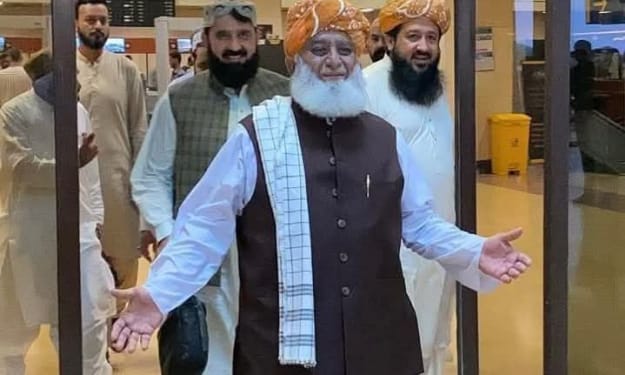
Maulana Fazlur Rehman: A Journey Through Faith, Politics, and Resilience
In the rugged political terrain of Pakistan, where ideologies collide and loyalties shift, one name has endured the test of decades—Maulana Fazlur Rehman. A man equally comfortable in the pulpit and in Parliament, his presence is as enduring as it is controversial. Neither wholly embraced by the secular elite nor shunned by the masses, Maulana has carved out a unique niche in the country’s complex political landscape.
By Qutbi Alam about a year ago in Journal
Iran’s Supreme Leader Claims Victory over Israel in First Public Remarks Since Ceasefire
In his first public address since the ceasefire took effect, Ayatollah Ali Khamenei asserted Iran's triumph over both Israel and the United States. Speaking from a concealed location—flanked by the Iranian flag and a portrait of Khomeini—he said Tehran had delivered a “hand slap” to U.S. forces after missile strikes hit the U.S. base in Qatar
By Omasanjuwa Ogharandukunabout a year ago in Journal
From Unfit for the Bench to “Heads” of the Classroom?/ The New Justice System Taught by the Old One
By Etleva Skonja The restructuring of Albania’s justice system through the vetting process has been one of the deepest and most controversial interventions in the judiciary. Hundreds of judges and prosecutors have been dismissed due to failure to justify their assets, connections with criminal elements, or breaches of professional integrity. But a new and troubling debate has emerged: Should these former magistrates be allowed to teach at the School of Magistrates?
By E verteta.alabout a year ago in Journal