nsfw
NSFW not safe for work. Content you would not want your workplace manager to see.
What Gen X Inherited
Every generation likes to believe it invented volume. Gen X did not. We inherited a working set of tools from the 70s and then spent twenty years arguing about which tools were still legal. Black Sabbath gave us the riff as law. Judas Priest gave us the silhouette and the twin guitar engine. Zeppelin, Purple, Humble Pie, UFO, Thin Lizzy, and AC/DC gave us the rest of the vocabulary. Song length. Groove. Showmanship. The idea that a guitar could be both a rhythm instrument and a lead character. By the time we were old enough to buy our own records, the language was already there. We just changed the accent.
By Overdrive Recordsabout a month ago in Journal
Soundgarden Was Never Just Grunge
The word grunge did Soundgarden a favor and a disservice at the same time. It put them on magazine covers. It also filed them next to bands that did not share their engine. Nirvana wrote like a wrecking ball with a melody. Pearl Jam wrote like a stadium that had just learned to feel. Alice in Chains wrote like a minor key family secret. Soundgarden wrote like Black Sabbath had gone to art school and then joined a punk band that still practiced scales. That is not a side note. That is the whole plot. While Seattle became a brand, they kept the heavy riff in working condition.
By Overdrive Recordsabout a month ago in Journal
Rob Zombie and White Zombie
Some bands sell records. Some bands sell a world. White Zombie and the Rob Zombie solo years did both, but the world was the real product. The riffs were catchy. The samples were sticky. The image was a moving carnival of grindhouse film, comic books, choppers, and cheap neon dread. Gen X did not just hear this music. We saw it. That is why it lasted in a decade that already had enough sad young men with guitars.
By Overdrive Recordsabout a month ago in Journal
Alice in Chains
Seattle gets remembered as a uniform. Flannel. Quiet verse, loud chorus. A generation suddenly famous for being tired of being famous. That story is too small for Alice in Chains. They came from the same city and the same moment, but they brought a heavier bloodline. Sabbath in the riffs. Hair metal residue in the twin vocals. Something colder in the lyrics. Facelift in 1990 and Dirt in 1992 are the two records that made that difference impossible to miss. Together they are one of the most complete statements Gen X ever got about sickness, loyalty, and the cost of staying alive long enough to hear the chorus.
By Overdrive Recordsabout a month ago in Journal
The Post Grunge Bands We Actually Grew Up With
There is a polite version of the late 90s and early 2000s rock story. In that version the serious people finished with Nirvana and Soundgarden, smirked at everything that came after, and moved on to whatever indie record made them feel selective. That story leaves out the music that actually lived in the truck, the shop radio, the night shift, and the first apartment with a cheap stereo. Staind and Puddle of Mudd belong to that second story. So do a handful of their neighbors. Call it post grunge if you need a filing cabinet. Just do not pretend the filing cabinet was empty.
By Overdrive Recordsabout a month ago in Journal
Metallica Black Album
If you grew up with a tape deck in the dash and a boom box that could rattle the windows, you already know what happened in August 1991. Metallica did not just drop an album. They changed the address of heavy music. They took a sound that lived in clubs, tape trading circles, and late night college radio and parked it in the driveway of every kid who had never set foot in a pit. That record is Metallica , the self titled one everyone still calls the Black Album. Thirty five years later it is still the record Gen X reaches for when they want to prove a point about what metal can be when it is written like a hit and mixed like a weapon.
By Overdrive Recordsabout a month ago in Journal
Writing as Journal, Not Just Product
Not everything that matters begins as something meant for an audience. Much of what shapes a person most deeply starts as private wrestling, unfinished realization, unresolved tension, or a question that has not yet settled into a firm position. Treating writing only as a product meant for consumption misunderstands one of its most essential functions. Before writing becomes communication, it is often orientation.
By Peter Thwing - Host of the FST Podcast6 months ago in Journal
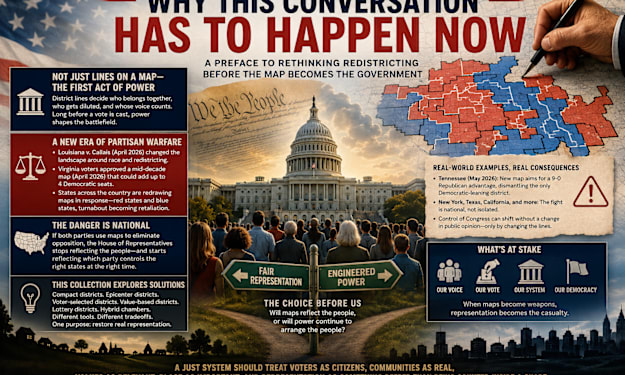
Why This Conversation Has to Happen Now
This Is Not an Abstract Exercise Brainstorming alternatives to redistricting can sound theoretical until the country enters a moment when the map itself becomes one of the main weapons of national power. At that point, the question stops being academic. It becomes immediate. If congressional control can be altered not mainly by persuading voters, but by changing the containers those voters are placed into, then redistricting is not a procedural side issue. It is one of the most consequential political powers in the country.
By Peter Thwing - Host of the FST Podcast6 months ago in Journal
Power Prefers Ambiguity to Truth
Ambiguity Is Safer Than a Lie Power rarely announces itself through outright lies. Lies are risky. They can be disproven. They can be exposed. They can be traced back to the person or institution that made them. What power often prefers instead is ambiguity. Ambiguity is safer than falsehood because it cannot be cleanly falsified. It blurs edges, stretches timelines, multiplies interpretations, and turns clarity into controversy.
By Peter Thwing - Host of the FST Podcast6 months ago in Journal
Why Communication Is About Meaning, Not Skill Display
When Language Becomes a Status Signal Communication is often treated as a performance of intelligence rather than a transfer of meaning. Fluency, vocabulary, wit, rhythm, rhetorical flair, and stylistic confidence are taken as evidence of insight, while quieter or less polished expression is often assumed to signal weaker thought. This framing subtly shifts the goal of communication away from understanding and toward display. When that happens, language stops serving meaning and starts serving status, even when the speaker or writer has no intention of performing.
By Peter Thwing - Host of the FST Podcast6 months ago in Journal
When a Single Word Changes Everything
Language Does More Than Carry Meaning Language does not merely carry ideas. It shapes them in transit. Two statements can express the same underlying thought and still land very differently depending on tone, phrasing, and framing. A single word can soften, sharpen, provoke, or disarm. This is not because language is fragile, but because human interpretation is layered. Words arrive carrying histories, emotional associations, and implicit judgments that interact with the listener’s prior experiences.
By Peter Thwing - Host of the FST Podcast6 months ago in Journal