literature
Best corporate culture and workplace literature to better your workplace experience. Journal's favorite stories.
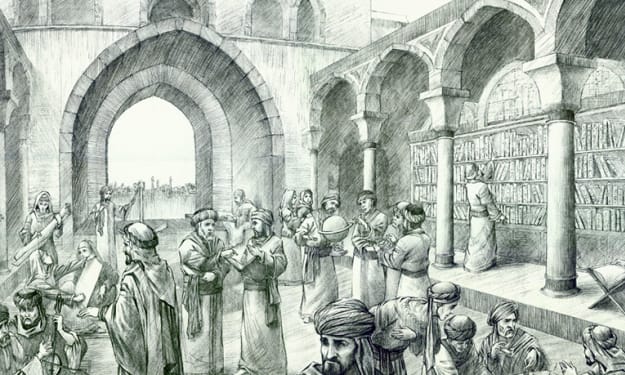
Bayt al-Hikmah: Where Stars of Knowledge Once Shone
During the Abbasid Caliphate, Baghdad emerged as a center of intellectual and economic excellence. One of the most iconic examples of their support for scientific advancement was the famous library of Baghdad, Bayt al-Hikmah—known in English as the House of Wisdom. From around the 5th to at least the 9th century, its collection was considered the largest in the world. The halls of this institution were always abuzz with the presence of prominent scholars of the time.
By Riham Rahman about a year ago in Journal
The Untold Aspects of The Lord of the Rings Trilogy Pt.1
Imagine a group of friends deep in discussion about the greatest fantasy franchises in the world. Naturally, names like Harry Potter, The Witcher, Game of Thrones, Star Wars, Narnia, Pirates of the Caribbean, and Marvel/DC Comics would come up. However, one name that must also be mentioned is J.R.R. Tolkien's immortal creation — The Lord of the Rings. Whether in books or on the silver screen, this franchise remains unforgettable. Formed with a unique blend of friendship, love, vengeance, lust for power, magic, and diverse races, the fantasy of this franchise can easily rival reality. In 2001, renowned director Peter Jackson brought this trilogy to the big screen with the first installment The Fellowship of the Ring. It garnered immense acclaim from critics and audiences alike, essentially immortalizing the franchise. This article dives into some lesser-known aspects of The Lord of the Rings trilogy. 1. The Production Struggle Initially, it was decided that the film would be produced under the Miramax production house, split into two parts. However, due to budget constraints, the studio informed Peter Jackson that the entire story must be condensed into a single film. Knowing this would result in a disaster due to the vast plot, Jackson stood firm. Eventually, New Line Cinema, under Warner Bros., came forward to realize the dream, greenlighting the full trilogy. 2. Casting Surprises Christopher Lee, who played Saruman, originally wanted to play the powerful wizard Gandalf. He was the only cast member who had read the entire book series multiple times—every year, in fact—and even memorized large portions. A true fan of the franchise, he was also the only cast member to have ever met J.R.R. Tolkien. Upon hearing that a film adaptation was in the works, he personally wrote to Peter Jackson requesting to play Gandalf. However, Jackson suggested he take the role of Saruman instead. Interestingly, Scottish actor Sean Connery was offered the role of Gandalf and even promised 15% of the total box office revenue. But he declined, saying he couldn't grasp the complexity of the character. Eventually, the role went to Sir Ian McKellen, who brought Gandalf to life brilliantly. For the role of Aragorn, actors like Nicolas Cage, Stuart Townsend, and Russell Crowe were approached but declined. Ultimately, it went to Viggo Mortensen. American actor Jake Gyllenhaal auditioned for Frodo, but Elijah Wood was chosen instead. 3. Helicopter Fear on Set Sean Bean, who played Boromir, had a severe fear of helicopters. The mountain scenes in the first film were shot in New Zealand, and most cast and crew were flown in by helicopter. But Bean refused to fly, so he would hike for nearly two hours to reach the shooting location. As a result, the entire crew had to wait for him every day on the mountain. 4. Differences Between the Book and the Film While four hobbits accompany Frodo in the films, there were five in the book. The missing one was Fredegar “Fatty” Bolger, who stayed behind in the Shire. He played a role in defending the Shire when Saruman attacked later. He briefly appears in the extended cut. Sauron is only shown as a giant eye atop a tower in the films, but in the book, he has a full physical description. His hunt for the One Ring was aimed at world domination. While the film shows Frodo setting out shortly after Bilbo gives him the ring, in the book, his journey begins 17 years later. Saruman’s death also differs. In the book, after the ring is destroyed in Mount Doom, the hobbits return to find that Saruman has taken over the Shire. They fight him, and eventually, Gríma Wormtongue kills Saruman by slitting his throat in a place called the Scouring of the Shire. 5. Epic Runtime Binge-watching this trilogy is no easy task. Each movie runs for nearly 3.75 hours on average. The original theatrical cuts total 9 hours and 18 minutes, while the extended editions stretch to an astounding 11 hours and 55 minutes — a record-setting runtime for a trilogy. 6. Groundbreaking Effects When the first film was released in 2001, CGI and VFX were just emerging technologies. Many new techniques debuted in this trilogy. To maintain realism, the director heavily used practical elements. Astonishingly, around 18,000 costumes were used, with 30–40 duplicates for each main character. There were also 2,000 unique weapons and about 10,000 arrows used, along with nearly 300 horses. The differences in character heights were achieved using clever camera angles and new visual effects. 7. Editing Nightmare The three films were released in 2001, 2002, and 2003, respectively. The editing team was pushed to their limits managing such large-scale productions. At one point, editing for The Fellowship of the Ring had just finished while The Two Towers was in production, and footage for The Return of the King was already being cut. Even after the theatrical release of the final movie, Peter Jackson shot additional scenes for the extended edition. To be continued...
By Riham Rahman about a year ago in Journal
Polish Wind
Introduction This is another Seven Days in piece that was getting a lot of traction, and it is a bit all over the place, but I thought it is relevant to writers about the difficulties of the English language that make it so brilliant to write with.
By Mike Singleton 💜 Mikeydred about a year ago in Journal
Live as if you were to die tomorrow. Learn as if you were to live forever
Life is a fragile and fleeting gift, one that often gets taken for granted amidst the routines and distractions of daily living. The quote "Live as if you were to die tomorrow. Learn as if you were to live forever" serves as a profound reminder that living fully and embracing continuous learning are not separate pursuits but deeply intertwined aspects of a meaningful existence.
By Nora Ariana2 years ago in Journal
Pune airport opens Udaan Yatri Café with Rs 10 tea, Rs 20 snacks for flyers
In a significant move to make air travel more affordable and passenger-friendly, Pune International Airport has inaugurated the 'Udaan Yatri Café' at its new terminal. This initiative, under the Ministry of Civil Aviation's UDAN (Ude Desh ka Aam Naagrik) scheme, aims to provide budget-friendly refreshments to travelers, addressing long-standing concerns about exorbitant food and beverage prices at airports.
By Abjol Hussain Laskar2 years ago in Journal
Best 12 Google Cloud Services companies in the world
Introduction: Finding the correct Google cloud partner is more important than ever in today's technologically advanced society. For this reason, we have compiled the list of the top 12 Google Cloud Services companies that you can rely on.
By Sam Joseph2 years ago in Journal
The Power of Storytelling
In a time where technology is developing at a breakneck pace and information is abundant, storytelling has become a potent technique for engaging audiences. Stories have a special power to captivate, uplift, and connect with people on a deeper level, whether in marketing, education, or interpersonal relationships. Gaining insight into the power of narrative can improve communication and create deep connections.
By Shahjalal Shakik2 years ago in Journal
Do You Remember 19
Sometimes, you are just 19 – standing in your kitchen on a Friday morning, wondering how you woke up late again and didn’t have time for breakfast. You rush through your morning, still feeling the weight of the night before, but it’s okay. You’ll make do with what you’ve got. You’ll grab something small later. Maybe a snack from the fridge. Maybe a piece of fruit, though you can’t remember the last time you really craved one. You’re just 19, and this moment is fleeting. You wonder, as you pull your jacket over your shoulders, how you’re going to say goodbye to the teenage years. You’re still not sure when or how, but you’ve got thirty Fridays left. Just thirty.
By Parthivee Mukherji 2 years ago in Journal
Crimson Wind
Crimson Wind Captain Ellie Thorn had always dreamed of reaching the End of the Sky. Not the edge of the world—no, that was child's talk—but the place where the sky itself was said to shimmer and crack open, revealing secrets meant for only the bravest of travelers. All she needed was her ship: a balloon so massive and brilliant red it seemed a second sun rising over the hills.
By Gabriela Tone2 years ago in Journal