history
Key historic events throughout the ages in relation to business, work, corporate figures and moguls.
Gaza Under Siege
Gaza Under Siege: A Humanitarian Crisis Unfolding As of May 2025, the Gaza Strip faces one of the most severe humanitarian crises in recent memory. With continuous airstrikes, an ongoing blockade, and limited humanitarian access, the region is under immense pressure, both physically and emotionally. Civilians, including children and the elderly, are bearing the brunt of the conflict.
By Yeasin Arafat2 years ago in Journal
A Bold New Look for Android: Unpacking the Upcoming UI Overhaul
Android, the world's most popular mobile operating system, is on the cusp of a significant visual transformation. After years of iterative updates, Google is reportedly working on a comprehensive user interface (UI) overhaul that promises to refresh the look and feel of the platform. Early glimpses of this redesign have surfaced, offering a tantalizing preview of the changes in store for Android users. This article delves into the details of this upcoming UI overhaul, exploring the key changes and their potential impact on the Android experience.
By Arif Islam2 years ago in Journal
A massive tariff on millions of Americans’ purchases just went into effect — cue the chaos. Content Warning. AI-Generated.
A new wave of economic turbulence has hit American consumers and businesses alike. As of this month, a massive tariff increase targeting a broad range of imports has officially gone into effect. The result? Rising prices, consumer confusion, and growing tensions across supply chains.
By Sheikh Mohammad Sagor Ahmmed2 years ago in Journal
Gaza community kitchens warn food is running out after two months of Israeli blockade
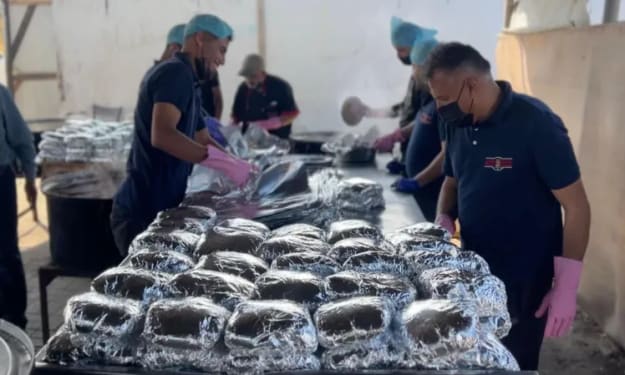
Gaza community kitchens warn food is running out after two months of Israeli blockade 2 hours ago Share Save Yolande Knell Middle East correspondent Reporting fromJerusalem BBC Cooks stir pots of rice and lentils at a community food kitchen run by the US-based humanitarian organisation Anera in Khan Younis, southern GazaBBC Anera's community kitchens in Khan Younis feeds some 6,000 people each day A hot meal is hard to come by in the Gaza Strip, but a lunch for needy families in the south is about to be delivered by donkey and cart. Today's dish is koshari - made with lentils, rice and a zesty tomato sauce - in a set of huge cooking pots in one of two community kitchens run by American Near East Refugee Aid (Anera), a US-based humanitarian organisation. "People rely on our meals; they have no source of income to buy what's left in the local markets and many foods are not available," says Sami Matar, who leads the Anera team. "In the past we used to cook rice with meat - with protein. Now, because of the closure, there's no type of meat, no fresh vegetables." Anera manager Sami Matar walks around the empty warehouse in southern Gaza Sami Matar showed a local BBC journalist around the empty Anera warehouse Two months ago, Israel shut all crossings to Gaza – preventing all goods, including food, fuel and medicines from entering - and later resumed its military offensive, ending a two-month ceasefire with Hamas. It said these steps were meant to put pressure on Hamas to release the hostages it still holds. Recently, the UN's World Food Programme and Unrwa, the agency for Palestinian refugees, said they had used up all their stocks of food aid. There is growing international pressure on Israel to lift its blockade, with warnings that mass starvation could be imminent and that intentionally starving civilians is a war crime. "Aid, and the civilian lives it saves, should never be a bargaining chip," the UN's humanitarian chief, Tom Fletcher, warned on Thursday. "Blocking aid starves civilians. It leaves them without basic medical support. It strips them of dignity and hope. It inflicts a cruel collective punishment. Blocking aid kills." Anera communal kitchen staff make up parcels of koshari to distribute to Palestinians in al-Mawasi, southern Gaza Hundreds of thousands of Palestinians are relying on community kitchens for their survival Hundreds of thousands of Gazans depend on a few dozen remaining kitchens for sustenance. The one run by Anera in Khan Younis feeds some 6,000 people a day. But if Israel does not lift its blockade, by far the longest it has ever imposed on Gaza, the kitchens - a last lifeline for so many - will soon have nothing to distribute. Food stockpiled during the ceasefire at the start of this year, has all but run out. "The coming days will be critical. We expect we have two weeks' supply, maybe less," Mr Matar says as he shows a local BBC journalist around the vast, empty Anera warehouse. "We used to receive more than 100 trucks every week - trucks of food parcels and hygiene kits. Now we don't have anything. "We struggle to provide food such as rice, lentils, pasta, cooking oil and salt, for our community kitchens. It's very expensive to buy 1kg of wood and we need over 700kg a day for cooking." A displaced woman waits for a food parcel from an Anera community kitchen in al-Mawasi, southern Gaza A displaced mother said there was no cooking gas or food to make meals for her family Israel has accused Hamas of stealing and storing humanitarian aid to give to its fighters or sell to raise money. The UN and other agencies deny aid has been diverted and say that they have strict monitoring mechanisms. "We work hard to avoid any interference from any parties. We have an accurate and strong distribution process," says Mr Matar, inspecting lists of aid recipients on his computer. "We have a database of hundreds of thousands of people, including their names, ID numbers and addresses - the co-ordinates of the camps. This avoids duplication with the work of other non-governmental organisations and ensures transparency." UN's top court begins hearings on Israel's legal duties towards Palestinians UN agency runs out of food aid in Gaza after Israeli blockade 'It's really hard to have any hope': Gaza doctor describes daily struggle Back in the outdoor kitchen, Mr Matar tests the food from the steaming pots to check its quality. Parcels are wrapped up for distribution; each can serve up to four people. All the workers receive food for their own hungry families. The rest is soon transferred on the donkey cart through the bustling streets to al-Mawasi, a crowded tent camp for displaced people on the coast, where dozens of field monitors supervise the hand-out. An elderly man walking with crutches looks relieved as he clutches two parcels of koshari to feed his family of seven. "Thank God, this will be enough," he says. "Don't even ask me about the situation," he goes on. "We're only alive because death hasn't taken us yet. I swear I was searching for a loaf of bread since the morning, and I found none." An elderly man holds two food parcels of food from an Anera community kitchen in the al-Mawasi area of southern Gaza Each of the parcels of food can serve up to four people "The situation is tragic, and it keeps worsening," comments a weary looking mother. "Life is humiliating here. We have men who are unable to work. There is no income, and all the products are so expensive. We're unable to buy anything." "At this time, this is excellent," she says of the warm meal she has just been given. "Because there is no cooking gas, no food. When we want to have a cup of tea, I collect leaves to start a fire." It has now been more than a year and a half since the war in Gaza began, triggered by the Hamas-led attacks on southern Israel. That assault killed around 1,200 people and more than 250 people were taken hostage. Some 59 are still held captive, with up to 24 of those believed to be alive. Israel's military campaign has killed more than 52,400 people in Gaza, mostly women, children and the elderly, according to the Hamas-run health ministry. More than 90% of the 2.1 million population has been displaced - with many forced to flee multiple times. The UN has warned that the current situation "is likely the worst it has been" due to the blockade, the renewed offensive and evacuation orders that have displaced some 500,000 people since 18 March. An Anera communal kitchen staff member guides a donkey pulling a cart laden with parcels of koshari to distribute to Palestinians in al-Mawasi, southern Gaza Anera distributes the food to tents in al-Mawasi rather than requiring people to queue for food at the kitchen There is growing international pressure on Israel to lift its blockade, with warnings that intentionally starving civilians is a potential war crime. The UN says that Israel has a clear obligation under international law as an occupying power to allow and facilitate aid for Gazans. Last Friday, US President Donald Trump said he had told Israel's Prime Minister, Benjamin Netanyahu that "we've got to be good to Gaza" and pushed him to allow more food and medicine into the strip. There was no official response to that, but earlier in the week, the Israeli foreign ministry rejected criticism from the UK, France and Germany, which described the blockade as "intolerable" in a joint statement and insisting "this must end." The ministry said more than 25,000 lorries carrying almost 450,000 tonnes of goods had entered Gaza during the ceasefire. It added: "Israel is monitoring the situation on the ground, and there is no shortage of aid." Israeli officials have indicated they plan to overhaul the aid distribution system. For now, supplies are piling up at Gaza's border crossings waiting to be brought in, while inside the territory, aid workers carefully ration what is left of their stock. In al-Mawasi camp, children gather playfully around Sami Matar and the Anera workers giving out the last of the day's food parcels. Many are painfully thin, with new warnings of acute malnutrition in Gaza - especially among the young. Anera's Sami Matar speaks to a boy eating a plate of koshari in al-Mawasi, southern Gaza Sami Matar appealed to Israel to reopen Gaza's crossings "I don't know what will happen if our supplies end," says Mr Matar, weighed down by the responsibility of his work. "The feeling of having to stop this vital help to people would be so stressful and depressing to me and my staff." "We have an urgent appeal," he continues. "Look at us, see our desperation, understand that time is running out. Please we just need to open the crossings again." Israel-Gaza war Israel Palestinian territories
By CryptoCurrency News 2 years ago in Journal
Tragic Mediterranean Boot Disaster: Over 60 Migrants missed
Tragic Mediterranean Boot Disaster: Over 60 Migrants missed The Mediterranean an important round of thousands of immigrants looking for a better life in Europe, the Mediterranean has demanded many people for life in the tragic boat royal. In one of the most heartbreaking episodes of recent times, a boat with migrants from the Libyan coastal city of Zara fell under stormy conditions and turbulent water pressure. From now on, 61 people are dead, and it is suspected that most victims of African countries such as Nigeria, the Gambia and other countries will come to the region south of Sahara.
By Akm Shamim Hossain2 years ago in Journal
The Arkadiko Bridge: The World’s Oldest Bridge and a Testament to Mycenaean Genius
Tucked into the serene hills of the Peloponnese in southern Greece lies a seemingly modest stone structure with an extraordinary history. The Arkadiko Bridge, also known as the Kazarma Bridge, is not only the oldest surviving bridge in Europe—it holds the distinction of being the oldest bridge in the world still in use today. Constructed during the Bronze Age, over 3,000 years ago, this ancient thoroughfare is a silent monument to the technological prowess of the Mycenaean civilisation.
By Muhammah Hanzalah2 years ago in Journal
The Hell Behind Construction Sites.
The Hell Behind Construction Sites: The Hidden Reality of Building Giants Introduction When you gaze at a towering skyscraper, you see beauty—steel, glass, and elegance. But hidden behind that polished exterior is a story of struggle, exhaustion, and relentless labor. This is the untold story of construction sites—the invisible battlefield that powers the modern world. It’s time we expose the raw truth behind the structures that shape our cities.
By Sayed Zewayed2 years ago in Journal
What's in Your Locker
Going back to junior high (middle school) and then on to high school ad what did you pack your lockers with day to day. To be honest the only things I actually put in my locker was my coat and books. If I close my eyes and try to remember when walking down the hallway and yes sometimes, I did peek into other's lockers.
By Mark Graham2 years ago in Journal
Live as if you were to die tomorrow. Learn as if you were to live forever
Life is a fragile and fleeting gift, one that often gets taken for granted amidst the routines and distractions of daily living. The quote "Live as if you were to die tomorrow. Learn as if you were to live forever" serves as a profound reminder that living fully and embracing continuous learning are not separate pursuits but deeply intertwined aspects of a meaningful existence.
By Nora Ariana2 years ago in Journal