business wars
Iconic and sometimes notorious business wars between key thought leaders and competitors in multiple categories, genres, and topics. From Nintendo and Sega to Penthouse and Playboy.
The Rise, Fall, and Reinvention of Kodak: A Business Lesson Every Entrepreneur Should Know
In the world of business, history is full of companies that once ruled their industries, only to fall from grace because they failed to adapt. One of the most famous examples is Kodak — a brand that was once so dominant in photography that its name was practically synonymous with taking pictures. At its peak, Kodak controlled over 85% of the U.S. photography market. They sold cameras, film rolls, and photo development services around the globe. People trusted Kodak to capture their most precious memories — birthdays, weddings, graduations, and holidays. But by 2012, Kodak had filed for bankruptcy. How could a company that once led an entire industry collapse so spectacularly? The answer offers powerful lessons for entrepreneurs, business owners, and anyone chasing success in a fast-changing world. --- The Kodak Moment: A Billion-Dollar Empire Founded in 1888 by George Eastman, Kodak revolutionized photography by making it accessible to ordinary people. Before Kodak, photography was a complicated, expensive process left to professionals. Eastman’s invention of the portable camera and roll film changed everything. His famous slogan, “You press the button, we do the rest,” captured the company’s promise: make photography easy for everyone. By the mid-20th century, Kodak was a household name, with its distinctive yellow packaging appearing in homes across the world. The company was so successful that in 1976, it controlled 90% of film sales and 85% of camera sales in America. It was a textbook example of brand loyalty and market dominance. --- The Missed Opportunity That Cost Them Everything In a twist of irony, Kodak actually invented the digital camera in 1975. An engineer named Steven Sasson built the first prototype, capable of capturing images digitally rather than on film. It was a bulky device, but it worked. However, when Sasson presented his invention to Kodak executives, their response was lukewarm. They feared digital photography would cannibalize their highly profitable film business. So, they shelved the idea, convinced that people would always prefer printed photos. This decision turned out to be one of the biggest missed opportunities in business history. --- The Digital Revolution and Kodak’s Decline While Kodak clung to its film business, companies like Sony, Canon, and Nikon embraced digital cameras. Tech giants like Apple and Samsung later integrated high-quality cameras into smartphones, making it easier than ever to take and share pictures. Kodak tried to catch up, releasing digital cameras and printing services. But by then, it was too late. Their brand was associated with film, and consumers had already moved on. In January 2012, Kodak filed for bankruptcy protection, a humbling fall for a company that once shaped the future of photography. --- The Comeback Nobody Saw Coming Surprisingly, Kodak didn’t disappear. After restructuring, the company pivoted to focus on commercial printing, packaging, and professional services. In recent years, it even ventured into pharmaceutical ingredients and blockchain-based image rights management. While it’s no longer the cultural icon it once was, Kodak’s resilience offers a valuable business lesson: even giants can fall, but they can also reinvent themselves. --- Key Business Lessons from Kodak’s Story 1. Never get too comfortable. Market dominance today doesn’t guarantee it tomorrow. 2. Embrace innovation, even if it threatens your current business. If you don’t disrupt yourself, someone else will. 3. Listen to your engineers and creative thinkers. Kodak’s own team invented the digital camera, but leadership ignored it. 4. Brand identity can be a double-edged sword. Kodak was so tied to film that it struggled to evolve. 5. It’s never too late to pivot. Even after bankruptcy, Kodak found new ways to stay relevant. --- Final Thought: In business, survival belongs not to the strongest, but to the most adaptable. The Kodak story is a powerful reminder for entrepreneurs, startups, and big brands alike: stay curious, stay hungry, and always be ready to embrace the next big thing — even if it threatens what you built yesterday.
By SHADOW-WRITESabout a year ago in Journal
THE SITUATION OF PALESTINE . AI-Generated.
The situation in Gaza is dire and has been widely described by international organizations, legal experts, and human rights groups as a genocide or at risk of genocide, particularly in the context of Israel's ongoing military offensive following the October 7, 2023, Hamas-led attack. Current Situation
By Zahinul Hakimabout a year ago in Journal
Chinese Robots Run Against Humans in World’s First Humanoid Half-Marathon — and Lose by a Mile. AI-Generated.
In a historic event that merged athleticism with cutting-edge robotics, the world witnessed the first-ever humanoid half-marathon held in China, where a group of humanoid robots competed against human runners in a 21.1-kilometer race. The futuristic contest, which was put on by a group of top Chinese universities and robotics companies and took place in Beijing, was meant to show off new developments in artificial intelligence and humanoid robotics. While the robots captivated spectators with their mechanical strides and uncanny resemblance to human motion, the final results confirmed what many had suspected: robots are still far from outrunning their creators. Despite months of preparation, advanced programming, and highly engineered designs, none of the robots came close to challenging the human athletes, finishing the race several hours behind the top runners—or dropping out entirely due to technical malfunctions.
By Rezwan Al Shahriarabout a year ago in Journal
Announcing New Computer Use in Microsoft Copilot Studio for UI Automation
Introduction Microsoft continues to push the boundaries of AI-powered automation with its latest enhancement to Microsoft Copilot Studio—UI Automation via Computer Use. This new capability empowers developers and business users to automate repetitive tasks by interacting with applications just like a human would, leveraging AI to streamline workflows and boost productivity.
By Dewan Minhajulabout a year ago in Journal
The Media's Role in Combating Misinformation
In an era where information travels at the speed of light, the line between fact and fiction often blurs. Imagine a world where news of a zombie apocalypse trends higher than climate change reports. Welcome to the age of misinformation, where distinguishing truth from falsehood has become a daily challenge. As guardians of information, the media play a pivotal role in this battle. But how equipped are they to fight this war? Let's dive into the strategies and best practices that media outlets employ to maintain information integrity and combat the spread of misinformation.
By Alain SUPPINIabout a year ago in Journal
Rubio warns if it's not possible to end the war in Ukraine, US needs to 'move on
U.S. Secretary of State Marco Rubio has issued a stark warning that the United States may abandon its current peace mediation efforts in Ukraine if no progress is made soon. Speaking to reporters in Paris on April 18, 2025, Rubio stated, "If it is not possible to end the war in Ukraine, we need to move on." The remarks signal a growing sense of frustration within the U.S. administration over the prolonged stalemate in peace negotiations between Ukraine and Russia. Rubio's remarks come at an important time in the diplomatic effort to end the war that has devastated Ukraine since Russia's full-scale invasion in 2022. Despite numerous despite summits, backchannel communications, and high-level negotiations, there hasn't been a complete ceasefire. The most recent talks in Paris-attended by U.S., Ukrainian, and European leaders -failed to achieve a breakthrough. A subsequent round of discussions is scheduled in London, but expectations are muted. Russia, on the other hand, has been uncompromising in its demands, such as the suspension of Ukraine's military mobilization and the cessation of Western arms shipments to Ukraine. Ukrainian President Volodymyr Zelenskyy has strongly rejected these conditions, calling them unacceptable and a threat to national sovereignty. Ukraine continues to insist that any peace agreement must include the withdrawal of Russian forces from occupied territories and accountability for war crimes committed during the conflict. The U.S. administration's push for a peace deal was initially framed by President Donald Trump as a key foreign policy objective. During his campaign and early presidency, Trump promised to end the war swiftly through aggressive diplomacy and leverage over NATO and Russia. However, the reality of deeply rooted territorial, political, and security concerns has significantly complicated such an outcome. Rubio's statement marks a potential shift in U.S. policy. While it does not mean immediate disengagement, it suggests that Washington is considering scaling back its efforts if talks remain unproductive. According to officials, the administration may instead focus more heavily on economic support and rebuilding Ukraine's infrastructure, rather than trying to broker an elusive peace deal. One significant development alongside the diplomatic efforts has been the announcement of a new U.S.-Ukraine economic partnership. On the sidelines of the Paris talks, the two countries signed a memorandum of intent aimed at boosting Ukraine's reconstruction. The agreement lays the groundwork for a multibillion-dollar investment fund that will focus on energy, transportation, and digital infrastructure reconstruction. It also grants access to Ukraine's abundant mineral resources. Rubio noted that while peace remains the top priority, strengthening Ukraine's economy is essential for long-term stability. European leaders have responded cautiously to Rubio's remarks. French President Emmanuel Macron and German Chancellor Annalena Baerbock have continued to urge all parties to remain engaged in the peace process. Both leaders emphasized that any potential U.S. disengagement could weaken the overall diplomatic front and embolden Russia. Macron, who hosted the recent round of talks, stressed the importance of Western unity in addressing Russian aggression. The idea of "moving on" from peace efforts sends the wrong message at a sensitive time, according to critics of the US strategy. Some analysts worry that it could undermine Ukrainian morale or give Russia the impression that international pressure is waning. Others, however, view Rubio's comments as a realistic assessment of a complex situation that has defied resolution for over three years. years. As the war drags on, the question of how long the U.S. and its allies can sustain their current level of involvement-militarily, economically, and diplomatically-continues to be a subject of debate. Rubio's remarks underscore the urgent need for results, but they also highlight the limits of diplomacy in the face of intransigence on both sides. It remains to be seen whether the United States actually intends to "move on" or is employing the threat as a negotiating tool. What is clear is that patience is wearing thin, and time may be running out for a peaceful resolution.
By J P PRINCE about a year ago in Journal
Clickbait Killed the Journalist: Navigating Press Freedom in the Digital Age
Imagine a world where journalists are silenced not by censorship, but by algorithms. In the digital age, the press faces a paradox: the internet amplifies voices but also muffles truths. As newsrooms shrink and misinformation spreads, how do we safeguard press freedom?
By Alain SUPPINIabout a year ago in Journal
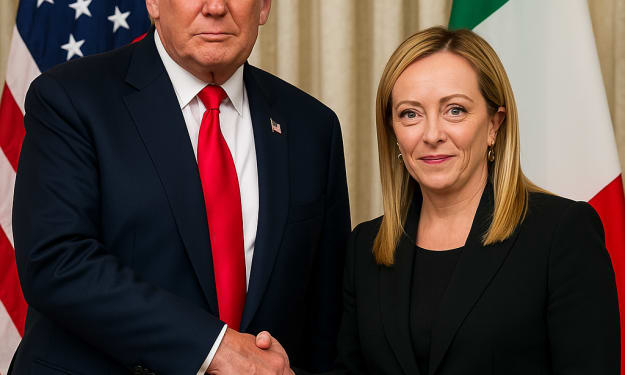
Trump Meets Italian PM Meloni as EU Trade Tensions Rise
Trump and Meloni’s High-Stakes Meeting: What It Means for U.S.-EU Trade Relations This week, I’ve been closely following one of the most significant diplomatic meetings of 2025—former U.S. President Donald Trump’s sit-down with Italian Prime Minister Giorgia Meloni at the White House. As someone who watches global affairs with interest, this meeting stood out because of its timing and the high-stakes conversation surrounding it.
By AS SADIK RAHMANabout a year ago in Journal