business wars
Iconic and sometimes notorious business wars between key thought leaders and competitors in multiple categories, genres, and topics. From Nintendo and Sega to Penthouse and Playboy.
Online Tutoring Jobs In USA: Your Career Gateway (2025)
The design sector has been very popular in online marketplaces for many years. Many people are earning a lot of money in this sector every month despite being poorly educated. This sector is a very creative sector. In this sector, the value of work efficiency is much higher than certificates. Nowadays, this sector has become much easier. The time it took a designer to design a design a few years ago, now it does not take much time to do that design. Because now there are good AI tools for designing.
By CareerNextTechabout a year ago in Journal
----
Online Tutoring Jobs In USA: Your Career Gateway (2025) The present era is the era of technology. With the development of technology, people now want to learn everything from home and earn money online. With the development of technology, students want to take classes from home. Teachers in the present era also feel more comfortable taking classes online.
By CareerNextTechabout a year ago in Journal
How Weighted Hoodie Made $500M in 3 Years
Selling oversized hoodies on TikTok Shop and becoming one of the fastest-growing apparel brands on the platform. Today, we’re talking about how Hudson sells hoodies designed to feel like a hug. We’ll take a look at how this young founder grew up, stumbled, and eventually built a $500 million business.
By Jingsourcing.com about a year ago in Journal
Why Must You Get Travel Insurance?
Taking vacations is a blow. Unfortunately, dreams do not always come to actualization. With luggage, anything may go wrong. Planes may experience delays. It is possible to become sick or hurt while on vacation. Possible issues like this can end up costing a hefty penny. This is why getting travel insurance is a smart move.
By Emily Willsonabout a year ago in Journal
Iran - US Nuclear Deal
The Iran-U.S. nuclear deal, officially known as the Joint Comprehensive Plan of Action (JCPOA), stands as one of the most pivotal and controversial diplomatic agreements of the 21st century. Signed in 2015 between Iran and six world powers—the United States, United Kingdom, France, Germany, Russia, and China—the deal aimed to limit Iran’s nuclear program in exchange for relief from economic sanctions. Nearly a decade later, the deal remains in a state of uncertainty, with efforts to revive it met with mistrust, geopolitical shifts, and domestic opposition on all sides. Background: What the JCPOA Was Designed to Do At its core, the JCPOA was a non-proliferation agreement. Iran agreed to drastically reduce its uranium enrichment activities, limit its stockpile of enriched uranium, and open its nuclear facilities to international inspections by the International Atomic Energy Agency (IAEA). In return, crippling economic sanctions—particularly those related to oil exports and banking—were lifted, offering Iran a chance to reintegrate into the global economy. The agreement was hailed as a diplomatic breakthrough. Supporters argued it prevented Iran from acquiring a nuclear weapon without the need for military conflict. Critics, however, saw it as overly lenient, claiming it merely delayed Iran’s nuclear ambitions without permanently dismantling its capabilities. U.S. Withdrawal and Its Fallout The turning point came in May 2018, when then-President Donald Trump unilaterally withdrew the United States from the JCPOA, calling it a “disastrous deal.” The Trump administration reinstated and intensified sanctions under its “maximum pressure” campaign, aiming to force Iran back to the negotiating table under more favorable terms. Iran responded by gradually stepping away from its commitments, enriching uranium beyond JCPOA limits and restricting IAEA inspections. This breakdown severely strained U.S.-Iran relations and led to heightened tensions, including cyberattacks, sabotage incidents, and the targeted killing of Iranian General Qasem Soleimani in 2020. The risk of open military conflict briefly surged, and hopes for reviving diplomacy dimmed. Biden’s Approach: Hope for Revival President Joe Biden came into office promising to rejoin the JCPOA, but only if Iran returned to full compliance. Indirect negotiations began in Vienna in 2021, with European intermediaries attempting to bridge the growing chasm between the two sides. While progress was made, multiple rounds of talks failed to yield a breakthrough. Several factors complicated the negotiations. Iran demanded guarantees that a future U.S. administration wouldn’t abandon the deal again—something the Biden administration couldn’t legally promise. Meanwhile, Iran’s domestic politics shifted after the 2021 election of hardline President Ebrahim Raisi, who took a more confrontational stance. Israel and some Gulf states also lobbied against a renewed deal, fearing it would legitimize Iran’s regional influence. Current Status: Stalemate with High Stakes As of 2025, the JCPOA remains dormant, neither fully alive nor entirely dead. Iran continues to enrich uranium to near-weapons-grade levels, though it insists its program remains peaceful. The U.S. has imposed new sanctions and explored alternative means of containment, such as regional security pacts and tighter coordination with European allies. This stalemate has dire implications. Without a functioning agreement, the risk of proliferation in the Middle East increases, raising the likelihood that other countries could seek nuclear capabilities in response to Iran. It also limits global cooperation on other security challenges, such as counterterrorism and energy stability, especially in a region as volatile as the Middle East. Broader Geopolitical Implications The fate of the Iran-U.S. nuclear deal goes beyond bilateral relations. It underscores the fragility of international agreements in the face of changing political winds. The U.S. withdrawal in 2018 eroded trust not only in Washington’s commitment to diplomacy but also in the idea that multilateral deals can survive leadership changes. For Iran, the experience reinforced the belief that engagement with the West brings few lasting benefits. Meanwhile, other global players like China and Russia have taken advantage of the vacuum. Iran has strengthened its ties with Beijing and Moscow, signing long-term economic and military agreements that give it more strategic flexibility. These shifts could recalibrate power dynamics in the region and complicate future efforts by the West to isolate or pressure Tehran. Conclusion: A Deal Worth Saving? Despite its imperfections, the JCPOA represented a rare moment of consensus and diplomacy in a region often defined by conflict. It proved that negotiation, not just coercion, could deliver tangible security outcomes. Reviving the deal—or crafting a new, more comprehensive framework—remains a challenging but potentially crucial task for global stability. Ultimately, the Iran-U.S. nuclear deal is not just about uranium enrichment levels or centrifuge counts. It is about building a sustainable model of conflict resolution in a world where trust is scarce and the cost of failure is dangerously high. Whether diplomacy can overcome politics remains the central question.
By Naveed Younisabout a year ago in Journal
Trump Deploys 2,000 National Guard Members After Los Angeles Immigration Protests
After widespread demonstrations against federal immigration laws, former President Donald Trump took a bold step in the face of rising tensions over immigration enforcement by approving the deployment of 2,000 National Guard troops to Los Angeles. Disputable raids and detentions by Immigration and Customs Enforcement (ICE) in primarily Latino areas served as the impetus for the protests, which attracted hundreds of people. The Trump administration's tough immigration policies and readiness to employ military action to uphold law and order were highlighted by the National Guard's deployment.
By Tanvir Shahariarabout a year ago in Journal
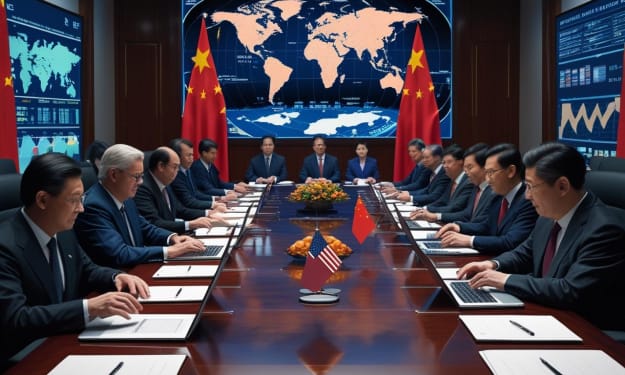
The London Showdown: U.S.–China Trade Talks on June 9 Could Reorder the Global Economy
1. 🇺🇸🇨🇳 Why London? Why Now? After months of escalating tension—from “Liberation Day” tariffs to rare-earth chokeholds—the U.S. and China are taking their latest gamble in London on June 9, 2025
By MILTON CHANDRA ADIKARYabout a year ago in Journal