
Sodium Ethoxide Procurement Guide: Powder vs Ethanol Solution, Purity, Packaging and Safe Handling
Why Physical Form Matters in Sodium Ethoxide Sourcing

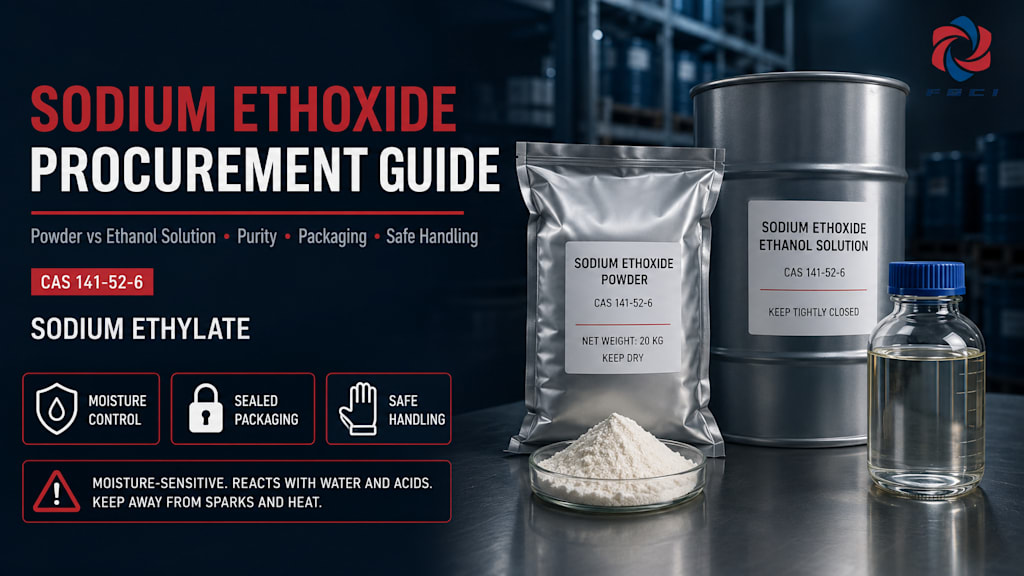
Sodium ethoxide is used in pharmaceutical intermediates, dyes and pigments, polymers, fine chemicals, and other industrial processes. Buyers can source it as a powder or as a solution in ethanol, and choosing between these forms is often more important than comparing headline purity alone.
The appropriate form depends on the process solvent, required active content, dosing system, storage capability, transportation conditions, and the facility’s safety procedures. Powder and solution products also require different specifications, packaging controls, and incoming inspections.
For powder, purchasing teams commonly examine total alkalinity, free alkali, sodium carbonate, appearance, and protection from moisture. For an ethanol solution, the central questions involve concentration, solvent identity, solution appearance, packaging compatibility, and consistency across batches.
A responsible procurement review should connect the product form with the intended application, supplier documentation, packaging, delivery route, and site-specific safety requirements.
Confirm Product Identity and Available Forms
Sodium ethoxide may also appear in commercial documents under names such as sodium ethanolate or sodium ethylate. The chemical is identified by CAS 141-52-6, but the CAS number alone does not indicate whether the supplied product is a powder or an ethanol solution.
Every quotation should clearly identify:
Full product name and CAS number
Powder or solution form
Active content or concentration basis
Solvent identity for a solution
Applicable specification
Packaging format
Batch and transportation documents
When comparing powder and solution forms, specifications, packaging, or batch documentation for Sodium ethoxide CAS 141-52-6, buyers should verify that the offered physical form is stated consistently throughout the quotation and supporting documents.
The same description should appear on the specification sheet, Certificate of Analysis, Safety Data Sheet, package labels, packing list, invoice, and transportation records. If one document says “sodium ethoxide” while another describes a solution, procurement teams should confirm the concentration and solvent before approval.
Choose Powder or Ethanol Solution According to the Process
Neither sodium ethoxide powder nor sodium ethoxide in ethanol is universally superior. The better choice is the form that fits the buyer’s process and facility controls.
Procurement FactorSodium Ethoxide PowderSodium Ethoxide in EthanolProcess solvent compatibilityRequires evaluation of how the solid fits the processMay suit processes already designed around ethanolActive contentHigher active content may reduce transported volumeActive content depends on the declared concentrationDosing and transferRequires equipment and procedures suitable for a reactive solidRequires systems suitable for a reactive, solvent-based liquidStorage capacityNeeds sealed, moisture-protected storageNeeds compatible liquid storage and solvent-related controlsMoisture controlParticularly dependent on package sealing and controlled exposureWater entry can still affect concentration and qualityPackagingMoisture-resistant bags or drums may be usedCompatible, leak-resistant containers are requiredTransportationClassification must be confirmed for the solid productRequirements depend on concentration, solvent, quantity, and routeFacility safety proceduresMust address reactive powder receiving and storageMust address both chemical reactivity and ethanol-related hazards
A powder may appeal to buyers seeking higher active content or less solvent in the purchased material. However, the facility must be able to receive, store, sample, and use a moisture-sensitive reactive solid under approved conditions.
A sodium ethoxide solution may integrate more easily into a process that already uses ethanol. The buyer must still confirm concentration, solvent quality, packaging compatibility, and transportation requirements.
The purchasing decision should involve production, engineering, safety, quality, logistics, and procurement personnel rather than being made from price per kilogram alone.
Evaluate Sodium Ethoxide Powder Specifications
Total alkalinity is commonly used to describe the overall alkaline content measured under the supplier’s specified analytical method. It can provide a useful indication of active material, but its meaning depends on the method and calculation basis.
Free alkali refers to alkaline material reported separately from the intended sodium ethoxide content. Its relevance depends on the buyer’s reaction, formulation, and impurity tolerances.
Sodium carbonate may form through exposure or other chemical changes and is generally treated as a separate quality parameter. A result for sodium carbonate should not be assumed to represent free alkali or total alkalinity.
Appearance is another practical receiving check. Buyers should request the supplier’s current description and compare delivered material with the agreed standard. Unexpected discoloration, clumping, package damage, or other visible changes should be investigated by qualified personnel.
Because sodium ethoxide powder is moisture sensitive, batch quality cannot be evaluated separately from packaging and storage history. A satisfactory production result may not remain representative if the package loses integrity during transportation or warehousing.
Procurement teams should establish agreed limits for total alkalinity, free alkali, sodium carbonate, and appearance. These values should be confirmed through the current specification and the COA for the proposed batch.
Evaluate Sodium Ethoxide Solution Specifications
For a sodium ethoxide solution, declared concentration is the primary commercial and quality parameter. Buyers should confirm whether concentration is reported by weight, volume, or another agreed basis.
The quotation, product specification, label, and COA must use the same definition. A concentration figure without a reporting basis can cause errors in product comparison, inventory planning, and incoming acceptance.
Solvent identity should be explicitly stated. If the product is supplied as sodium ethoxide in ethanol, the documentation should not describe it merely as a generic solution.
Solution appearance may help identify unusual changes, but visual inspection cannot replace concentration testing or document review. Buyers should confirm the expected appearance and the supplier’s applicable acceptance criteria.
The concentration test method or method reference should be reviewed where relevant. Procurement teams should also examine recent COAs to determine whether concentration remains consistent across batches.
Packaging compatibility is essential for a reactive chemical solution. The supplier and buyer’s safety specialists should confirm that the container, closure, seal, and transportation package are suitable for the offered concentration and delivery conditions.
Understand Total Alkali, Free Alkali and Sodium Carbonate
Total alkali, free alkali, and sodium carbonate describe different aspects of powder quality and should not be treated as interchangeable terms.
Total alkali represents the overall alkalinity reported using an agreed analytical approach. Depending on the specification, it may be used as an indicator related to active content.
Free alkali describes a separately measured alkaline impurity or component. Sodium carbonate is another distinct parameter that may provide information about material condition or exposure.
The interpretation of these values depends on the supplier’s analytical methods and calculation conventions. Two suppliers may use similar terminology while applying different reporting approaches.
Before ordering, buyers should agree on definitions, units, test methods, and acceptance limits. The batch COA should report the required parameters separately and use the same basis as the approved specification.
Review Moisture Sensitivity and Chemical Reactivity
Sodium ethoxide is sensitive to moisture and reacts with water or acids. This characteristic has direct procurement implications for packaging, storage, sampling, transportation, training, and emergency documentation.
The package should remain sealed and provide moisture protection appropriate for the supplied form. Powder packaging must protect against humidity and physical damage, while solution packaging must also address container compatibility and leak prevention.
Storage requirements should be taken from the current SDS, supplier documentation, applicable regulations, and the buyer’s approved site procedures. This article cannot replace a site-specific safety assessment or instructions from qualified professionals.
Container opening, sampling, testing, and production use should only take place in suitable facilities under established procedures with trained personnel. Procurement teams should verify that the receiving site can meet these requirements before ordering.
Transportation planning must account for product form, concentration, quantity, destination, carrier, and shipping method. Relevant emergency and dangerous-goods documentation should be reviewed before dispatch.
Compare Packaging Options
Packaging formats such as 20 kg or 200 kg units may be available, but buyers should confirm the actual options for the selected form and shipment.
Powder may be offered in moisture-protected bags or drums with inner sealing. Buyers should verify package construction, closure, tamper evidence, net weight, and expected protection during transportation.
A solution generally requires a compatible liquid container with secure sealing and appropriate leak protection. The package must match the concentration, solvent, transportation route, and applicable requirements.
The larger package is not automatically the more economical choice. Consumption rate, storage capacity, internal movement, equipment, and the risk associated with keeping a container open should all influence package selection.
Customized packaging or labels may be possible, but minimum quantities, lead time, compatibility review, and additional documentation should be confirmed before payment.
Every package should carry clear product identification, form or concentration, lot number, net weight, and required hazard information.
Audit Safety and Transportation Documents
A supplier qualification file should include:
Current product specification
Batch-specific Certificate of Analysis
Current Safety Data Sheet
Product-form and concentration details
Dangerous-goods classification information
Packaging and hazard labels
Transportation documents
Export and customs documents
Lot-traceability records
Storage instructions
Classification and transportation requirements can differ between powder and solution. They may also vary with concentration, package size, destination, carrier, and mode of transportation.
Buyers should avoid copying classifications or shipping instructions from an earlier order without verifying that they apply to the current product and route. The supplier, logistics provider, regulatory specialists, and qualified safety personnel should confirm current requirements.
Use Samples and Incoming Inspection to Verify the Supplier
A representative sample or small trial order can help buyers assess specification compliance, appearance, packaging, documentation, and supplier responsiveness.
The sample should be linked to a known lot and accompanied by the relevant COA. Buyers should also confirm whether it represents the commercial material that would be supplied in a larger order.
Evaluation must take place only in appropriately equipped facilities using approved procedures and trained personnel. A sample should not be opened or tested casually because of its reactive nature.
A trial order can reveal issues not visible in a specification, such as damaged seals, unclear labels, inconsistent concentration reporting, document delays, or poor complaint response.
Recent COAs from several batches can also help buyers evaluate consistency instead of relying on one ideal sample.
Build an Incoming Inspection Plan
A practical receiving framework may include:
Verify the product name and CAS 141-52-6.
Confirm whether the shipment is powder or ethanol solution.
Check package condition, seals, labels, and tamper evidence.
Compare lot numbers with the COA and shipping records.
Review the batch results against the approved specification.
For powder, review total alkalinity, free alkali, and sodium carbonate.
For solution, confirm concentration and its reporting basis.
Verify the declared solvent identity.
Compare appearance with the agreed description.
Retain a properly identified sample under approved procedures.
Quarantine and report nonconforming material before use.
The scope of testing should reflect the application, product form, supplier history, order size, and the buyer’s quality system.
Sodium Ethoxide Supplier Qualification Checklist
Before approving a sodium ethoxide supplier, confirm that:
The intended application has been communicated.
Powder or ethanol solution is clearly specified.
The powder specification addresses total alkalinity.
Free alkali and sodium carbonate are reported separately where required.
Solution concentration and reporting basis are defined.
Ethanol is confirmed as the solvent when applicable.
A representative sample or trial quantity is available.
A batch-specific COA can be supplied.
A current SDS is available for the exact product form.
Packaging compatibility and sealing are documented.
Moisture or leak protection is appropriate.
Transportation and export documents can be prepared.
Lot numbers provide complete traceability.
Production and delivery lead times meet the schedule.
Technical and quality contacts respond clearly.
Quality complaints and deviations follow a documented process.
Questions to Ask Before Buying Sodium Ethoxide
Procurement teams can ask prospective suppliers:
Is the supplied product a powder or a solution in ethanol?
How is active content or solution concentration defined and tested?
Which powder parameters are included on the batch COA?
Are total alkalinity, free alkali, and sodium carbonate reported separately?
What packaging formats are available for each form, including any 20 kg or 200 kg options?
What SDS, transportation, storage, and export documents are provided?
Can you provide a representative sample or small trial quantity from a traceable batch?
How are specification changes, lot traceability, damaged packaging, and quality complaints managed?
Written answers allow procurement, safety, quality, and production teams to compare potential suppliers using consistent criteria.
Conclusion
Successful sodium ethoxide procurement begins with choosing the physical form that fits the process and facility. Powder purchasing centers on total alkalinity, free alkali, sodium carbonate, appearance, and moisture protection, while solution purchasing requires clear concentration, solvent, packaging, and transportation information.
Compatible packaging, accurate documents, controlled delivery, representative samples, and consistent batch performance are essential for both forms. By evaluating these factors together, buyers can make better-informed sourcing decisions without relying on price or a single purity figure.
About the Creator
Enjoyed the story? Support the Creator.
Subscribe for free to receive all their stories in your feed.
Comments
There are no comments for this story
Be the first to respond and start the conversation.