
Shey Phoksundo Trek Journal: The Lake That Didn't Look Real
A Personal Travel Diary

Day 0 — Kathmandu, The Night Before
I am sitting on my hotel bed in Thamel with a headlamp I don't know how to use and a list of things I apparently should have packed three weeks ago.
I found this trek the way you find most things that change your life — accidentally, through someone else's offhand comment at a dinner party. A woman I barely knew had just come back from western Nepal and said, quietly, almost to herself: "There is a lake there that doesn't look like it belongs to this world." I didn't ask her anything else. I didn't need to.
That was eight months ago. I am finally here.
My guide texts to confirm the 5 a.m. pickup. His name is Tendi. The message ends with a single thumbs-up emoji which, for reasons I can't fully explain, makes me feel much better about everything.
Day 1 — Kathmandu to Nepalgunj
The flight to Nepalgunj takes less than an hour. You leave the green hills around Kathmandu behind and the land below flattens out into the Terai — the great tropical plain that stretches toward India, dense and hazy and hot.
Nepalgunj hits you like a wall of warm air the moment the plane door opens. The city moves at a different frequency from Kathmandu: louder, flatter, more urgent. We eat lunch at a restaurant near the hotel — mutton curry, rice, a salad I'm told to avoid, a lassi so cold and thick I want to sit with it for the rest of the afternoon.
Tendi runs me through tomorrow's plan over tea. We fly to Juphal at first light. From there we walk. He spreads a hand across the table as if gesturing at the whole region and says: "Dolpo. You will see."
I write that down in my journal. You will see. I am starting to collect these small sentences.
I go to bed at nine o'clock. This is not a thing I have done voluntarily since I was eleven years old.
Day 2 — The Flight to Juphal
I need to tell you about this flight.
The Twin Otter carries maybe fifteen people. It takes off from Nepalgunj and almost immediately begins weaving between ridgelines — not over them, between them — as if the pilot is threading a needle at 200 kilometres an hour. The woman sitting in front of me grips both armrests and closes her eyes. The man beside her takes photographs with the calm efficiency of someone who has done this many times before.
Then the clouds open and the Kanjiroba Himalaya appears.
I have been to the Alps. I have flown over Greenland. I have seen mountains before. None of it prepared me for this. The scale is simply different — not larger, exactly, but more absolute, as if these peaks operate by different physical laws than everything else.
We land at Juphal on a strip of dirt carved into a hillside at 2,475 metres. The plane brakes hard, stops maybe twenty metres from the edge of a drop, and everyone exhales simultaneously.
Tendi is smiling as we climb out. "Good flight," he says.
We start walking an hour later.
Day 3 — Juphal to Dunai, Dunai to Chhepka
The first day of trekking descends through terraced farmland to the Bheri River valley before climbing back up along the southern bank. There are stone houses with flat roofs loaded with drying fodder. There are children who appear out of nowhere to walk alongside you for ten minutes before vanishing just as suddenly. There is a woman carrying a load I could not lift off the ground who overtakes me on an uphill section without appearing to breathe harder.
Humility arrives early on Himalayan trails.
We reach Dunai — the administrative centre of Dolpo — by early afternoon and push on toward Chhepka. The trail enters Shey Phoksundo National Park via a suspension bridge over the Thuli Bheri River. The bridge sways. The river below is white and fast and very far down.
I stop at the far end and turn back to look at where I've just come from. The gorge walls rise on both sides, the river disappears into shadow, and the bridge hangs there between two worlds like a held breath.
We are in it now, I think.
The teahouse in Chhepka is run by a woman named Diki who feeds us potatoes fried with turmeric and cumin and a thermos of tea so sweet it makes your eyes water. I eat everything on my plate and ask if there is more.
Day 4 — Chhepka Through the Forest
Deep forest today. Blue pine and spruce and birch, the trees enormous and draped in moss, the light coming through them in long slanted columns that make the whole trail feel like the inside of a cathedral.
My legs are finding their rhythm. This is the thing about multi-day trekking that no one warns you about — the first two days your body is confused and resistant, and then somewhere on day three or four it accepts what is happening and settles into a different gear entirely. You stop checking your watch. You stop thinking about anything much beyond the next turn in the trail.
We passed a mani wall today — a long low structure of flat stones carved with Tibetan prayers, stretching for maybe thirty metres along the path. Tendi told me to keep it on my right as we passed, which is the respectful direction. I traced my fingers along the carved syllables and thought about all the people who had done the same thing for hundreds of years before me.
The teahouse tonight is basic. My room is a thin-walled box with a narrow mattress and a blanket that smells of wood smoke. I sleep better than I have in years.
Day 5 — The Waterfall, Then the Climb
A waterfall appeared around a bend today that stopped all five of us in our group mid-stride and held us there, wordless, for a full two minutes.
It drops several hundred metres off a sheer cliff face in a single unbroken sheet, and the noise of it fills the entire valley — not a roar but something lower and more constant, a vibration you feel in your chest. The air around it is cold and wet. Small rainbows appear and disappear in the spray.
I ate my packed lunch sitting on a rock fifteen metres from the base of it and did not once look at my phone.
The afternoon climb into higher altitude brought us through winter pasturelands where yaks grazed among wildflowers with the unbothered dignity of animals that know they are in the right place. The grass was very green. The sky above it was very blue. These sentences sound simple. They were.
Tendi pointed ahead and slightly upward as we neared the evening's teahouse and said: "Tomorrow you see the lake."
I didn't sleep well that night. Not from anxiety. From anticipation.
Day 6 — Ringmo and Phoksundo
I don't know how to write about this either, but I'm going to try.
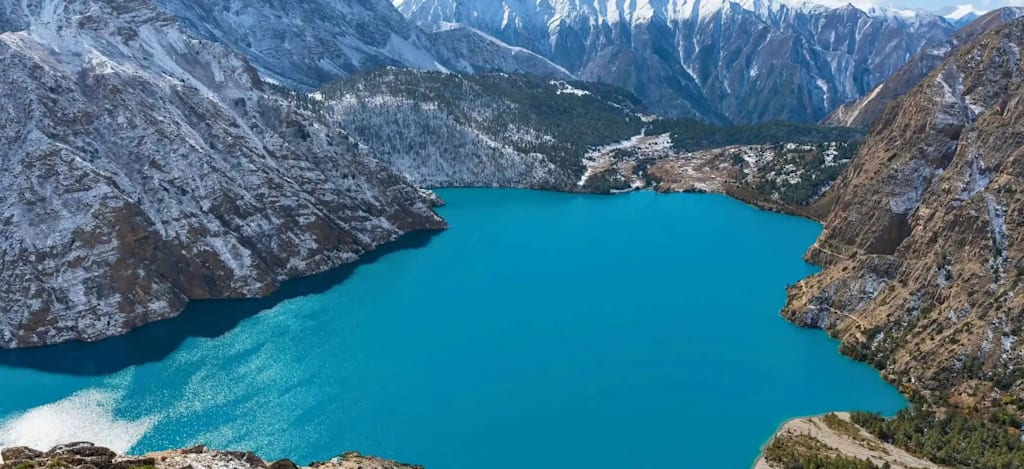
You come around a hillside above the village of Ringmo and the lake just appears — sudden and total and unlike any colour I have a proper name for. Turquoise is the word everyone uses and it is both accurate and completely inadequate. The water is transparent in the shallows and then darkens through layers of blue-green to something almost indigo at the centre. It sits in the mountains at 3,611 metres, ringed by snow-dusted peaks, and it does not look like something the Earth produces naturally.
It looks like something the Earth kept secret.
The woman at the dinner party was right. It doesn't belong to this world. Or rather — it makes you feel that you are the one who doesn't quite belong here, and that the lake has been getting along perfectly well without you.
I sat on the shore for a very long time.
Ringmo village is small and ancient and largely Bon-Po — followers of the pre-Buddhist spiritual tradition that predates Tibetan Buddhism in this region. The doorways are carved. Prayer wheels spin at the village entrance. An elderly man circled the lake perimeter slowly with a string of beads, lips moving, completely absorbed in something we were only watching from the outside.
That evening I wrote several pages in my journal and then crossed most of them out because they were trying too hard to explain something that simply has to be experienced.
If you are trying to decide whether to do the Shey Phoksundo Lake Trek: go. Stop deciding and go.
Day 7 — The Monastery and the Afternoon Light
We spent a second day at the lake. I had worried this might feel like too long in one place. It did not feel like too long.
In the morning we walked to Thashung Gompa, a monastery that clings to the cliff above the eastern shore like it grew there organically. A monk inside made us butter tea without being asked and watched us drink it with the patient expression of someone who has seen many foreigners encounter butter tea for the first time. I managed to finish mine. Tendi looked impressed.
The interior of the monastery was hung with thangkas — painted scroll paintings whose colours should have faded centuries ago but hadn't. Reds and golds and that particular Himalayan blue that you also see in the lake, now that I think about it. As if the whole landscape is working in the same palette.
In the afternoon I climbed to a viewpoint above Ringmo with two other trekkers — a couple from Japan on their honeymoon who had been photographing everything so thoroughly that I had initially mistaken them for professional photographers. From the viewpoint, the lake spread out below us in full, the village a small cluster at its edge, the mountains rising behind it in a series of white and grey planes that kept going until they disappeared into cloud.
Nobody said anything for a while.
Then the Japanese woman said, quietly and in very precise English: "I think this is the most beautiful place I have ever seen."
I think so too.
Day 8 — The Long Walk Back Begins
There is something about the return journey that the outward trek cannot give you.
On the way in, you are moving toward something. Your attention is always slightly ahead of you — the next village, the next ridge, the lake at the end of the trail. On the way back, you have already seen the thing. The journey is no longer about arrival. It becomes about the walking itself, which is where I think the real point has been all along.
I noticed things today that I had walked past without seeing four days earlier. A tiny shrine built into a crack in the cliff face above the gorge. The way the suspension bridges cast moving shadows on the river below in afternoon light. The sound the blue pine forest makes in a breeze — not like any other trees, a drier and more resonant sound, like something breathing slowly.
My body is tired in a good way. The kind of tired that feels like the body has been used properly, which is different from exhaustion and different from the tiredness of sitting still for too long.
Tendi is quieter on the return journey too. I think he spends the inward trek watching his group, and the return trek thinking his own thoughts. I like him very much for this.
Day 9 — Juphal and the Last Night in Dolpo
Back in Juphal by mid-afternoon. The airstrip at the edge of the hillside. The small tea stall where a man sells instant noodles and lukewarm Fanta from a cooler that appears to have no power source.
The other trekkers in our group sat outside and talked about what they were going back to. Jobs. Children. Other treks. One of them — a retired architect from Amsterdam named Pieter — said he had been coming to Nepal every two or three years for twenty years and that each time he left he understood slightly less about his own life than when he arrived, and that this felt like progress.
I thought about that for a while.
Tonight I'm sleeping in a small guesthouse near the airstrip. My journal is almost full. I have one page left and I have been trying to decide what to write on it. I think I'll leave it blank until I'm home and can see the whole thing from a distance.
Day 10 — The Flight Back, and Kathmandu
The flight from Juphal to Nepalgunj, the wait in the small airport, the connecting flight to Kathmandu — all of it passes in a kind of pleasant daze.
Kathmandu in the evening is loud and crowded and full of the particular smell of the city — diesel and incense and street food — and I loved it. I was glad to be back in it. I was also aware, in a way that will probably take weeks to fully settle, that something had shifted slightly in how I was looking at things.
Tendi and I said goodbye at the airport. He told me I was a good trekker. I told him that was almost certainly not true. He laughed and said, "You finished. That means you are a good trekker."
I took a taxi to the hotel. I got a room, showered for approximately forty minutes, ordered everything on the room service menu that sounded like it contained vegetables, and sat in bed eating it while the city noise came through the window.
I thought about a lake the colour of something that doesn't have a name.
I thought about a monk who made butter tea without being asked.
I thought about a retired architect who finds clarity in confusion, and a Japanese woman saying I think this is the most beautiful place I have ever seen, and Tendi saying quietly on Day 1: you will see.
He was right. I saw.
Get yourself to Dolpo. Walk until the trail runs out at the edge of that lake.
Let it do what it does.
About the Creator
Places Nepal
Places Nepal is the best trek company in Nepal, offering expert-led Himalayan adventures with a focus on safety, authentic experiences, and responsible tourism
Enjoyed the story? Support the Creator.
Subscribe for free to receive all their stories in your feed.
Comments
There are no comments for this story
Be the first to respond and start the conversation.