
She Paid 42 Yuan for Beef Balls. Then the Shop Owner Posted Her Face and Called Her a Thief.
A canceled WeChat payment, an Alipay receipt, and the legal line between protecting a business and publicly shaming a customer.
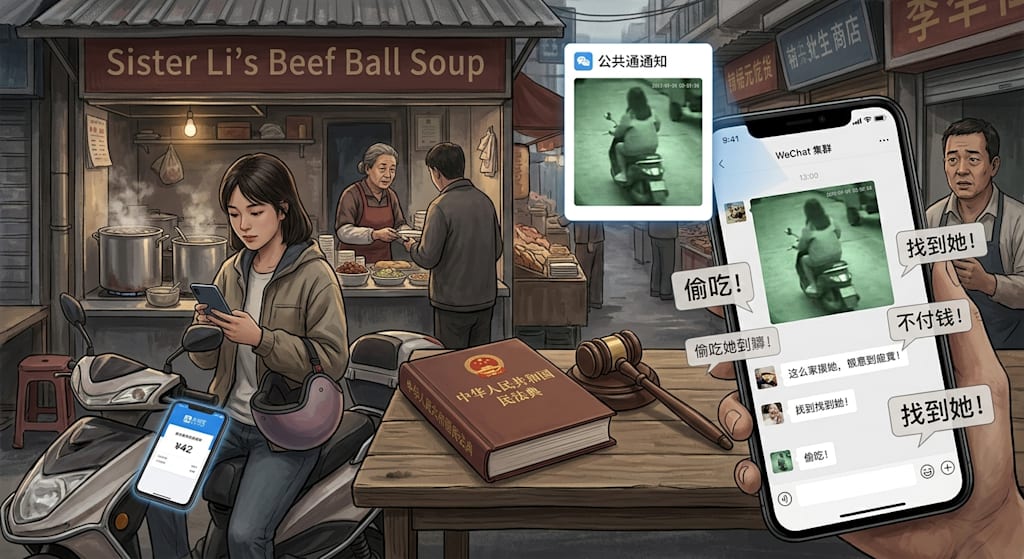
At noon on October 4, at the Huidong Fruit and Vegetable Wholesale Market in Guilin, Ms. Li stopped at a beef ball shop. She scanned the code to pay. Her WeChat balance was too low. She canceled the WeChat payment and switched to Alipay. The 42 yuan went through. She got on her bike and left.
Inside the shop, the WeChat speaker announced: “Payment canceled: 42 yuan.”
The owner heard that. He did not open Alipay to check the record. He did not go after her. He posted on WeChat Moments: A young woman did not pay. I do not know if she forgot or skipped the bill. I hope she sees this and comes back.
Then he went to the security office. He pulled the surveillance footage. He edited the video. He sent it to a WeChat group. One clip. Two. Several. The caption read: “I don’t believe it. These days, people still dine and dash?”
Ms. Li saw the Moments post first. She did not think much of it. Later, she opened the videos in the group and saw her face clearly. People in the group wrote: “Freeloading, mooching.” “Shameful. That is what you call being cheap.”
She posted her Alipay payment screenshot in the group. The owner replied: “After all that, it was a misunderstanding.” “Very sorry.” He refunded the 42 yuan.
Ms. Li left the group and deleted the owner on WeChat. Three days later, she posted about the incident on social media and called the police. She wants a public apology pinned on Moments for 15 days and 1,000 yuan in compensation for emotional distress. She is preparing to sue.
The shop owner told reporters the surveillance video was blurry, that the face could not be seen clearly, and that once he confirmed it was a misunderstanding he apologized and refunded the money. He also said that three days later, after she posted online, strangers added him on WeChat to insult him or bombarded him with calls. He has gone to the police station to cooperate with an investigation.
The matter now has two parts. The 42 yuan for the beef balls is settled. The surveillance video, the WeChat group, and the dine-and-dash accusation are not.
Portrait rights
Article 1019 of the Civil Code says that without the consent of the portrait rights holder, no one may make, use, or publicly disclose that person’s portrait. The law does not require a for-profit purpose. The shop owner sent surveillance video to a WeChat group. The video contained Ms. Li’s face. Group members could recognize her. They could point at her and curse her. He had publicly disclosed her face.
Face information is sensitive personal information under the Personal Information Protection Law. Processing sensitive personal information requires separate consent, a specific purpose, and sufficient necessity. The shop owner disclosed her face without consent in order to expose a dine-and-dash. That does not meet the requirements of being lawful, legitimate, and necessary.
The shop owner says the video was blurry. Ms. Li says her face was clearly visible. The group members’ accusations landed on her, which means the video was identifiable enough. If it was too blurry to see, the people in the group could not have identified her. That defense is hard to sustain in law.
Reputation rights
Article 1024 of the Civil Code says that no organization or individual may infringe another person’s right to reputation by insult, defamation, or other means. The shop owner posted videos in a WeChat group of several hundred people and used the word “dine-and-dash.” Group members began cursing “freeloading” and “being cheap.” Ms. Li’s social evaluation within that group was lowered.
The owner did not verify the payment. When he heard the WeChat payment canceled, he did not check Alipay. He did not contact the customer. He did not call the police. He posted on Moments, pulled surveillance, and sent it to the group. Opening the Alipay record takes a few seconds. He did not do it.
He later apologized and refunded the money. The apology came after Ms. Li clarified. If she had not added the owner on WeChat, had not seen the Moments post, and had not seen the group videos, she might never have known that she had become a dine-and-dash example in a group of strangers. She might have carried a label for something she never did.
The shop owner has surveillance. He can use it for security. He can hand it to the police after a report. He cannot make himself the judge, hang the customer’s face in a group, and let several hundred people put her on trial. He can defend his rights. He cannot put a customer on public trial.
Ms. Li’s demands are a public apology pinned for 15 days and 1,000 yuan in compensation for emotional distress. That request is modest.
Article 1000 of the Civil Code says that civil liability such as an apology should be commensurate with the specific manner of the act and the scope of its impact. The shop owner posted on Moments and in the WeChat group. Apologizing in those same spaces is reasonable. Pinning it for 15 days also fits the scope of impact.
Article 1183 of the Civil Code says that where infringement of personality rights causes serious mental distress, the infringed person has the right to request compensation for mental distress. In judicial practice, similar reputation and portrait rights cases often lead to mental distress awards between 1,000 and 5,000 yuan. The court will consider the degree of fault, the circumstances of the infringement, the scope of impact, and the actual mental distress suffered by Ms. Li. She was accused without cause, felt wronged, called the police, and prepared to sue. These are evidence.
Her acceptance of the 42 yuan refund does not affect liability for infringement. The refund concerns the payment. The infringement is separate.
The shop owner says he was cyberbullied. If that is true, he can file a separate police report or lawsuit. The shop owner’s initial act of publicly disclosing the surveillance video does not become lawful because he was later cursed at. When he hung someone else’s face out there, that person endured the same thing. That person was innocent.
This incident looks like a 42-yuan misunderstanding. It also shows a mindset of presuming the customer guilty. When WeChat canceled the payment, the owner assumed someone had skipped the bill. He did not verify. He did not communicate. He did not make private contact. He publicly hung someone out to dry and staged a group trial.
Forty-two yuan buys a jin of beef balls. It does not buy the right to put a person on trial at will.
Ms. Li is gathering evidence and preparing to go to court. The shop owner is at the police station explaining the situation. The videos in the group may still be there, or they may have been deleted. The screenshots remain. The Alipay record of the 42 yuan arriving is also still there.
The law lets a business report a suspected dine-and-dash. It does not let a business publish a customer’s face for a group to judge.
About the Creator
Jin
Writer of reamstories
https://reamstories.com/jin
Enjoyed the story? Support the Creator.
Subscribe for free to receive all their stories in your feed. You could also become a paid subscriber, letting them know you appreciate their work.
Comments
There are no comments for this story
Be the first to respond and start the conversation.