
She Asked for Five Days to Care for Her Mother. Her Manager Said No. Her Resignation Was Approved in Seconds.
A Victoria’s Secret employee’s leave request became a test of corporate compassion, and what happened next says less about one store than about how we treat family emergencies at work.
Five Days
I
On September 8, Hangzhou was still hot.
Inside the Victoria’s Secret store at Hubin Yintai in77, a twenty-six-year-old woman stood at the warehouse door, phone lit. She had just typed: “Manager, my mother has been diagnosed with lung cancer and needs surgery. I’d like to take five days off to go home and care for her.”
Before she typed “five days,” she had deleted “one week.” Before deleting “one week,” she had written a paragraph in her notes app: she could keep up with some online work during leave, she would come back as soon as possible, and no one else at home could care for her mother. She revised it four times. She changed “beg” to “request,” deleted “please, I’m begging you,” and left four words: “requesting coordination.”
Her manager replied quickly: “I understand, but I can’t approve that much leave.”
She typed again: “Can I take five days, then? I can coordinate with other stores for staffing.”
The manager said: “I really can’t approve it. There’s a major event coming up, and the store can’t spare anyone.”
She stared at “I really can’t approve it.” In the warehouse, newly arrived autumn and winter underwear was piled up. The plastic packaging carried the same logo. The light gave it a cold sheen. She remembered HR’s onboarding line: “New employees can’t apply for leave until three months after joining.” She had joined in July. It was September. She was a few days short of two months.
II
That night, she went home and called her mother. Her mother said, “It’s fine, you do your work. Your father is here for the surgery.” Her father had had heart bypass surgery three years earlier. He had to rest after walking more than twenty minutes. There was no one else at home.
She hung up, opened WeChat, and found her manager’s chat.
“I resign.”
Two words. No punctuation.
The manager replied instantly: “Okay, come in tomorrow and I’ll process your resignation.”
She stared at the reply, finger hovering over the screen. Then she typed: “So when I resign, you can find a way to coordinate, but when my mother needs surgery, you can’t?”
No reply.
III
The next day, she did not process her resignation. She went to the store, clocked in, and worked. A colleague asked, “Didn’t you say yesterday you were going to resign?” She said, “I’m still thinking.”
She messaged HR and explained. HR’s reply was long. She screenshotted it. HR said they understood, but training had explained that new employees could not apply for leave until three months after joining. From the store manager’s perspective, given the store’s needs, they had the right not to approve it. If it really got in the way of being with her family, then they could only respect her decision to resign first and deal with her family matters.
She saved the screenshot in a folder called “Evidence.” It also held yesterday’s chat records, screenshots of her leave request, and a photo of her mother’s diagnosis certificate.
IV
On September 9, a reporter from Jimu News contacted her. She said, “I still haven’t received a direct reply or an apology from the store manager.” The reporter called the Victoria’s Secret store. A staff member confirmed the post involved that store but said they did not know the full details and that the company would later issue a formal document. The reporter then asked the Hangzhou Shangcheng District Labor Rights Protection Center as a job seeker. The staff member explained: the authority to approve personal leave falls under an employer’s operational autonomy, and labor inspection authorities cannot force a company to approve personal leave. Only when statutory leave is met with wage deductions can labor authorities step in. If the employer has not issued a written termination notice, termination email, or resignation certificate, and no actual termination has occurred, the case does not yet meet the conditions for labor arbitration.
The staff member finally reminded her: “Do not be absent from work without authorization.”
She wrote that sentence down in her notes app.
V
After the matter spread on social media, the regional manager called. He said she was being given five days of paid leave and told her to go home and be with her mother for the surgery.
She asked, “And the store manager?”
The regional manager said, “You take your leave first. We’ll talk about the rest later.”
She hung up, opened WeChat, and found the store manager’s chat. The last message was still that line: “So when I resign, you can find a way to coordinate, but when my mother needs surgery, you can’t?” No reply.
She packed and bought a ticket for the last high-speed train home that day. After boarding, she sent her mother a WeChat message: “Mom, I’ll arrive tomorrow.”
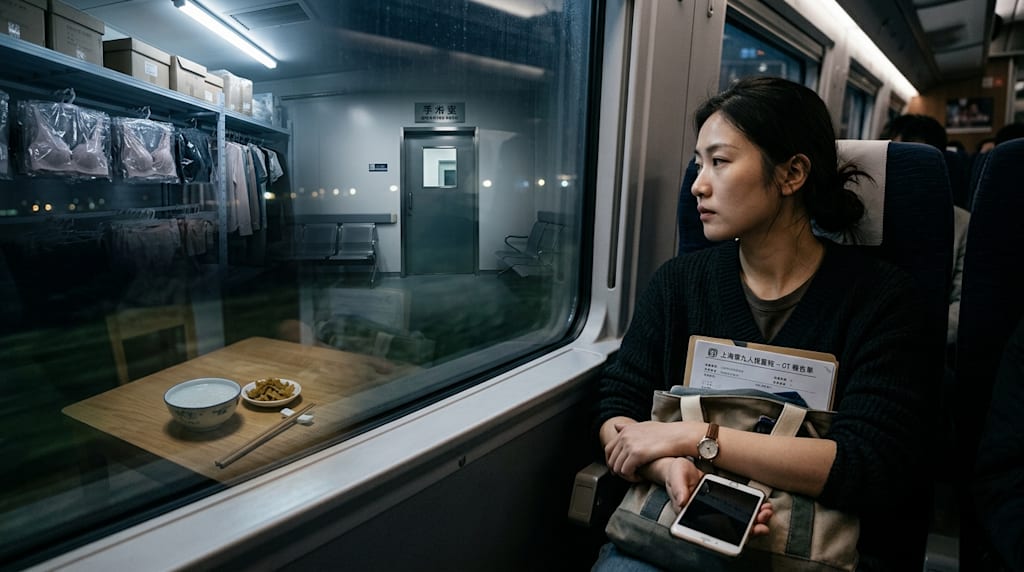
Her mother replied, “Okay,” then sent a photo. The photo showed the dining table at home: a bowl of porridge, a small dish of pickles, a pair of chopsticks. The porridge had gone cold.
She stared at the photo, put her phone face down on her knees, and looked out the window. The train passed through pitch-dark fields. Scattered lights appeared in the distance.
VI
The five days of leave were approved. The store manager still had not replied.
She kept returning to the same question. The word “resign” solved everything. “My mother needs surgery” got no “Okay.”
Her mother’s CT report was in her bag. The surgery was scheduled for Thursday. She needed to get to the hospital before then, sign forms, listen to a doctor list risks, and sit outside the operating room until the door opened.
As for the company, she said, “I haven’t decided yet. I’ll wait until my mother’s surgery is over.”
VII
In a 2024 judgment, the Supreme People’s Court wrote a sentence. An employee had asked for personal leave to care for a father with terminal cancer and was dismissed. The court held that, in enforcing its management system, the company “failed to embody a people-oriented development philosophy, was inconsistent with socialist core values, and ran counter to the Chinese nation’s traditional culture of filial piety—neither reasonable nor humane.”
The Beijing Dongcheng District Court said something similar in another case: an employer’s managerial authority should be exercised in good faith, with tolerance, and reasonably.
The young woman was on the train at that moment. She had not read those judgments. She turned her phone over and looked again at the photo her mother had sent. The porridge was cold. Half a dish of pickles remained. The chopsticks were laid out neatly.
She remembered her mother getting up first every morning. Filling the bowl with porridge. Putting pickles on the small plate. Laying out the chopsticks. Only then waking her. Twenty years, and the chopsticks had always been laid out the same way.
She turned off the screen, leaned back, and closed her eyes. The train kept going. Outside, the fields were pitch-dark, with only occasional lights flashing past. Someone was awake in the night.
About the Creator
Jin
Writer of reamstories
https://reamstories.com/jin
Enjoyed the story? Support the Creator.
Subscribe for free to receive all their stories in your feed. You could also become a paid subscriber, letting them know you appreciate their work.
Comments
There are no comments for this story
Be the first to respond and start the conversation.