
Real Madrid can split a contract. It cannot split an icon.
La Liga apologized fast because broadcast money was on the line. Real Madrid stayed quiet because the loss hit Mbappé’s company and because it wanted Javier Tebas to sweat.
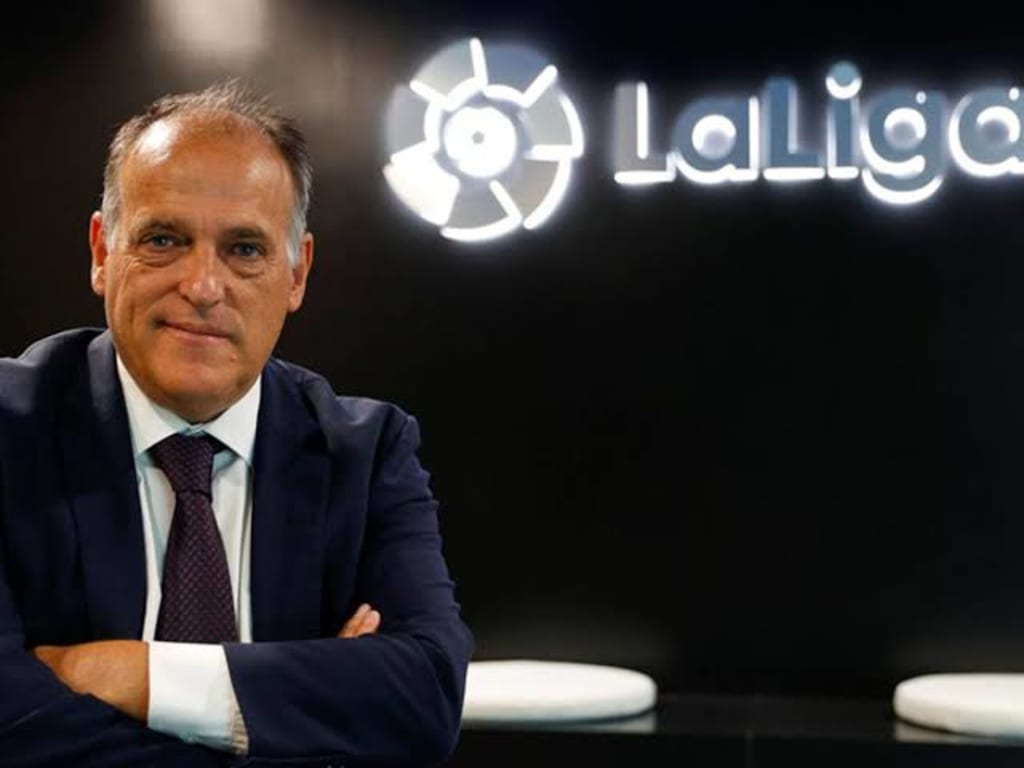
One controversy, two speeds. La Liga president Javier Tebas wrote to the Chinese side and apologized in public almost at once. Then he met Chinese ambassador Yao Jing and said an “isolated incident” should not damage a relationship built on “mutual respect, trust and cooperation.” Real Madrid said nothing official. It used friendly media to send a narrower message: Mbappé’s China sponsorships belong to his personal company. Real Madrid’s deals with Chinese sponsors have not changed. The player did not mean to offend. He has a right to express personal views. CCTV rejected that split. It said Mbappé is a Real Madrid player, so the club cannot avoid responsibility. It also said nothing would move until Real Madrid apologized.
The gap is not a matter of PR taste. La Liga’s money depends on Chinese broadcast fees. It cannot separate itself from the dispute. Real Madrid can keep the first financial hit off its own books because of an unusual image-rights deal. It also has an interest in letting the crisis damage Tebas. But the club missed a simpler point. In China, a club that sells a player as its global face cannot later call him a private contractor when that face crosses a political line. Contracts can assign costs. They cannot assign symbolic blame.
Why La Liga could not separate itself
Tebas’s fast apology looked weak to some. It was a league boss protecting his main asset. La Liga does not treat China as one club’s overseas side project. Chinese broadcast money helps fund the league’s payments to all twenty clubs. CCTV stopped showing La Liga games on October 26. That hit the central revenue pool. Tebas listed the dates in his statement: a strategic agreement with the Chinese Football Association through 2029 and a broadcast deal with CCTV. Those dates were not decoration. He was telling Spain and Europe that La Liga has a long institutional stake in China and cannot let one incident sink it.
La Liga cannot draw the line Real Madrid wants to draw between “Mbappé” and “the La Liga product.” Mbappé is one of the most recognizable faces in La Liga broadcasts. The league sells that face to Chinese broadcasters and sponsors. When the face collides with a Chinese red line, the league cannot say the problem belongs to the player’s personal company. Tebas speaks for twenty clubs, and most of them rely on the league’s central broadcast checks. CCTV’s blackout hurts those clubs first. La Liga’s China team warned Real Madrid before the story exploded. That warning shows what the league was protecting: the league’s total China revenue. Tebas had no real choice. He had to put out the fire because the fire was burning the league’s shared wallet.
Why Real Madrid could keep the loss at arm’s length
Real Madrid’s calm had a contract behind it. To sign Mbappé in 2024, Florentino Pérez gave him a deal that is rare at the club. Mbappé keeps about 80% of his personal image-rights income. Real Madrid keeps 20%. The club’s normal split is fifty-fifty. Dongpeng, Mengniu and Milkground ended deals with Mbappé himself. On paper, those losses land on the Paris company run by Mbappé and his mother. They do not land directly on Real Madrid’s profit-and-loss statement. L’Équipe reported that the three China deals were worth nearly €7 million a year and were likely to be renewed the next spring. A renewal could have reached tens of millions of euros. Most of that money was never Real Madrid’s to book. In the Bernabéu accounts, the club could say its own revenue had not dropped.
Real Madrid’s Chinese sponsor Roborock also did not announce a termination right away. The club used that fact to tell reporters that a player’s personal deals and a club’s sponsor deals are separate. A player’s cancellation, the club argued, does not equal a club sponsor cancellation. Inside the club’s risk review, the direct and countable loss looked limited. That does not mean the club felt no pain. Ten to fifteen percent of international merchandise sales come from China. Mbappé shirts are among the best sellers. CCTV’s suspension and consumer anger will eventually cut into that money. But compared with La Liga’s immediate reliance on broadcast fees, Real Madrid thought it had more time. It could push the commercial damage to “later.”
The contract explains why Real Madrid was not in a hurry. It does not explain why the club looked almost pleased to let the fire burn. The deeper reason is the long fight between Florentino Pérez and Tebas. Tebas has called it a “cultural clash over the vision of football.” The Super League, the CVC fund deal and control over refereeing are all part of it. In that fight, La Liga’s warning looked less like help and more like Tebas trying to reclaim authority over Real Madrid in a crisis. Real Madrid rejected the help. Some senior figures, according to L’Équipe, found the situation “quite amusing” and wanted to see how Tebas would handle it. That is not crisis management. It is a political calculation. Let the fire burn. It mainly burns Tebas’s broadcast fees. Real Madrid can stand to one side and watch an opponent it has long tried to weaken.
The club’s choice to speak through OK Diario instead of issuing an official apology was part of the same move. Real Madrid was telling Madrid and Europe that the Bernabéu would not be represented by La Liga and would not issue a club-level apology for a player’s personal remarks. It tried to do two things at once: keep the money loss off its books and make Tebas pay in the power fight.
Why “personal act” does not work in China
The weak point in Real Madrid’s plan is not the contract logic. The weak point is how responsibility works in a cross-cultural crisis. A contract can say who pays which penalty. Symbolic responsibility does not follow contract clauses.
CCTV aimed at that gap. It did not argue about image-rights percentages. It returned to a plain fact: Mbappé is a Real Madrid player. For two years, Real Madrid has sold shirts, signed sponsors and run social media around Mbappé as the face of the new Galácticos. The club made money from that face. That made a public bond that goes beyond the contract. The price of that bond is simple. When the face crosses a line on core dignity, the club cannot reclassify him the next day as a man who runs his own company.
Real Madrid also said the player has a right to express personal views. CCTV said the remarks crossed a bottom line and went beyond free expression. By turning a Chinese public offense into a Western free-speech argument, Real Madrid did not put out the fire. It moved the argument from “Did he offend?” to “Does he have the right to offend?” Chinese viewers do not treat the second question as open for debate. CCTV’s line “do not indulge in wishful thinking” and its condition that “nothing moves until Real Madrid apologizes” meant one thing. A contract split cannot replace an adequate public stance. Real Madrid can show that its sponsor contracts are still in place. It cannot show that it understands why China rejects the sentence “this has nothing to do with us.”
There is a second risk. Real Madrid told Spanish media that Chinese sponsors “understand” Mbappé. That claim can put its Chinese partners in a bad spot. If the club says Chinese sponsors accept that the player meant no offense, while those same brands cut ties with Mbappé under a zero-tolerance posture, the gap forces the brands to speak more clearly. Their next statement is unlikely to help Real Madrid. Reassuring European investors by speaking for Chinese partners about their forgiveness is an costly kind of arrogance.
The line beyond the ledger
La Liga and Real Madrid made different calls because they were counting different things. La Liga was counting the immediate survival of shared broadcast money. It had no room to separate itself. Real Madrid was counting what its contracts could absorb and what a power fight with Tebas could gain. It had a reason to separate itself. Both calls look rational inside their own spreadsheets. Real Madrid’s call ignored a fact outside the spreadsheet. On questions of core dignity, blame is not split by image-rights percentages. When a club makes a player its global face, it signs an unwritten joint-liability clause. A contract can say who pays which bill. It cannot say whether an icon can be reduced to an individual after a scandal. CCTV’s “wishful thinking” line pointed at that mistake. The cleverest contract split can look, in public symbolism, like a refusal to understand. Real Madrid can wait. China has set a clear condition. Before the apology is in place, nothing moves. A status report on a sponsorship contract is not an apology.
About the Creator
Jin
Writer of reamstories
https://reamstories.com/jin
Enjoyed the story? Support the Creator.
Subscribe for free to receive all their stories in your feed. You could also become a paid subscriber, letting them know you appreciate their work.
Comments
There are no comments for this story
Be the first to respond and start the conversation.