
PTSD & CPTSD:
The Things We Carry Behind Closed Doors

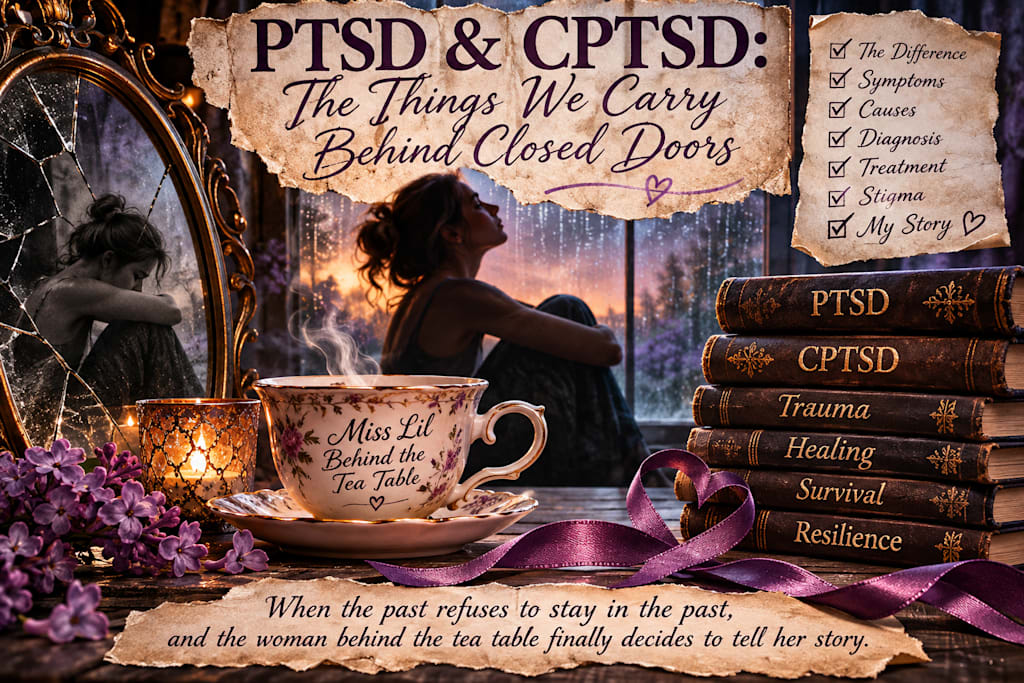
PTSD & CPTSD: The Things We Carry Behind Closed Doors
When the past refuses to stay in the past, and the woman behind the tea table finally decides to tell her story.
So the pickings are slim, and none of the current true crimes are tickling Miss Lil's fancy for discussion today. Don't get me wrong, there is plenty of current crime we could cover. There is always crime, and someone, somewhere, going back to court for something.
Sets down her teacup.
Today, however, I don't exactly feel like diving into those waters.
No, I think today I'm going to give you a peek behind that curtain. The one I know a few of my dedicated followers have been dancing around. That paid subscription button, or just that subscribe button in general on my profile here on Vocal Media.
The stories are worth it, I promise.
Come a little deeper into my corner of the world. See the things I can't necessarily say on social media. Get a front-row seat to how this tiny little squish noodle of mine actually works. There is more to Miss Lil than true crime, cryptids, haunted places, and a healthy appreciation for a steaming cup of tea.
There are pieces of me that don't make it into the public posts. Stories I've tucked away. Experiences I've carried. Thoughts that have spent years rattling around in my head, waiting for somewhere to land.
So, for those of you who were all buckled in for this week's true crime, I apologize. It just isn't coming today.
Instead, we're going somewhere a little more personal.
And this time, dear readers, I'm bringing you into my own head.
There are things that happen to us in this life that we never quite leave behind. We may leave the house, the relationship, the situation, or the people who hurt us, but sometimes a piece of what happened follows us out the door.
For some of us, it follows us for years.
It sits in the back of our minds, whispering when we least expect it. It shows up in the middle of an otherwise wonderful day. It makes us question perfectly innocent conversations, second-guess kindness, and sometimes feel like we're standing in the middle of a battlefield when all we're doing is trying to get through an ordinary afternoon.
I've spent a good portion of my life trying to understand that feeling.
I've spent years learning how to function around it, how to hide it, how to smile through it, and how to carry on when everything inside me is screaming to do anything but.
And for a very long time, I kept those parts of myself tucked away.
Not because I was ashamed of surviving, but because some stories are difficult to tell. Some memories have teeth. Some truths have been locked away for so long that even opening the door can feel like inviting the ghosts back inside.
But here's the thing, dear readers.
I've spent enough of my life being held prisoner by things I never asked for.
I'm not handing them another key.
I have PTSD. I have CPTSD. And today, we're going to talk about both. Not just the clinical definitions, not just the lists of symptoms, but what these disorders actually mean, why they happen, how they affect the people living with them, and why understanding them matters.
Because I am done pretending that the things I carry don't exist.
This is my story, too.
And before we go any further, I want to make something clear. I'm not a doctor, a psychologist, or a therapist. I'm a woman who has lived with these disorders, struggled with them, and spent a considerable amount of time trying to understand them. I'll share the medical information, the research, and what professionals have learned, but I'll also share the personal side. The side that doesn't always make it into the pamphlets or the neatly organized lists of symptoms.
Because knowing the definition of trauma and understanding what it feels like to live with it are two very different things.
First, What Exactly Are We Talking About?
Let's start with the basics, shall we?
Most people have heard of PTSD. Post-Traumatic Stress Disorder. It's a term that has become more familiar over the years, particularly when discussing military veterans, survivors of violent crime, and people who have experienced catastrophic events.
But there's another term that deserves just as much attention: CPTSD, or Complex Post-Traumatic Stress Disorder.
They're related, but they aren't quite the same thing.
And understanding the difference is important, because trauma doesn't come in one convenient little package.
Some people experience a single terrifying event. Others experience years of repeated trauma. Some experience trauma during childhood, when the very people who should have protected them were the ones causing the harm.
The circumstances can be different, but the consequences can follow people into adulthood and affect nearly every corner of their lives.
PTSD: When the Past Refuses to Stay in the Past
Post-Traumatic Stress Disorder can develop after someone experiences or witnesses a traumatic event involving actual or threatened death, serious injury, or sexual violence.
Now, before anyone decides that PTSD is exclusively a military issue, let's put that misconception to bed.
PTSD can develop following:
Sexual assault or abuse.
Physical violence.
Domestic violence.
Serious accidents.
Natural disasters.
Combat experiences.
Witnessing death or serious injury.
Violent crime.
Life-threatening medical experiences.
Other qualifying traumatic experiences.
And here's something important: not everyone who experiences trauma develops PTSD. People respond differently to traumatic experiences, and there isn't a simple formula that predicts who will develop the disorder.
PTSD isn't a sign that someone failed to cope. It isn't a character flaw. It isn't a lack of strength.
It is a recognized mental health condition involving changes in how a person processes traumatic experiences and responds to perceived danger.
Imagine having an experience that leaves you terrified, injured, or convinced that you might not survive.
The event ends. You leave the situation. Perhaps years pass.
But your body and mind continue responding as though the danger might return at any moment.
You hear a particular sound, smell something familiar, or encounter someone who reminds you of what happened. Suddenly, your heart is racing, your muscles are tight, and your entire body seems to be preparing for a threat that isn't actually standing in front of you.
Your logical brain knows you're in the present.
Your nervous system is having a very different conversation.
This is one of the most frustrating aspects of PTSD. You can understand that you're safe and still struggle to feel safe.
The symptoms of PTSD
PTSD symptoms are generally divided into four categories.
1. Intrusive memories and re-experiencing
These are unwanted reminders of traumatic experiences that can intrude into everyday life.
They may include:
Distressing memories that appear without warning.
Repeated nightmares.
Flashbacks.
Emotional or physical reactions to reminders.
Feeling as though the traumatic experience is happening again.
Flashbacks aren't always what movies portray. They don't necessarily involve someone collapsing or completely losing awareness of their surroundings.
Sometimes they're fragments. A sound, a smell, a sensation, or an overwhelming emotional response.
Sometimes a person knows exactly where they are but feels transported emotionally to somewhere they'd desperately rather not be.
And sometimes the memories arrive at the most inconvenient moments.
Because apparently trauma doesn't believe in making appointments.
2. Avoidance
Avoidance is the brain's attempt to protect itself from reminders of the traumatic experience.
A person might avoid certain places, people, conversations, activities, or even their own thoughts.
They might refuse to discuss something that happened. They might take a different route to avoid a location. They might stop participating in activities they once enjoyed because something about them has become associated with the trauma.
And sometimes people don't even realize why they're avoiding something.
They simply know they don't want to go there.
3. Negative changes in thoughts and mood
Trauma can change how people view themselves and the world around them.
This can include:
Persistent guilt or shame.
Fear, anger, or sadness.
Feelings of isolation.
Difficulty experiencing happiness.
Losing interest in previously enjoyed activities.
Difficulty remembering parts of the experience.
Believing the world is dangerous or that people cannot be trusted.
This is where things can become particularly difficult.
You can have wonderful people around you and still struggle with the feeling that something terrible is waiting just around the corner.
You can have a beautiful day and still feel an inexplicable heaviness.
And you can know that you have things to be grateful for while simultaneously struggling with the things that hurt you.
Those feelings can exist together.
4. Changes in arousal and reactivity
This is the part where the body seems to have permanently misplaced its off switch.
Symptoms can include:
Hypervigilance.
Being easily startled.
Irritability.
Angry outbursts.
Difficulty concentrating.
Sleep disturbances.
Reckless or self-destructive behavior.
Hypervigilance deserves particular attention.
It's the constant feeling of needing to watch, listen, assess, and anticipate.
Who's entering the room? What was that noise? Why did their voice change? Is something wrong? Did I miss something?
Imagine never quite being able to relax because some part of your mind is always standing guard.
Even when nothing is happening, you're waiting.
And that, dear readers, is exhausting.
For a PTSD diagnosis under the American DSM-5-TR system, symptoms must persist for more than a month and cause significant distress or interfere with everyday functioning.
Symptoms can also appear months or even years after a traumatic experience.
The passage of time doesn't automatically make trauma disappear.
CPTSD: When Survival Becomes a Way of Life
Now let's talk about Complex Post-Traumatic Stress Disorder.
This is where the conversation becomes a little more complicated.
CPTSD is frequently associated with prolonged or repeated traumatic experiences, particularly those involving interpersonal harm, situations where someone has little control, or circumstances from which escaping is difficult.
Examples include:
Prolonged childhood abuse.
Childhood neglect.
Repeated sexual or physical abuse.
Long-term domestic violence.
Captivity or human trafficking.
Repeated exposure to threatening environments.
Ongoing psychological abuse.
But I want to make an important distinction. CPTSD is not exclusively a childhood condition. It can develop following prolonged trauma at different stages of life. Nor does every person who experiences childhood abuse or neglect automatically develop CPTSD.
The circumstances matter, but so do the individual experiences and resulting symptoms.
So, what makes CPTSD different?
It includes the core symptoms of PTSD, but it also involves three additional areas that clinicians call disturbances in self-organization.
That's a rather clinical way of describing something that can affect a person's entire sense of who they are.
Let's break those down.
1. Emotional dysregulation
This is difficulty managing emotional responses.
Someone with CPTSD may experience emotions that feel overwhelmingly intense. Other times, they may feel almost nothing at all.
They might become overwhelmed by something that appears relatively minor to someone else. They might struggle to calm down after becoming upset. They may experience intense anger, sadness, or fear.
Or they may shut down completely.
And here's something people often misunderstand: emotional dysregulation doesn't mean someone is choosing to be difficult.
It means their ability to regulate emotional responses may have been affected by trauma.
Sometimes the reaction seems much bigger than the situation in front of them because the reaction isn't entirely about the situation in front of them.
It's about everything that situation has come to represent.
2. A negative sense of self
This one can be particularly heartbreaking.
CPTSD can affect the way someone sees themselves at a very fundamental level.
People may struggle with:
Persistent feelings of worthlessness.
Deep-rooted shame.
Believing they are fundamentally damaged.
Excessive guilt.
Feeling responsible for things that were never their fault.
Believing they are difficult to love.
Feeling that they will never be good enough.
Think about what happens when someone spends years being told they are worthless, unwanted, incapable, or responsible for another person's actions.
Eventually, those messages can become internalized.
The people who caused the harm may no longer be present, but the beliefs they helped create can remain.
And sometimes the hardest person to convince that you deserve kindness is yourself.
3. Difficulties with relationships
When the people who were supposed to provide safety become sources of fear, betrayal, or harm, relationships can become complicated.
Someone with CPTSD may struggle with:
Trusting others.
Fear of abandonment.
Emotional intimacy.
Establishing boundaries.
Feeling safe in relationships.
Withdrawing when relationships become close.
Feeling disconnected from people around them.
There can be a painful contradiction here.
Wanting someone close while being terrified of what closeness might bring.
Wanting affection but struggling to accept it.
Wanting to trust someone while constantly looking for reasons not to.
It can become an exhausting internal tug-of-war.
And sometimes the person experiencing it doesn't even understand why they react the way they do.
They simply know that relationships can feel frightening, even when the people involved genuinely care.
PTSD vs. CPTSD: So What's the Difference?
Let's put the two side by side.
PTSDCPTSDCan develop following a single traumatic event or multiple events.Often associated with prolonged or repeated trauma.Includes intrusive memories, avoidance, and heightened threat responses.Includes those PTSD symptoms plus disturbances in self-organization.Can affect mood, trust, and relationships.Often involves deeper difficulties with emotional regulation, identity, and relationships.May involve nightmares, flashbacks, and hypervigilance.May involve those same symptoms alongside persistent shame, worthlessness, emotional instability, and relationship difficulties.
Here's where I need to explain something that can be confusing, particularly for readers in the United States.
The World Health Organization recognizes CPTSD as a separate diagnosis in its ICD-11 classification system.
However, the American Psychiatric Association's DSM-5-TR does not list CPTSD as a separate diagnosis. Many of the symptoms associated with complex trauma are included within its broader PTSD diagnostic framework.
Under the ICD-11, PTSD and CPTSD are separate diagnostic categories. A person receives one diagnosis or the other under that system, not both simultaneously.
This doesn't mean the experiences aren't real. It means the diagnostic systems organize and classify those experiences differently.
And frankly, I think this is an important distinction because people can spend years trying to find the right words for what they're experiencing.
Sometimes having a name for something is the first step toward understanding it.
What Does Trauma Actually Do to the Brain?
Now, let's get a little nerdy for a moment. Don't worry, I'll try not to put you to sleep.
Trauma can affect the way the brain processes danger, memories, emotions, and stress.
There are three brain structures that frequently appear in trauma research.
The amygdala: This structure plays an important role in processing emotions and identifying potential threats. In people with PTSD, threat-processing systems can become unusually reactive.
The hippocampus: This structure helps process memories and place experiences into context. Trauma can affect how memories are processed and distinguished from present-day experiences.
The prefrontal cortex: This region helps with decision-making, emotional regulation, and assessing situations. Trauma-related changes in brain activity can affect how effectively someone regulates emotional and threat responses.
The body's stress-response system is involved, too.
When danger appears, the body prepares to survive. Heart rate increases, muscles tense, attention narrows, and the nervous system prepares for action.
That's a perfectly reasonable response when danger is actually present.
The problem is when the response continues long after the danger has passed.
A person may understand perfectly well that they are safe, but their body may respond as though they aren't.
And here's something I want readers to understand.
You cannot simply tell someone with PTSD to relax.
You cannot tell someone with CPTSD to stop overthinking.
You cannot tell someone who has spent years learning to anticipate danger that they should just trust people.
The brain and body don't necessarily respond to instructions simply because someone else thinks they should.
Healing takes more than a pep talk.
The Invisible Symptoms Nobody Talks About Enough
I want to spend some time here because I think this is where people often misunderstand trauma.
Not every symptom is dramatic.
Not every struggle involves nightmares, panic attacks, or visible distress.
Sometimes the symptoms are quieter.
Sometimes they're hidden behind an exceptionally well-practiced smile.
There is something called dissociation, for example.
Dissociation can involve feeling disconnected from your thoughts, emotions, body, surroundings, or sense of time.
Some people describe feeling as though they're watching themselves from outside their bodies. Others describe the world feeling unreal, distant, or dreamlike.
Sometimes there are gaps in memory.
Dissociation can be particularly unsettling because it may happen without someone consciously deciding to disconnect.
Then there's emotional numbness.
You may know you should feel happy, sad, excited, or upset, but the emotion simply doesn't arrive in the way you expect.
You may feel disconnected from experiences that should be meaningful.
And then there's the exhaustion.
Not ordinary tiredness after a long day.
The kind of exhaustion that comes from constantly monitoring your surroundings, managing your reactions, trying to anticipate problems, and working to keep everything together.
Imagine spending an entire day appearing perfectly fine while internally navigating a minefield of thoughts and feelings.
Then imagine going home and having to do it all over again tomorrow.
People sometimes mistake this for being antisocial, moody, overly sensitive, or difficult.
They don't see the effort involved in simply getting through an ordinary day.
And that is one of the reasons I wanted to write this article.
Because not every battle announces itself.
Some of them happen quietly, behind closed doors, while the rest of the world assumes everything is perfectly fine.
How Are PTSD and CPTSD Diagnosed?
There isn't a blood test, brain scan, or magical little machine that can tell a doctor whether someone has PTSD or CPTSD.
Diagnosis requires an assessment by a qualified mental health professional.
They look at a person's symptoms, experiences, duration of symptoms, and how those symptoms affect everyday functioning.
For PTSD, clinicians using the DSM-5-TR examine four major symptom groups:
Intrusive memories and re-experiencing.
Avoidance.
Negative changes in thoughts and mood.
Changes in arousal and reactivity.
They also consider the nature of the traumatic exposure, how long symptoms have persisted, and whether they cause significant distress or impairment.
For CPTSD, clinicians using the ICD-11 examine the core PTSD symptoms along with difficulties involving emotional regulation, self-concept, and relationships.
There are assessment tools available, including the International Trauma Questionnaire, which helps evaluate symptoms associated with ICD-11 PTSD and CPTSD.
But here's something important.
A person cannot diagnose themselves simply by reading an article, watching a video, or checking off a list of symptoms.
Other conditions can share similar symptoms, and trauma-related disorders can occur alongside depression, anxiety, and other mental health conditions.
A proper evaluation matters.
And if you're reading this and recognizing yourself in some of these descriptions, please don't panic.
Recognizing a symptom is not the same thing as receiving a diagnosis.
It may, however, be a reason to speak with someone qualified to help you understand what you're experiencing.
Treatment: Can You Actually Get Better?
This is the part I really want people to read.
Because I don't want anyone walking away from this article thinking that a PTSD or CPTSD diagnosis means they are doomed to spend the rest of their lives trapped in their past.
There are treatments available.
People do improve. They learn to manage symptoms, develop healthier coping strategies, rebuild relationships, and reclaim parts of their lives that trauma may have taken from them.
Does that mean healing is easy?
Absolutely not.
Does it mean everyone recovers in the same way or on the same timeline?
Not even close.
Treatment is personal, and finding the right approach can take time.
Cognitive Processing Therapy (CPT)
This therapy helps people examine the thoughts and beliefs that developed following trauma.
For example, someone might believe they were responsible for what happened, that the world is always dangerous, or that they are permanently damaged.
CPT helps identify those beliefs and work toward more balanced ways of understanding the experience.
Prolonged Exposure Therapy (PE)
This approach involves gradually and safely confronting trauma-related memories and situations that have been avoided.
It is conducted with professional guidance and helps people reduce avoidance and distress associated with traumatic memories.
Eye Movement Desensitization and Reprocessing (EMDR)
EMDR is a structured psychotherapy used to help people process traumatic memories.
During treatment, a therapist guides the person through recalling aspects of the experience while engaging in bilateral stimulation, commonly guided eye movements or alternating sounds or taps.
It is an established treatment option for PTSD.
Trauma-focused Cognitive Behavioral Therapy
Trauma-focused CBT helps people understand the relationship between their experiences, thoughts, emotions, and behaviors.
It can help develop healthier ways of responding to trauma-related thoughts and situations.
Skills-based treatment
For people experiencing complex trauma, therapy may also focus on emotional regulation, interpersonal relationships, boundaries, and rebuilding a healthier sense of self.
One example is STAIR, which stands for Skills Training in Affective and Interpersonal Regulation.
It focuses on developing emotional and relationship skills that can help people navigate the effects of trauma.
There is ongoing research into the best treatment approaches for CPTSD. Trauma-focused treatments used for PTSD can also help people with CPTSD, although some individuals may need additional support addressing the broader difficulties associated with complex trauma.
What About Medication?
Medication can be part of treatment, too.
Certain antidepressants, including sertraline and paroxetine, are FDA-approved for PTSD. Other medications may be considered depending on a person's symptoms and medical circumstances.
Medication doesn't erase traumatic experiences.
It may, however, help manage certain symptoms and make everyday life more manageable.
Treatment decisions should always be made with a qualified healthcare professional.
And one last thing about treatment: asking for help is not surrendering.
It isn't admitting defeat.
It is recognizing that you deserve support and that you don't have to figure everything out alone.
The Stigma: Why Are We Still So Uncomfortable Talking About Trauma?
Now, this is where Miss Lil might put her teacup down a little harder.
There is still an incredible amount of misunderstanding surrounding mental health conditions.
PTSD is often associated almost exclusively with military service. CPTSD is sometimes dismissed as someone giving a fancy name to having a difficult childhood.
People are told to get over it, move on, stop dwelling on the past, or simply think positively.
And then there are those who believe that if someone can work, laugh, socialize, maintain a relationship, or appear happy, they cannot possibly be struggling.
Let's get something straight.
A person can have a successful career and struggle with PTSD.
A person can laugh with friends and experience debilitating anxiety later that evening.
A person can love their family and still struggle with emotional regulation.
A person can have an amazing day and wake up the next morning feeling as though the world has fallen apart.
Being able to function doesn't mean someone isn't suffering.
And being able to smile doesn't mean someone isn't hurting.
I think one of the most damaging things we do as a society is expect people to demonstrate their suffering before we believe them.
We want visible evidence.
We want an explanation that makes sense to us.
We want someone to behave in a way that confirms our expectations of what trauma should look like.
But trauma doesn't follow a script.
Some people become quiet. Others become defensive. Some withdraw. Others become exceptionally good at keeping everyone else happy because disappointing people feels frightening.
Some people struggle to trust anyone. Others desperately seek reassurance.
There is no single personality that belongs to someone with PTSD or CPTSD.
And there is no reason to make someone prove how much they've suffered before offering them compassion.
You don't have to understand someone's entire history to treat them with kindness.
Living With the Aftermath: The Part That Doesn't Fit Into a Medical Pamphlet
Now, dear readers, let's step away from the clinical explanations for a moment.
Because I can give you definitions, symptoms, diagnostic criteria, and treatment options all day long.
But there is another side to this conversation.
The side that happens when the appointments are over, the books are closed, and you're simply trying to get through an ordinary Tuesday.
Trauma can follow you into the most mundane parts of life.
It can show up when someone raises their voice.
It can appear when a familiar smell brings back something you'd rather forget.
It can turn an ordinary conversation into an exhausting exercise in reading every facial expression, listening to every change in someone's tone, and trying to anticipate what might happen next.
It can make trusting people difficult, even when they have given you every reason to trust them.
It can make accepting kindness uncomfortable.
It can make you question your own reactions and wonder why something that seems so insignificant to someone else has affected you so deeply.
And sometimes, it can leave you exhausted without you being able to explain exactly why.
For people living with complex trauma, there may also be an ongoing struggle with the internal stories they tell themselves.
Am I good enough?
Am I too much?
Am I difficult to love?
Is this my fault?
Why can't I just be normal?
These questions can become familiar companions.
And perhaps one of the hardest things about trauma is that the world doesn't stop while you're trying to process it.
Bills still need paying.
Children still need attention.
Families still need you.
Work still needs doing.
Dinner still needs making.
Life continues, whether your nervous system is ready for it or not.
Sometimes you manage beautifully.
Sometimes you don't.
Both days belong to the same person.
And neither day determines your worth.
The Good Days and the Bad Ones
I mentioned earlier that I have amazing days and horrid days.
I wasn't being poetic.
I meant it.
There are days when I feel like myself. Days when I can laugh, create, write, enjoy my family, and appreciate the little things that make life worth living.
And then there are days when everything feels heavier.
Days when I struggle.
Days when the thoughts are louder, the emotions are harder to manage, and the simplest things can feel like climbing a mountain.
I don't believe that makes me a failure.
I believe it makes me a human being living with something that requires effort, understanding, and patience.
One of the things I want people to understand is that progress doesn't always look like a straight line.
Sometimes progress is recognizing a trigger before it completely overwhelms you.
Sometimes it's walking away from a situation that isn't good for you.
Sometimes it's allowing yourself to feel something instead of immediately burying it.
Sometimes it's asking for help.
And sometimes, progress is simply getting out of bed, putting your feet on the floor, and deciding that today you're going to try again.
We don't give ourselves enough credit for those little victories.
We celebrate the big accomplishments but overlook the quiet battles that made them possible.
I don't intend to do that anymore.
Taking Back the Story
And now, readers, we arrive at the reason I wanted to write this piece in the first place.
For a very long time, there have been things I've kept to myself.
Stories I haven't told.
Experiences I haven't discussed.
Parts of my life that have remained behind closed doors because opening them felt too difficult, too uncomfortable, or simply too exhausting.
There is a strange thing about carrying secrets.
Eventually, you can become so accustomed to keeping them that you forget what it feels like not to carry them.
You learn which subjects to avoid. Which memories to tuck away. Which questions not to answer.
You become very good at changing the subject.
And sometimes you become very good at convincing yourself that silence is the same thing as healing.
It isn't always.
There is a difference between choosing privacy and feeling imprisoned by silence.
I am not suggesting that everyone needs to tell their stories publicly. Absolutely not. Your experiences belong to you. You decide what you share, when you share it, and with whom.
But I have reached a point in my own life where I want to make that choice for myself.
I want to write.
I want to talk.
I want to examine the things that have shaped me, even the uncomfortable ones.
And I want to do it without feeling that I must apologize for having a past.
This writing journey has become something I didn't entirely expect.
It has become cathartic.
Putting words to experiences, thoughts, and emotions that have spent years bouncing around inside my head has begun to feel like lifting an enormous weight from my chest.
Not every story is easy to write.
Not every memory is easy to approach.
But there is something deeply meaningful about taking something that once made you feel powerless and deciding how you want to tell that story.
I cannot change what happened in my life.
I cannot go back and give my younger self the words, protection, or understanding she may have needed.
I cannot erase the experiences that helped shape the person sitting here with this teacup.
But I can decide what happens next.
I can decide that my past will not be the only thing that defines me.
I can decide that my voice deserves to be heard.
And I can decide that the parts of me I've hidden away are not something I need to be ashamed of.
A Final Word From Miss Lil
So, dear readers, why did I decide to spend today's tea time talking about PTSD and CPTSD?
Because I live with these realities.
I know what it means to struggle daily. I know what it means to have wonderful moments and difficult ones. I know that some battles are invisible, and explaining them to someone who has never experienced them can feel like trying to describe a color they've never seen.
I am not writing this because I have all the answers.
I don't.
I'm writing because I think there is value in opening conversations that are often left behind closed doors.
And I want anyone reading this who recognizes pieces of themselves in these descriptions to understand something.
You are not weak because you struggle.
You are not broken because something happened to you.
You are not less deserving of love, patience, understanding, or happiness because your past has left its fingerprints on your present.
You do not owe anyone a detailed explanation of your trauma.
You do not have to turn your pain into something inspirational for someone else's comfort.
And you certainly do not have to pretend you're fine every single day.
Healing isn't always a straight line.
Sometimes it's a step forward, two steps backward, a long pause, and then another attempt.
Sometimes healing looks like getting out of bed.
Sometimes it looks like asking for help.
Sometimes it looks like setting a boundary, walking away, or finally admitting that something hurt you.
And sometimes, it looks like sitting down with a cup of tea and writing about things you once couldn't bring yourself to say out loud.
For me, this writing journey has become something more than putting words on a page.
It has become a way of opening windows in rooms I've kept closed for a very long time.
I have amazing days.
I have horrid days.
I struggle, sometimes more than I let on.
But I keep getting back up.
I may be missing a few pieces. I may look a little worse for wear. I may carry scars that nobody else can see.
But I'm still here.
And here's something I've come to understand: surviving something doesn't mean it gets to own the rest of your life.
My trauma is part of my story.
It is not the entirety of my story.
I am a writer. I am a woman who loves her family, her little corner of the world, her strange assortment of interests, and yes, her ridiculous collection of thoughts that occasionally require an entire pot of tea to sort through.
I am also someone who has struggled with things that aren't always easy to explain.
All of those things can be true.
So, dear readers, if you've been curious about that subscribe button, this is what I'm inviting you into.
Not a perfectly polished version of someone who has everything figured out.
Not a collection of pretty little stories tied up with a bow.
But a closer look at the person behind the words.
There will be laughter. There will be memories. There will be uncomfortable conversations. There will probably be a little profanity, because let's face it, Miss Lil has never been particularly good at pretending to be delicate.
And there will be honesty.
Because I've spent enough of my life carrying things in silence.
I'm ready to put some of them down.
Sets her teacup back on the table.
I may be missing a few pieces, dear readers, and I may look a little worse for wear.
But I never give up.
Never have yet.
And I'm certainly not starting now.
Welcome behind the curtain.
Love, Miss Lil. ☕
About the Creator
Lilithea Adasia
I dig where others look away. 🖤 True crime, paranormal mysteries, uncomfortable truths, and the beautifully broken human experience. I chase the stories others bury and ask the questions others avoid. Come curious. Leave questioning.
Enjoyed the story? Support the Creator.
Subscribe for free to receive all their stories in your feed. You could also become a paid subscriber, letting them know you appreciate their work.
Comments
There are no comments for this story
Be the first to respond and start the conversation.