
Playing with Someone Who Shows Their Hand
When a colleague laid every card on the table, the only thing left to lose was the habit of hiding.
0-10% · First Contact
The first time I met Ethan, it was in a conference room at a startup in San Francisco's SoMa district.
He arrived earlier than everyone else, his MacBook open to a dense Notion board. The meeting hadn't officially started when he spoke up: "Let me say a few things up front. One, my only real requirement for this product is that it ships. I don't care about a pretty deck. Two, my budget cap is five hundred thousand. Anything above that, I have to go back to the board, so don't waste your time padding numbers. Three, I got burned in my last partnership, so I will read every single addendum word by word, and I won't sign until I'm clear. If you think we can work with that, great. If it sounds like too much, you can leave right now."
The room went quiet for a few seconds. Someone spun a pen. Someone else flipped through a notebook, pretending to be busy. Only Ethan picked up his half-cold black coffee and took a sip, like a man who'd already served the ball. What happened next depended on whether the other side could return it.
At the time, I had the same thought running through my head as most people in that room: Isn't this guy being a little too honest? Laying out your hand and your scars on the table like that, isn't that just asking to be taken advantage of?
That thought, as I later learned, was my problem. Not that he was too simple. It was that I was too used to taking the long way around.
10-40% · Three Exceptions
The first came in week two. The prototype was on its fourth revision, and Ethan had left eleven comments in Figma. His wording was direct to the point of bluntness: "Tag the data source on screen three, or I'm not signing off." "The user flow in section five skipped a step, I couldn't follow it." No padding. No "maybe we could" or "it might help if." I rolled my eyes at the screen, but went through each comment and fixed it. Later I learned that he talked to everyone this way, including his own CEO. In his system, "making people comfortable" had never made the top three priorities. "Making people understand" did.
The second happened on a rainy Wednesday. He showed up fifteen minutes early, holding two drip coffees from Blue Bottle. He handed me one and said: "I got here early because my last meeting ended ahead of schedule. You don't owe me anything for it."
He'd even cut off the "thank you" before it could land.
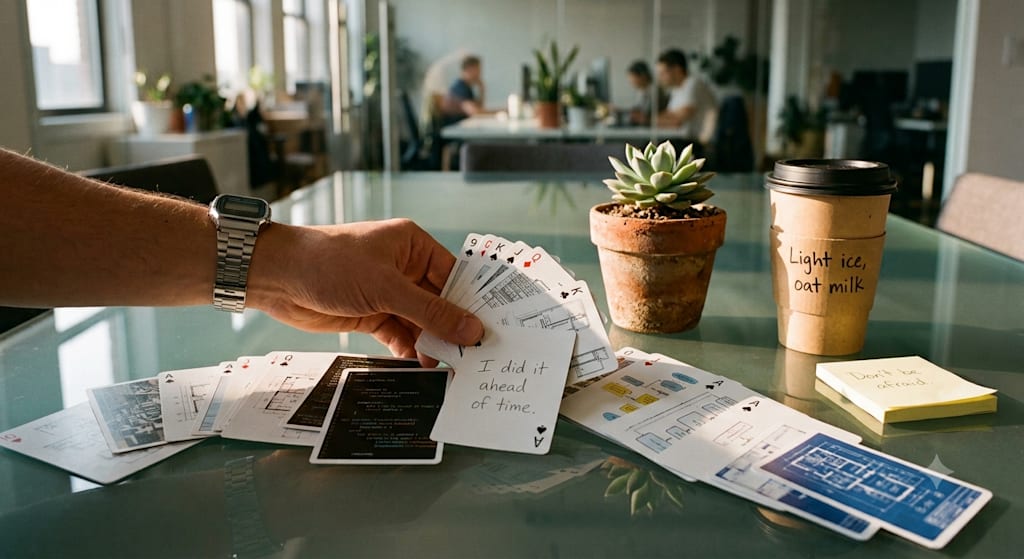
I took the cup and noticed a line written in Sharpie on the sleeve: "Light ice, oat milk." It wasn't for me; it was what he'd told the barista. This man's need for control extended to the base and temperature of a coffee. But he never hid that need. He wrote it on the sleeve for everyone to see.
The third happened on a late Thursday night. I asked him why he was so committed to this product. Market validation was lukewarm, investors weren't thrilled, and the ROI didn't make much sense on paper. He stopped typing, leaned back in his chair, thought for a moment, and said: "Because I said I'd finish it. If you're not going to finish something, you shouldn't say yes to it in the first place."
Then he turned back to his user flow diagram. He didn't look at me. He didn't wait for a response. The sentence landed like a stone dropped into Still Water. Ripples spread, the surface settled, and he didn't even register that he'd thrown a stone. To him, it was just Tuesday.
None of these three moments were "highlights." But if emotional temperature had a scale: the first was the cold of equal treatment, the second was the warmth of fifteen extra minutes, the third was the plainest sentence in the world, "I said I'd finish it." Not one of them was a confession. But each one pushed a needle, just a little.
45-60% · Almost Touching
The turn came in week five.
We'd reached a critical decision point: two architectural paths, one final choice. Path A used an off-the-shelf third-party API, safe, clean metrics, but limited ceiling. Path B was a custom-built stack, risky, but if it worked, it would cut response times in half. Failure probability: nearly forty percent.
I listed pros and cons across half a Google Doc, looked up, and asked: "What do you think?"
He was quiet for so long I thought my AirPods had disconnected. Then he said: "Which one do you want me to pick?"
In that instant, something clicked. This man, who'd laid every card on the table from day one, had just pushed his last card across to me. It wasn't that he lacked judgment. It was that he was handing me the weight that came after judgment — the part that asked, "who carries it if we're wrong?"
The AC draft lifted a stack of Post-its at the corner of his desk. I caught a glimpse of the top one. Something written in pencil, mostly erased, with only two words left: "Don't be afraid."
I didn't ask what he'd written. He didn't explain. But that afternoon, we chose Path B. And the conference room stayed quiet for a long moment. Not awkward, just two people waiting for the other to be the one who said "so that's settled." Neither did.
Looking back, that was probably the closest we ever came to a real alignment. No confirmation. No commitment. No "we make a great team." Just a half-erased Post-it, and a question I never asked: what did you write?
It was never finished. But it was real.
70-75% · Breaking Before the Break
Failure came faster than expected. Path B hit a memory leak during stress testing. Service went down for forty-eight hours. The client sent a strongly worded email, CCing leadership on both sides.
At 1 AM, I sent him a Slack message: "I'm sorry. That was my call."
He responded with a green checkmark, followed by: "It wasn't your call that was wrong. We missed a garbage collection mechanism at the architecture layer. I signed off on the architecture. That's on me."
No reassurance. No "don't overthink it." No "we'll get 'em next time." He pulled the responsibility toward himself with something close to ruthlessness. Not because he was playing the "I'll carry this" role, but because in his system, attribution had to be precise. Emotion couldn't contaminate attribution.
But the next morning, I noticed he'd arrived forty minutes earlier than usual. His machine was on, showing logs he'd combed through line by line between 3 and 5 AM. A printed report sat on my keyboard. At the top right of the first page, circled in red pen: "This isn't your fault. This isn't my fault either. It's here, where we both missed it."
He sat across from me, next to a cold, untouched Nespresso. He didn't mention the 1 AM Slack. Didn't say "I didn't sleep well." Didn't bring up any emotion at all. He just tapped the red circle with his pen and said: "Next time, we add a stress pre-check here. I already updated the process doc last night."
That's when I finally understood something: this man's "vulnerability" never showed up as emotion. It showed up in the forty extra minutes he spent in the office. In the Nespresso he never touched. In the way he translated a "sorry" into "where we both missed it." If you weren't paying attention, you'd see only a rational, collected, unfazed person. But if you knew his habits — he wrote one sentence on a Post-it every single day. Except that day. That one was blank.
It was the only crack in his entire filtering system. No bigger than a fingernail. It lasted only a few hours. But if you saw it, you knew: his "not afraid to lose" wasn't an absence of pain. It was the refusal to show it.
75-85% · The Empty Routine
The week after the crisis, the project stabilized. Path B's memory issue was patched. The client retracted the email. Everything went back on track.
But I noticed two changes.
First: a small succulent appeared on his desk. One afternoon I walked past the kitchen and saw him misting it with a spray bottle. "When did you start keeping plants?" I asked. "Got it last week," he said. "This office is too dry."
When he said "dry," he meant the humidity. But I heard something else.
Second: he stopped leaving coffee on my desk. Before, he'd always buy two cups whenever he arrived early. Now he only brought his own. It wasn't distance, more like a restrained step back. He'd pulled the "fifteen minutes early" gesture back to neutral, retreating behind the boundary line of a regular collaborator.
That emptiness was harder than an argument. It wasn't punishment. It wasn't a cold shoulder. It was just a person's defense system running a repair script after a failure. He wasn't angry at me. He'd just returned to his own baseline.
And standing outside that baseline, I realized something for the first time: all those "exceptions" before — the early arrivals, the half-erased notes, the second cup of Blue Bottle — they were never "daily routine." They were permissions he'd opened, just for me. Now the system had revoked them. Not because I was "unworthy." But because he needed to confirm something: after a real collision, was I still willing to stand where I used to stand?
85-100% · The Reverse Move
The finale came three days before delivery. All the documents were signed. The conference room was down to just the two of us. I closed my laptop and was about to leave when he called out from behind me.
"Path B," he said. "If you had to choose again — would you still pick it?"
I stopped. It took me a long time to answer. The question wasn't really about the path. It was about whether, after the forty-eight hours of downtime, after the email that CC'd everyone, after the succulent that now sat on his desk, I still stood by that initial call.
I turned and looked at him. "Yes. But I'd add a stress pre-check."
His face didn't move. He just reached into his bag and pulled out a folder: seven pages of process revisions he'd written during those forty-eight hours. Each page timestamped and annotated. And at the bottom right of the last page, written in pencil:
"She said she'd add a pre-check. I did it ahead of time."
No signature. No date. No formal document markings at all. Just a pencil line that could be erased at any moment. But its existence meant something: while I was fixing Path B, he was fixing his own factory setting, the one that couldn't let anyone else make a decision. He'd handed the call over, and the moment I said "I'll add a check," he'd already prepared the toolkit for it.
This man never said, "You passed." He just gave me a seven-page folder and a pencil line that said "I did it ahead of time," and that was his answer.
And as I walked out of the conference room, sunlight fell across the succulent on his desk. The plant's shadow lay across the surface — narrow, maybe two fingers wide, resting quietly on the soil he'd misted that morning.
He'd known the outcome all along. He was just waiting for me to see it.
About the Creator
Jin
Writer of reamstories
https://reamstories.com/jin
Enjoyed the story? Support the Creator.
Subscribe for free to receive all their stories in your feed. You could also become a paid subscriber, letting them know you appreciate their work.
Comments
There are no comments for this story
Be the first to respond and start the conversation.