
No Job, No Degree, No Skills? Start With One Sentence: “Are You Still Hiring?”
You don’t need a five-year plan. You need a paycheck, a schedule, and the courage to walk into the nearest place with a red hiring sign.
Walk Out the Door and Ask: Are You Still Hiring?
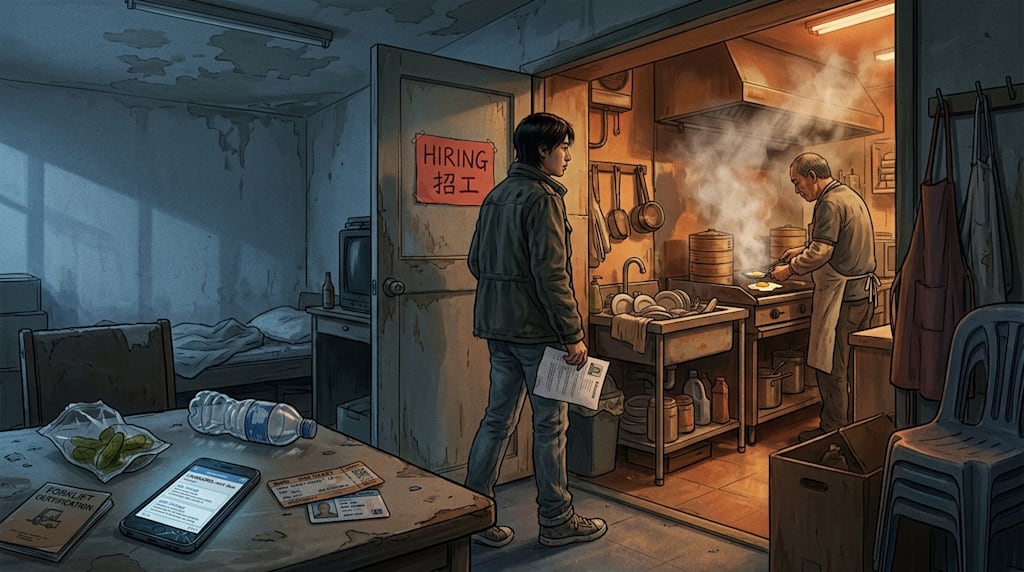
At seven in the morning, your phone lights up. The job app pushes three listings. You tap. First: associate degree or above. Second: relevant experience preferred. Third: proficient in office software, editing. You scroll. You see “general worker.” You tap. Age 18 to 45. Can work shifts. Dorm included. You put the phone face down on the pillow. There is a water stain on the ceiling shaped like a period that never got finished. The landlord messaged last night: don’t forget this month’s rent.
You sit up. On the table: half a bag of pickles, an empty water bottle, your ID card. You think about yesterday’s interview. The boss said, “We’ll call you.” You waited until ten. No call. You open the chat. You type: “Hello, may I ask about the interview result?” You delete it. You toss the phone aside. Your chest feels tight.
How long has this been? A month, three months, half a year? You scroll short videos. Someone your age makes hundreds of thousands a year. A classmate posts a badge. A relative asks in the group chat, “Where are you working now?” You mute the group. Your mother calls. You say, “I’m looking. Soon.” You hang up. You stare at the calendar. You don’t know what day it is.
Stop for a second. You have no job, no degree, no skill. That is your current state. It is not your name. It is not your whole life. Many people have been here. The difference is some keep lying in bed scrolling. Some put on shoes and go out. What you need to do today is not figure out your whole life. It is to make money today. To pay next month’s rent.
Open the job app. Turn off the degree filter. Turn off the experience filter. You see listings: kitchen helper, hotel housekeeping, security guard, factory worker, warehouse sorter, stock clerk, delivery rider, store salesperson, customer service, home cleaning, elder care. You tap each one. Some include meals and dorm. Some pay four thousand to six thousand. Some say: can endure hardship, can work shifts. You save them. You make a table: company, position, pay, hours, dorm, payday, contact. You fill in five rows.
You put on a jacket. You take your ID and a half-finished resume. The resume has your name, phone number, available start date. You walk downstairs. The breakfast shop has a red paper on the door: Hiring server. Meals included. Two days off per month. You stand there for ten seconds. You walk in. “Are you still hiring?” The boss is frying an egg. He doesn’t look up. “Yes. Can you get up early?” You say, “Yes.” He says, “Come tomorrow at seven. Trial shift.” You nod. You walk out with a cup of soy milk. You take a sip. It burns your tongue.
That is the first move. Find a place where you can stand. Don’t worry about whether it looks good. Don’t worry about what classmates think. You lack income, not face. If it is legal, pays on time, and doesn’t wreck your body, start.
Jobs with low barriers fall into five groups.
Group one: jobs with meals and dorm. Kitchen helper, server, hotel housekeeping, security guard, factory worker, warehouse sorter, stock clerk. These usually don’t require a degree. Some include meals and a dorm. Once you are in, learn the process. Learn not to be late. Learn to finish what you are told. The pay may not be high, but money comes in every month.
Group two: jobs where you can learn a trade. Auto repair, beauty, hairdressing, cooking, pastry, plumbing, AC repair, elevator repair, forklift. These often start low. You may be an apprentice. You hand the master a wrench. You write down steps. You watch the wires. After six months, you can replace a part alone. After a year, you can fix one kind of problem. The skill stays in your hands. No one can take it.
Group three: jobs that need talking. Sales, customer service, store salesperson. You don’t need a degree. You need to open your mouth. You can stand in a mall for a day and ask thirty customers, “Would you like to look at this?” Twenty-nine say no. After the twenty-ninth, the thirtieth stops. You write down what he asked. Next time, you answer that first.
Group four: jobs that need care. Quality inspection, stocking, data labeling, basic clerk. If you can use a computer, type, and do Excel sum and filter, you can do many basic jobs. Search “Excel for beginners” on Bilibili. Study twenty minutes a day. Every function you learn is one less time you have to ask someone.
Group five: jobs that care for people. Home cleaning, elder care, hospital companion, postpartum care. Go to the local human resources bureau. Many places have subsidized training. You finish, get a certificate, and start. You turn an old man. You feed him. You write down how much water he drank. These are work.
Maybe you don’t want these jobs. You want easy, high-paying, respectable work. Fine. If you don’t have savings, you don’t have the capital to choose. Do a job that keeps you alive. After you have savings, then choose. Take the first stable job. Change later.
Job hunting is not waiting. You send five resumes. You wait three days. No reply. You decide you are useless. You send fifty. You interview at ten. One of them needs someone. Every day, send ten to twenty. Interview at two or three. Wear clean clothes. Arrive ten minutes early. In the interview, don’t say, “I’m lost.” Say: “I don’t have much experience, but I can work hard, I can take shifts, I’m willing to start from the bottom, and I want to stay long-term.” Bosses don’t want a genius. They want someone reliable.
After the interview, write it down. Pay, hours, dorm, payday, duties. After three interviews, compare. Choose one. Don’t wait for a perfect job. A perfect job will not show up when you are broke.
After you start, you will be tired. You stand all day. Your feet swell. You move boxes. Your back hurts. Customers yell at you. Your supervisor talks down to you. You go back to the dorm. You lie down. You want to quit. You can quit, but find the next place first. Don’t quit with nothing lined up. Open your table. Update your resume. Send three applications. Tomorrow, go to work. After work, go to an interview. You have pay in your hand. You are not panicking.
Degree and skill can be added later. But the order matters. If you have no money, don’t take a loan for a thirty-thousand-yuan training course. Don’t believe “guaranteed pass” or “guaranteed job.” Go to the human resources bureau, community center, or union. Ask about free training: electrician, welder, forklift, cook, pastry, elder care, home cleaning. If yes, sign up. If no, find free courses online. Study while working. One hour at night. Three hours on the weekend. Save money. Then enroll in a proper adult vocational school, junior college, self-study exam, adult exam, or open university. Ask about tuition, length, exams. If you can handle installments, do it. If not, wait until you have saved enough.
You will meet people like this: by day, they work in a factory. At night, they study Excel. Later, they become clerks. By day, they work security. At night, they study electrical work. Later, they get a certificate and become repair workers. They were not born capable. They just did not stop where they were.
Job hunting has traps. No deposit. No training fee. No uniform fee. No ID held hostage. Don’t trust “high pay, daily settlement” or “easy ten thousand a month.” Keep screenshots of pay, attendance, chats. If something feels wrong, leave. No matter how broke you are, don’t hand yourself over.
If you don’t know what to do today, use this list.
Day one: Write a one-page resume. Name, phone, start date, shifts you can take. List three jobs you can accept.
Day two: Register on two job apps. Apply to ten. Check scam warnings.
Day three: Interview at two. Go to shopping districts, industrial parks, neighborhood gates. Look for paper notices.
Day four: Go to the human resources bureau, community center, union. Ask about free training.
Day five: Interview at two more. Compare pay, hours, dorm, payday.
Day six: Pick one. Ask about payday, overtime pay, dorm, resignation process.
Day seven: Start. Or keep applying.
After seven days, you will find that the confusion is still there, but it is smaller. Because you have income, a schedule, coworkers, a report due tomorrow. You no longer lie in bed all day thinking, “What do I do?” You start thinking, “How much can I save this month?” “Can I move up in this position?” “Should I learn forklift?”
You close the job app. You put on shoes. You take your ID and the half-finished resume. The red paper at the breakfast shop is still there. You walk in. The boss looks up. “How was the trial?” You say, “It works.” He hands you an apron. You tie it. You walk into the kitchen. The faucet is running. Dishes are stacked in the sink. You reach out. You pick up the first bowl. Dish soap foam touches your wrist. You turn on the water. You rinse. Next one.
This is today. Tomorrow, you will come again.
About the Creator
Jin
Writer of reamstories
https://reamstories.com/jin
Enjoyed the story? Support the Creator.
Subscribe for free to receive all their stories in your feed. You could also become a paid subscriber, letting them know you appreciate their work.
Comments
There are no comments for this story
Be the first to respond and start the conversation.