
My Boss Said “We’ll Talk After the Holiday.” That Was Worse Than Working the Whole Time.
Overtime has an end. Waiting for a vague answer doesn’t.
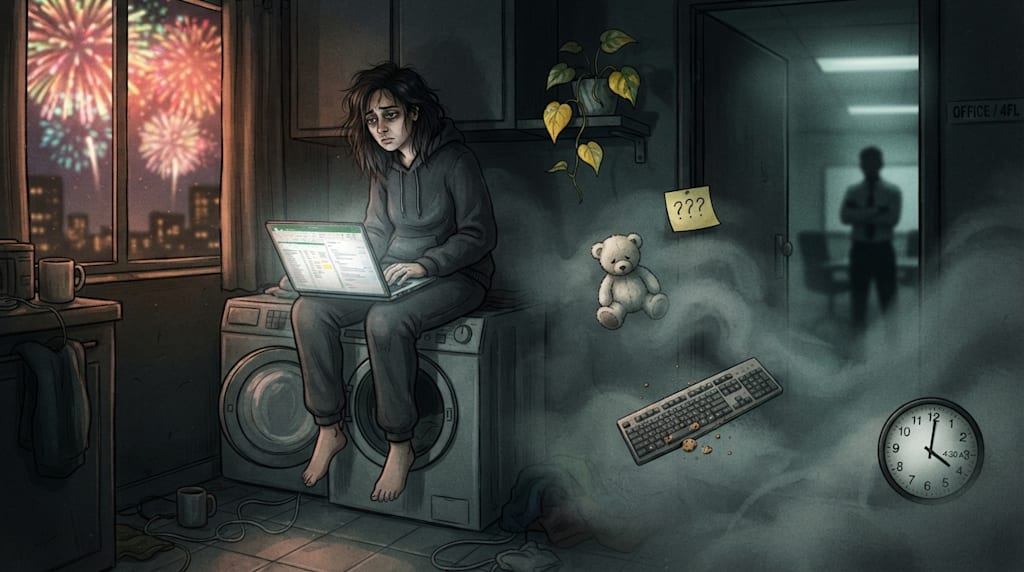
On the first day of the holiday, I put my laptop on the washing machine. The drum spun. The screen lit up. My boss’s “we’ll talk after the holiday” spun along with it.
I was on holiday, and I wasn’t. Remote, but still clocking in from a different place. Others were stuck in highway traffic. I was stuck in the project group chat. Others slept until they woke up naturally. I woke at 7:20, reached for my phone, checked the group. No one had said anything. I checked it three times anyway.
None of that was the worst part. The worst part was not knowing whether any of this overtime meant anything.
On the last day before the holiday, my boss came out of the meeting room and patted my shoulder. “We’ll talk about this project after the holiday.”
I said okay. He left. I stood there with half a cup of cold coffee.
Xiao Zhou leaned over from her desk and said quietly, “Did you hear?”
I asked, “Hear what?”
She lowered her head, typed on her keyboard, and said, “Nothing.”
Then she put on her earphones. They were white. The cord was tangled around the back of her chair.
That night at home, I scrolled the group chat. I scrolled until 2 a.m. The phone charger was hot. I unplugged it, then plugged it back in. Outside, someone set off fireworks. Bang. My heart jumped. I thought a message had arrived.
Holiday overtime has boundaries. The work is there. Each task done is one less. Tiring, but you know where the enemy is.
“We’ll talk after the holiday” has no boundary. It’s fog. You don’t know if there’s a list in the fog, or if your name is on it.
Guo Degang has a bit: death is scary, but what’s scarier is being told, “Tomorrow at 4:30 p.m., you’ll be executed.” Those dozen or so hours before the execution are the real torment.
Management psychology research says much the same. Burgard, Brand, and House analyzed longitudinal data on a group of American workers in 2009. People who lived in constant fear of losing their jobs had higher risks of depressive symptoms and physical health problems. Sweeny has a review titled Waiting Is the Hardest Part. Waiting is the hardest.
The moment you’re told you’ve been “optimized out,” your emotions peak. But from that moment on, unemployment no longer haunts you. You update your resume, ask around for opportunities, plan your next job. You have an enemy and a direction.
But “might be optimized out” has no enemy and no direction.
Grillon’s team’s NPU threat experiment: certain safety, no shock; predictable threat, a cue before the shock; unpredictable threat, shocks come at random.
Predictable shocks trigger brief fear. Unpredictable shocks trigger sustained anxiety.
What makes people most anxious is knowing something bad will probably come, but not knowing when.
This is “we’ll talk after the holiday.” You know the company may restructure. You know a list may exist. You don’t know which day after the holiday, which meeting room, which sentence will land on you.
The whole holiday, you’re waiting for the other shoe to drop. The shoe doesn’t drop. You lose a couple of pounds first.
The lack of a sense of control makes it worse. In psychology, the sense of control isn’t the illusion that everything is under control. It’s the feeling that my actions can affect the outcome at least a little.
Middle-class parents are anxious about their children’s future because that’s the thing they’re most powerless over. The workplace version of “we’ll talk after the holiday” is the same. You don’t know the criteria for restructuring. You don’t know who’s on the list. You don’t know whether the boss’s words were a stalling tactic or whether he simply hadn’t decided.
The only thing you know is: this isn’t up to you.
You can only wait. You wait for other people to finish their meetings and make their decisions.
Anxiety isn’t purely negative. A Chinese saying goes: “If you don’t think ahead, trouble will be close at hand.” Anxiety faces the future and prepares for it.
Ancestors who felt no anxiety were eliminated by lions. Those who worried about dry seasons and stored grain early survived.
Moderately anxious people start reviewing earlier, get checkups on time, insure their cars, and leave buffer in their plans.
The Yerkes-Dodson law says arousal and performance have an inverted U relationship. No tension and performance drops. Too much tension and it collapses. Moderate anxiety tends to produce the best performance.
Anxiety becomes a problem when there’s too much of it.
“We’ll talk after the holiday” usually doesn’t bring moderate anxiety. It has no boundary and no timetable. You can’t do anything to affect it. You can only idle. Idling drains people most.
Uncertainty can’t be eliminated. Tomorrow is inherently unknowable. It’s the world’s factory setting, not your bug.
A mature response isn’t to buy certainty. Fortune-telling and refreshing messages are attempts to do that. So is over-planning. A more practical approach is to learn to live with uncertainty and move your attention back to what you can control.
In Acceptance and Commitment Therapy, there’s the white bear effect. Wegner’s experiment: the more you order yourself not to think of a white bear, the clearer the white bear becomes.
Emotions are the same. “Why am I anxious again?” “I can’t be nervous anymore” becomes anxiety squared: anxiety about anxiety.
Acceptance means I admit I’m worried right now, and I admit the outcome isn’t entirely up to me. Then I carry that worry and do what I believe is worthwhile.
Embracing uncertainty means no longer making certainty a precondition for action. You don’t need to see tomorrow clearly before you’re willing to live today well.
If you’re also stuck in “we’ll talk after the holiday,” try a few things.
On the first day back, proactively book time with your boss. Don’t wait. Book 15 minutes. Turn vague questions concrete: Is the project continuing? What’s my role? Does the restructuring involve me? If you can’t say yet, roughly when can you?
Asking may not get answers, but asking itself can help you reclaim a bit of control.
I wrote three questions on a sticky note and stuck it next to my computer. The note was yellow, buy-one-get-one-free from the supermarket, not very sticky. I pressed it three times.
Set an anxiety window. For example, 20 minutes after dinner, specifically for worrying. Don’t keep refreshing rumors at other times.
The more you order yourself not to think of a white bear, the clearer it becomes. Better to give the white bear a fixed time to come out and wander.
I set mine for 8:00 to 8:20 p.m. At 8:21, I started thinking again. But at least for those 20 minutes, I was sitting down thinking, not thinking while washing dishes.
Make a list of what you can control. Update your resume, organize project achievements, contact friends and headhunters, calculate cash flow, prepare a Plan B.
These actions don’t necessarily mean you’re leaving. They let you know: I have options.
People with options wait more steadily.
I dug out my resume. The last update was two years ago. The photo still had short hair. Now my hair is longer, and three strands have turned white.
Separate facts, guesses, and emotions.
The boss only said, “We’ll talk after the holiday.” That’s a fact.
“I’m going to be optimized out.” That’s the plot your brain filled in.
“I’m panicking.” That’s an emotion.
Write all three down, and you’ll find many fears are plot, not fact.
I wrote on the back of the sticky note. Facts: one line. Guesses: three lines. Emotions: two lines. After writing, I went to pour a glass of water. The cup was from the company, printed with “One Heart, One Journey.” Half the words had rubbed off.
Allow yourself to rest. Uncertainty can’t be eliminated, but you can keep it from eating your entire holiday. Eat and see friends. Sleep when you can.
You don’t have to solve all your problems before you deserve an afternoon of sunlight.
I turned off the computer and went to the balcony. Two leaves of the pothos had turned yellow. I watered it. Water leaked from the bottom of the pot and dripped onto the tile. I rubbed it with my foot.
On the first day back, I booked time with my boss. He was seven minutes late.
I sat in the meeting room, the three questions in front of me. He came in and said, “Sorry, just finished a meeting.”
I said, “It’s fine.”
Then I asked him the first question. He thought about it and said, “The project continues. You’re in charge.”
The second question. He said, “Your role doesn’t change.”
The third question. He paused and said, “There is restructuring, but it doesn’t involve you.”
I nodded. He said, “Anything else?”
I said, “No.”
He said, “Then go get busy.”
I stood up. The chair legs scraped the floor. The sound was sharp.
I went back to my desk, tore off the sticky note, and crumpled it into a ball. I didn’t throw it away. I put it next to the keyboard.
There were a few cookie crumbs under the keyboard cover. I picked it up and shook it.
Then I opened the document and started working.
Overtime continues. “We’ll talk after the holiday” will come again.
But this version of today, I’ll live first.
About the Creator
Jin
Writer of reamstories
https://reamstories.com/jin
Enjoyed the story? Support the Creator.
Subscribe for free to receive all their stories in your feed. You could also become a paid subscriber, letting them know you appreciate their work.
Comments
There are no comments for this story
Be the first to respond and start the conversation.